
Updated September 2026.
Every article on how to get more patients gives you the same nine tactics and leaves out the only thing that matters, which is what to do first. Order is not a detail here. Traffic sent to a practice that does not answer its phone is money on fire, and a beautiful new website means nothing if nobody can find you in the map pack. This is the sequence we run when we take over a practice: five steps, four of which cost nothing but staff time, with the paid step deliberately last.
Think of patient acquisition as a pipe with five joints. A leak at any joint wastes everything upstream of it. If your phone goes to voicemail at 4:45, it does not matter how good your ads are. If your profile has the wrong hours, it does not matter how many reviews you have. If your reviews are two years old, it does not matter how well your service page ranks.
So the sequence works from the narrow end outward. Fix the last joint first, then the one before it, and only widen the top of the pipe once the rest holds water. Practices that run it the other way spend real money learning that they had a conversion problem, not a traffic problem.
The other reason order matters is compounding. Reviews improve map pack position. Map pack position improves ad click-through, which lowers cost per click. Lower cost per click means more budget for the terms that convert. Run in sequence, each step subsidizes the next one. Run in parallel at 20 percent effort, none of them do.
| Step | Real cost | Effort | Time to first patient |
|---|---|---|---|
| 1. Fix the booking path and response time | $0 | 1 week of attention | Immediate |
| 2. Work the Google Business Profile properly | $0 | 1 afternoon, then 20 min a week | 2 to 6 weeks |
| 3. Turn reviews into a habit, not a campaign | $0 to $100 a month | 30 seconds per visit | 3 to 8 weeks |
| 4. Message the patients you already have | $0 to $100 a month | 2 hours to set up | Days |
| 5. Buy traffic with search and paid social | $1,500+ a month in spend | Ongoing management | Days, at a price |
Steps one through four are free. That is not a rhetorical trick, it is the actual state of most practices we audit: four unclaimed wins sitting in the building while the budget goes to a channel that cannot compensate for them.
Call your own office on a Friday at 4:45 and count what happens. Fill out your own web form on a phone and time the reply. Try to book online from a bus. Whatever breaks in that exercise is costing you more patients than any channel on this page. The rules we hold practices to are simple: answer inside four rings, return every missed call within an hour, reply to a web form in under fifteen minutes during business hours, and never make a new patient print anything.
The profile is the first thing a nearby searcher sees and the only place a small practice can outrank a large group without any website authority at all. Correct hours including holidays, every service listed as its own entry, twenty real photos of the actual office and team, a booking link, and a short post once a week. Google's profile content guidelines are worth ten minutes of reading before you touch it, because the common shortcuts are the ones that get listings suspended.
Not a quarterly push. A habit. Every visit ends with a direct review link, sent by text before the patient leaves the lot. Recency does more work than raw count, and reviews that name the specific service help you appear for that service. Never trade anything of value for a review, which both Google and the FTC endorsement rules treat as a violation. If you are in healthcare, keep replies generic and never confirm that a reviewer was a patient, a point we go through in detail in our guide to handling patient reviews without breaking HIPAA.
Lapsed patients, unfinished treatment plans, people who called and never booked. This list is the cheapest appointment source in your building and most practices touch it once a year. A short text sequence to that list usually produces bookings within days, and it costs the price of a messaging tool.
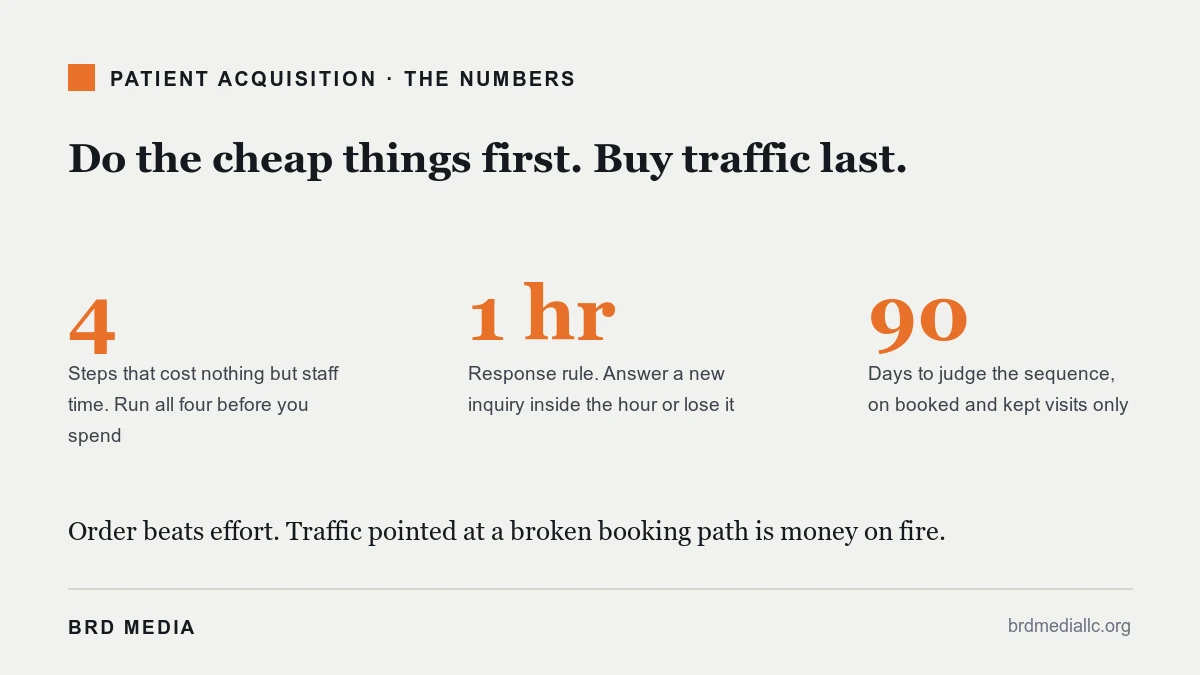
Once the first four hold, paid becomes arithmetic rather than a gamble. Search ads first, because intent is unambiguous and you can point them at a page that now converts. Build campaigns by service rather than one catch-all, fence them to a realistic drive time, and add negatives for job seekers, students and symptom browsers. Paid social comes after that, and its job is offers and retargeting the people who already visited, not cold acquisition.
Underneath both, the structural work continues: service pages, neighborhood pages, schema, and the technical fixes that decide whether you rank at all. That is what medical practice SEO services for growing practices buy you, and it is the part that keeps producing after you stop paying for clicks. For the week-by-week version of the whole build, see our walkthrough of the first 90 days of marketing a practice.
Our honest take. The most expensive advice in this category is "post more." We have watched practices spend a year on daily social content and add almost nothing to the schedule, while the same hours spent on review collection and call handling would have filled it. Social is proof, not acquisition. Use it to reassure the people search already sent you, and stop measuring your growth in followers.
Stop buying directory upgrades sold over the phone. Stop paying for a rankings report that never mentions appointments. Stop running ads to your homepage. Stop letting the booking form ask for eleven fields when four will do. And stop judging any channel on a single month, which is long enough to be misled and too short to know anything.
Stop, too, with the discount reflex. When the schedule thins out, the instinct is to cut price, and it almost never fixes the underlying problem. A discount brings in people shopping on price who do not come back, it trains your existing patients to wait for the next offer, and it hides whatever was broken in steps one through four. If an offer is part of the plan, make it a reason to act now on something you were going to charge for anyway, not a permanent markdown on your core service.
One more: stop treating physician or professional referrals as separate from marketing. For most practices it remains the highest-value channel per hour invested, and it is trackable if you bother. We laid out the modern version of that play in our piece on building a referral pipeline online.
The free steps cost attention and about two weeks of it. Paid management for a single location starts at $2,500 a month with us, $4,000 for the middle tier, $6,500 for full market capture, and ad spend is separate and sits in an account you own along with the site, the tracking and the content. Every tier carries the same 90-day guarantee.
Score the whole thing on four numbers: new appointments booked by source, kept-appointment rate, cost per booked patient, and first-year value of a new patient. If a coordinated practice marketing program cannot trace a booked patient back to the search that produced them, the tracking is broken and every budget decision after that is a guess. That is the real answer to how to get more patients: fix the pipe, then widen it, and measure the only thing that pays the bills.
Once the first five steps are running, the question turns to which channels to add and what each one costs to keep. The wider playbook for growing a physician practice picks up there.
Tell us your market and your open capacity, and we will tell you which step you are leaking at.
Get a straight answerSources: Google Business Profile content guidelines · FTC Endorsement Guides · Google Search Central, local business structured data
See BRD Media first in Google
Add us as a preferred source and our SEO breakdowns rank higher in your own Search results, AI Mode and AI Overviews.