
Page one of Google will teach an IV clinic how to get a first booking. Ad groups by drip, call tracking, local search, a launch offer. Then it stops, as if the patient walks out of the clinic and the job is done. The economics say the opposite. A drip clinic prices like a subscription and markets like a one-off sale, and the gap between those two is where most of the revenue goes missing.
This is the part nobody writes down: a NAD drip repeat visit protocol, and the same logic for every other drip on your menu, run as a procedure with a trigger, a timing rule, a message and an owner. It is marketing work built around a clinical schedule, not a replacement for one.
Ask how IV clinics keep patients and you get the same three answers. Sell memberships and packages. Ask for a review the day after the visit. Send a newsletter. None of that is wrong. Packages and memberships are where the category's economics work, and a review request sent within a day or two reaches the patient while the visit is still fresh.
The trouble is that all three are products or campaigns. None of them is a system that decides who gets contacted, when, with what, and by whom. That is what the rest of this post builds, and it is the piece our IV therapy and GLP-1 clinic marketing services build once the first-visit campaigns are running.
The first visit decides most of it. By the time a follow-up message goes out, the patient has already made up their mind about whether this was a place they return to. So the return has to be set up while they are still in the chair.
Four things need to happen before the patient leaves:
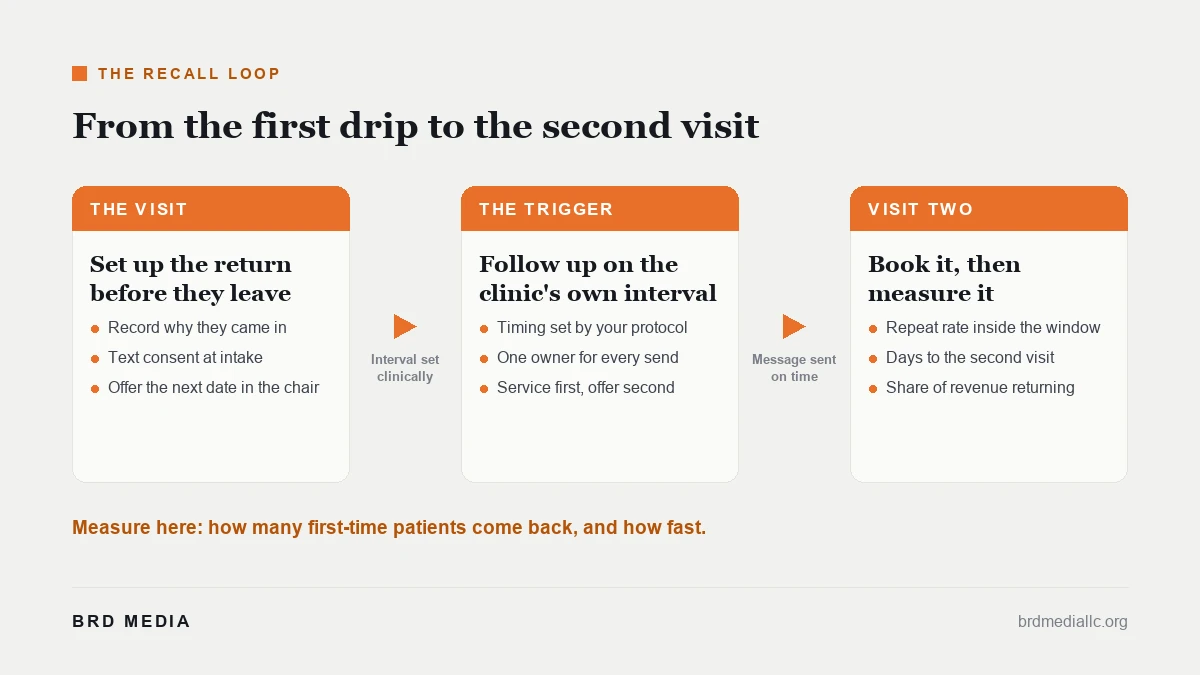
Every recall track has the same five parts. The trigger is the event that starts it: a completed visit, a missed series appointment, a lapse past the interval. The timing is set relative to that event, and it comes from the clinic's own schedule. The channel is text for anything time-sensitive and email for anything that needs a paragraph. The message has one job. The owner is the person who sends it or checks that the automation did.
One rule overrides the rest. The interval between visits is a clinical decision made by your medical director, not a marketing one. We never set it and neither should the software. The recall system reads the interval your protocol sets and times the message against it. If the protocol changes, the recall timing changes with it.
| Visit type | Repeat interval | Recall trigger | The message's one job | Signal it worked |
|---|---|---|---|---|
| A series the clinic's protocol prescribes (NAD or any other drip) | Set by the clinic's protocol for that patient | A series appointment not booked by the day it should have been | Get the next session on the calendar | Series completion rate |
| Event-driven hydration | None fixed; driven by the patient's calendar | The next event they told you about at intake | Remind them you exist before the event, not after | Second visit inside the season |
| Routine wellness drip | The cadence the patient and provider agreed on | The agreed date passing with nothing booked | Offer two specific times | Days from due date to booking |
| Mobile or group booking | None fixed | The group host's visit completing | Turn the guests into their own bookings | Guests who book individually |
| First visit, no stated reason | Unknown | A set number of days after the visit, chosen by the clinic | Ask one question that sorts them into a track | Reply rate |
Service first, offer second. The first message on any track is about the next appointment, not a discount. A patient who was going to come back anyway does not need twenty percent off, and a clinic that trains its patients to wait for the discount has built a promotion calendar, not a practice.
Keep health claims out of the message. A recall text says the next session is open and offers two times. It does not tell the patient how they will feel, and it does not refer to a condition they have. The FTC's health products guidance judges a message by its net impression, and a friendly reminder can still carry a claim. Email that promotes anything falls under the CAN-SPAM rules, including an opt-out honored within 10 business days, per the FTC's compliance guide. Texting has its own consent rules, and your counsel should sign off on the intake wording once.
The review request is part of the same system. It goes out a day after the visit, on its own, and it is written so it never asks the patient to describe their treatment. We covered the wording in asking for Google reviews without a HIPAA problem.
Once a patient has come back on the same cadence two or three times, the pattern is real, and that is the moment a standing arrangement makes sense to them. Before that, a membership pitch is a sales conversation with somebody who has not decided they like you. How to price and structure that offer is a separate subject, and our breakdown of how a membership should be structured covers tiers and what goes in each. The recall system's job is to produce the repeat pattern that makes the offer an easy yes.
Three, tracked monthly. Repeat rate: of the first-time patients in a month, how many came back inside the window your protocol implies. Days to second visit: the median gap, which should shrink as the system matures. Share of revenue from returning patients: the number that tells you whether the clinic is becoming a practice or staying a promotion.
Paid media has a narrow role here. It reaches people who visited the site and never booked, using site-visitor audiences with the tracking set up so no health information reaches the platform. Patient lists do not get uploaded to an ad platform, and the ad itself cannot imply the viewer has a condition, which Meta's personal attributes standard rules out in so many words. That is the job Meta ads management for clinics does inside a retention plan, and it is a small job compared with a text that goes out on time.
The honest take: retention work is premature for some clinics. If the first visit runs late, the chair is uncomfortable, or nobody greets the patient by name, a recall system just sends reminders about an experience people did not enjoy. Fix the visit first. Then build the track.
Premier IV is the clinic we point to. The system was built for GLP-1 patients and included compliant acquisition, a 14-day text and email nurture and a conversion path to a recurring plan, and it produced $80,496 or more in cohort lifetime value across 12 patients at $6,708 each. The detail is on the Premier IV case study.
Pull last quarter's first-time patients and count how many came back. Add a "reason for visit" field to intake if it is missing. Write consent wording for texts and email and get it approved. Pick one visit type, write its trigger, timing, message and owner, and run it for thirty days. A NAD drip repeat visit protocol is not software. It is five decisions written down, and a name next to each one.
Engagements start at $2,500 a month on a six-month term. CRM automations come in at the Blackwing tier and above.
We will map your drip menu to recall tracks and show you where returning revenue is leaking.
Book a consultSources: FTC health products compliance guidance · FTC CAN-SPAM Act compliance guide for business · Meta advertising standards, privacy violations and personal attributes
See BRD Media first in Google
Add us as a preferred source and our SEO breakdowns rank higher in your own Search results, AI Mode and AI Overviews.