
Updated September 2026.
Almost every guide to marketing for doctors is a list of channels with no budget attached, no timeline, and no opinion about what to do in month one versus month five. This one is built the other way around. It names five channels that carry a physician practice, tells you what each costs and how long it takes to produce a patient, and lays out the month-by-month order we use when we take on a practice. One clarification before we start: this page is about growing a practice, not about selling products to physicians. Those are two different jobs that share a search term.

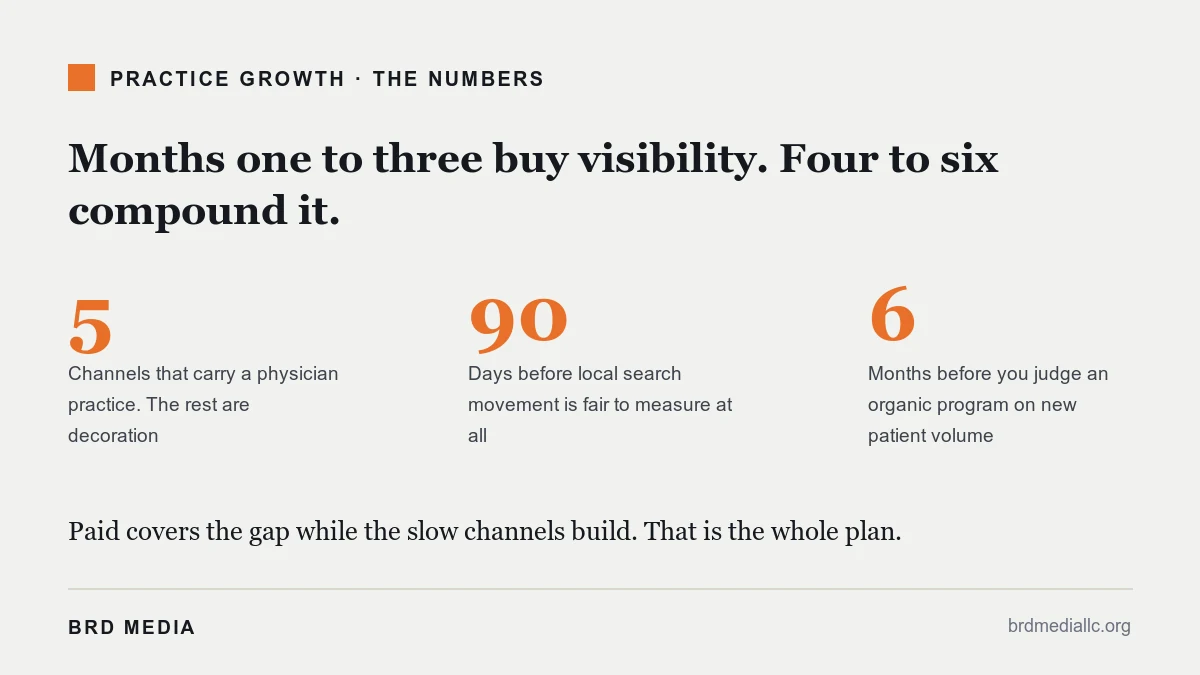
Strip out everything that sounds good in a pitch deck and this is what is left. Local search, meaning your Google Business Profile plus the pages on your site that match how patients search. A website that loads fast on a phone and answers the questions people actually type, including insurance, wait times, and what the first visit involves. A review engine that runs constantly rather than in panicked bursts. Paid search for the conditions and procedures where somebody is looking right now. And referral outreach to the physicians who see your future patients before you do.
Notice what is not on the list. Print. Radio. Daily social posting. Directory upgrades sold over the phone. None of those are evil, they are just unmeasurable or low-yield compared to the five above, and a practice with limited attention should not be spreading itself across ten things that half work.
The referral channel deserves a note because it behaves unlike the other four. It does not scale with budget, it scales with follow-through. A single primary care group that starts sending you two patients a month is worth more over a year than most ad campaigns, and the cost is a lunch, a one-page summary of what you treat, and a report back to the referring physician after every visit. That last part is the one practices skip, and it is the reason referral relationships go quiet. Track referrals by source the same way you track ad clicks, or you will never know which relationships are worth your time.
| Channel | What it does | Typical monthly cost | Time to first patient |
|---|---|---|---|
| Google Business Profile and local search | Wins the map pack in your radius | $0 plus management | 4 to 12 weeks |
| Website and condition pages | Converts the search into a booking | Build cost, then hosting | Immediate once fixed |
| Review engine | Decides whether they pick you or the next listing | $0 to $100 | 3 to 8 weeks |
| Paid search | Buys volume today while organic builds | $1,500+ spend | Days |
| Physician referral outreach | Steady, high-value, relationship driven | Staff time | 2 to 8 weeks |
The first quarter is not the quarter you judge results in, it is the quarter you remove the reasons results cannot happen. Week one is audit: profile accuracy, site speed on a real phone, call handling, form response time, and tracking good enough to tell which calls came from where. Most practices we take over are missing the last one entirely, which means every prior spending decision was made on a feeling.
By week three the review engine is running and the condition pages are being written. By week six paid search is live on a narrow set of high-intent terms, geo-fenced to a realistic drive time, with negatives for the job seekers, students and symptom-browsers who will otherwise eat the budget. Paid exists in this window to keep the schedule moving while medical practice SEO services for physician groups do the slower structural work underneath.
If you want the week-by-week version of this quarter, we wrote it out in detail in our guide to the first 90 days of marketing a medical practice.
This is where the work either starts paying or gets cut. Organic rankings for condition and procedure terms begin producing calls. The review count crosses the threshold where patients stop hesitating. Paid search gets cheaper because your brand is now familiar and your quality scores improve. The referral conversations you started in month two turn into a repeatable trickle.
The discipline in this window is subtraction. Every channel gets judged on new patients booked and kept, at a cost you would pay again. Anything that has not produced in six months with the budget it needed gets stopped, and the money moves to whatever did. Practices that skip this step end up funding three dead channels forever because nobody wanted to admit a decision was wrong.
Month six is also the right time to widen the site. By then you know which conditions and procedures produce the patients you want more of, and those get real pages rather than a paragraph on a services list. A page per condition, written for the question a patient types rather than the terminology a chart uses, is the single highest-yield content work in physician marketing. It is slow, it is unglamorous, and two years later it is still producing calls without a media budget attached.
HIPAA is the reason a lot of physician marketing is timid, and most of that timidity is unnecessary. The rule governs protected health information. It does not prohibit advertising, content, reviews or email. Under the privacy rule, marketing has a specific legal definition, and using protected health information for it generally requires a written patient authorization, with limited exceptions for things like treatment communications.
What that means on a Tuesday afternoon: get a business associate agreement signed with any vendor that touches patient data, including your CRM and your call tracking. Never build an ad audience from a condition list. Never confirm in a public review reply that the person was your patient, even to defend yourself. Have one written response script and let the front desk use it. We covered the review side specifically in our piece on getting more Google reviews without breaking HIPAA.
Our honest take. The most common failure in physician marketing is not a bad channel choice, it is an unanswered phone. We have audited practices spending five figures a month on ads while sending 30 percent of inbound calls to voicemail during business hours. Before you approve a single new budget line, have someone call your office at 4:45 on a Friday and tell you what happened. Fix that first and half the marketing problem disappears.
Four numbers, reviewed monthly, and no dashboard longer than one page. New patient appointments booked, by source. Kept-appointment rate, because booked and kept are different businesses. Cost per booked patient by channel. And average revenue per new patient over the first year, which is the number that decides what you can afford to pay for one.
Impressions, clicks, followers and keyword counts are diagnostic at best. They tell you why a number moved, they are not the number. If your current report leads with traffic, ask for a different report. A coordinated medical practice marketing program should be able to trace a booked patient back to the search that produced them, and if it cannot, the tracking is broken.
We publish pricing because the alternative wastes a discovery call. Management starts at $2,500 a month for a single location, $4,000 for the middle tier, and $6,500 for full market capture. Every tier includes the technical work, the site build or reskin, profile and schema work, tracking, and reporting, and every tier carries the same 90-day guarantee. Ad spend is separate and lives in accounts you own, as do the site, the analytics and the content.
When you compare quotes, compare what is included and who holds the keys at the end. Marketing for doctors goes wrong most often on ownership, not on price: a cheaper retainer that leaves you with nothing portable is the expensive option.
This playbook assumes you have room to build. If the schedule needs filling sooner than that, the five steps that fill a schedule fastest is the shorter path, cheapest and quickest work first.
Tell us your specialty, your radius and your open capacity, and we will tell you which two channels to run first.
Get a straight answerSources: 45 CFR 164.501, definition of marketing · 45 CFR 164.508, uses and disclosures requiring authorization · Google Business Profile content guidelines
See BRD Media first in Google
Add us as a preferred source and our SEO breakdowns rank higher in your own Search results, AI Mode and AI Overviews.