
Every page one of Google that covers a mobile iv hydration service area business is written for someone else. Most of page one is a how-to-start guide: licensing, the van, the supplies, the nurse. The rest assumes a clinic with a storefront and a pin on the map. A mobile clinic has neither, and the advice that works for a fixed address works against a hidden one.
This post starts where those pages stop. It covers what a service-area profile does with a hidden address, what a city page has to contain before it counts, how many cities are defensible, what the citation set looks like with no public address, and what to measure. No clinical claims anywhere in it. Drip contents, intervals and who is a candidate for what are the clinic's call, and the marketing has to work around that.
Set the Google Business Profile up as a service-area business. Hide the address, because Google's own guidelines say a business without storefront signage at its location should not show one. List the areas you serve, up to twenty of them, and keep the overall reach to roughly two hours' drive from where the business is based, which is the ceiling Google states in its guidelines for representing a business. Build a page for each city you actually serve.
All of that is right. It is also the whole of what the category publishes, and it leaves out the part that decides whether the profile ranks anywhere but the owner's own street.
The address is hidden from customers. It is not hidden from Google. The profile still has a base location, and proximity to that base is still one of the three things the map pack is decided on. So a mobile clinic based in a house in Elmhurst competes in Elmhurst's map pack like any other business there, and competes in Naperville's map pack from twenty minutes away, against clinics that are parked in Naperville.
The service areas you list do not change that. Google's service-area settings page says the areas show customers where you serve. In our experience they do not act as extra pins; the profile still ranks from its base. Three things follow from this, and none of them appears on page one:
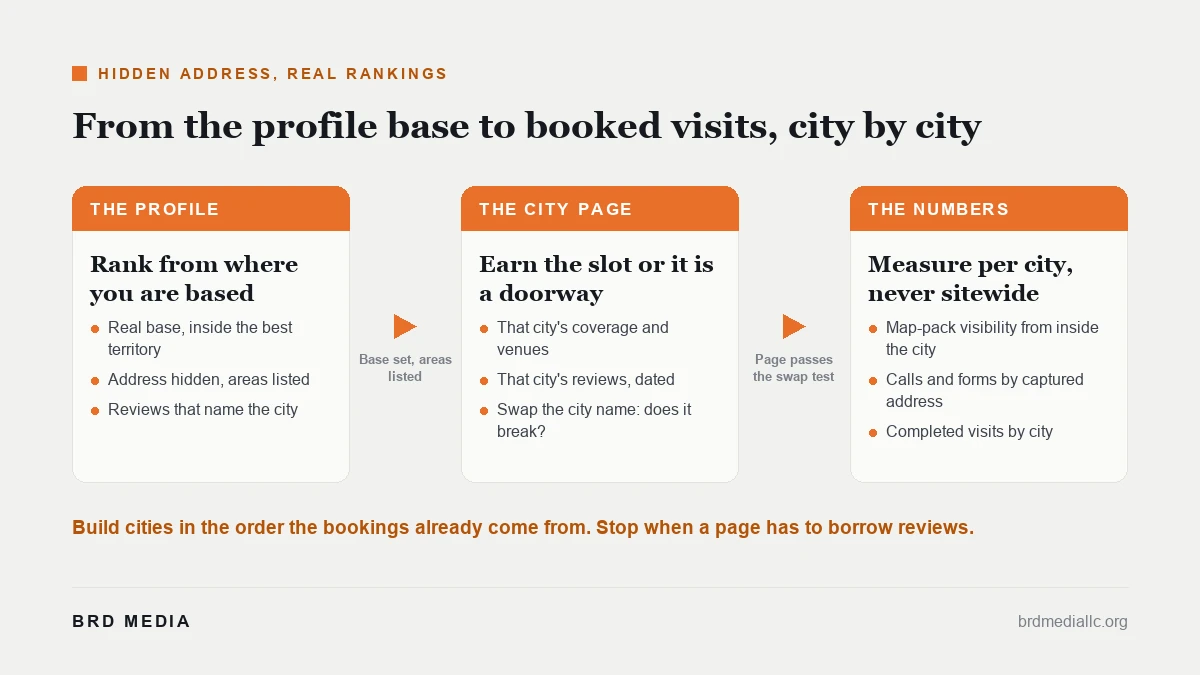
Page one says "build city landing pages" and stops. The pages that get built off that advice are usually one template with the city name swapped in, and Google has treated that pattern as a doorway for years. A city page that earns its slot is a page about serving that city. Here is the difference, element by element.
| Element | What it must contain | What makes it a doorway instead | How to check |
|---|---|---|---|
| Coverage | Which neighborhoods, hotels, event venues and office parks in that city you go to, and the response window for each | "We serve [City] and surrounding areas" | Could a nurse plan a route from the page? |
| Proof | Reviews from patients served in that city, named by area, labeled as reviews with the month and year | The same three reviews on every city page | Search the review text; it should appear once |
| Menu | The drips most booked in that city, as your booking data shows, with the clinic's own descriptions | The full menu pasted in | Compare the page to the bookings report |
| Booking path | A booking form that captures the address first and confirms it is inside the service area | A generic contact form | Submit a test from outside the area |
| Local detail | Parking, building access, whether you serve hotel guests, group bookings for events in that city | Nothing a competitor page could not say | Swap the city name; does the page still make sense? |
The test in the last row is the one to run on every page before it goes live. If you can change the city name and nothing else breaks, it is not a city page.
Fewer than the service-area list. The profile can name twenty areas. The site should carry a page for each city only while each page can pass the table above, and most clinics run out of genuinely different things to say somewhere between the fourth and the eighth city. Past that point, new pages stop adding coverage and start diluting the pages that were working.
The order to build them in is the order the bookings already come from. Pull last quarter's completed visits by address, group by city, and build the top three first. Those pages have reviews to draw on, a booking pattern to describe, and a reason to exist. The city you would like to serve but have not yet visited gets a line in the service-area list and no page until there is something true to put on one.
Where the bookings are already concentrated in one metro, the treatment-page structure matters more than another city page. Our med spa SEO guide covers the treatment-first site structure that a mobile clinic should mirror: one page per drip, written properly, before the fifth city page.
The consistency rule still applies. Name, phone and website have to match everywhere the clinic is listed. The address is the exception: it is withheld on the profile and withheld on every directory that allows a service-area listing. A few directories do not offer that option, and the choice there is to skip the directory or list the address. Listing it in one place and hiding it everywhere else is the mistake to avoid, because the mismatch is what Google sees.
Where the clinic is also certified to run search ads, the certification listing itself is a citation. The LegitScript post covers what that application asks for; the point here is only that the business name and phone on it should match the profile.
Sitewide numbers hide everything that matters here. A mobile clinic can be up thirty percent in organic traffic and losing its best city at the same time. Track three things per city, monthly:
When the first number moves and the third does not, the page is ranking and the offer or the booking path is losing people. When the third moves without the first, the bookings are coming from somewhere else, usually paid or referral, and the city page is not doing the work yet. That per-city read is what our local SEO services report on for service-area clients, because it is the only view that tells you which page to fix.
The honest take: a service-area clinic should stop adding cities when the next page would have to borrow its reviews from the last one. At that point the better investment is a second base, staffed and real, in the city you cannot reach from the first. Google's guidelines do not allow a virtual office to stand in for it.
Premier IV is the clinic we point to for this category. A compliant, multi-location GLP-1 patient acquisition engine delivered 99 qualified leads, 12 or more new patients at roughly a 12 percent lead-to-patient rate, and $80,496 or more in cohort lifetime value at $6,708 per patient over twelve months. The detail is on the Premier IV case study.
Open the profile and check the base address is the real one and sits inside your best territory. Pull last quarter's visits by city. Run the swap-the-city-name test on every city page you have and take down the ones that fail it. Rebuild the top city first, with that city's reviews and that city's booking pattern on it. A mobile iv hydration service area business ranks city by city, and the first city done properly teaches you how to do the rest.
Engagements start at $2,500 a month on a six-month term; the three tiers are on our pricing page. Ad spend is separate and belongs to you.
We will map your bookings against your city pages and show you which page to fix first.
Book a consultSources: Google Business Profile, guidelines for representing your business (service-area businesses, hiding the address, the two-hour reach) · Google Business Profile, manage your service areas (up to 20 areas)
See BRD Media first in Google
Add us as a preferred source and our SEO breakdowns rank higher in your own Search results, AI Mode and AI Overviews.