
Building a steady flow of google reviews for medical practice visibility is one of the highest-return things a clinic can do for local growth, and it is also the one most front desks are quietly terrified to touch. The fear is understandable but mostly misplaced. Asking a patient for an honest Google review is not a HIPAA violation. Disclosing that someone is a patient, or naming their treatment, is. This guide draws the line in plain English, hands you copy-paste scripts that carry zero protected health information, and shows the automation and review math that actually move rankings.
Here is the part nobody at the front desk believes until they see it in writing: a review request is compliant as long as all three of these hold true.
The thing that trips up practices is almost never the ask. It is the response. Confirming that a specific person received care from you is itself a disclosure of protected health information, even when you are just being polite.
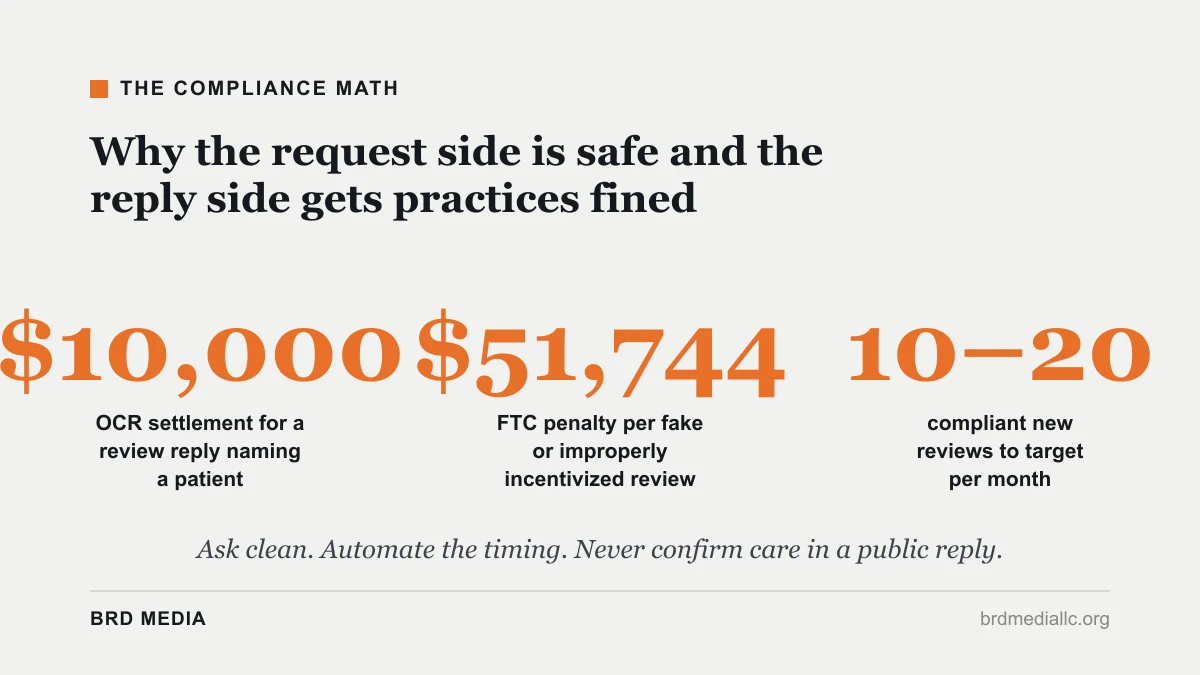
The $10,000 lesson. In 2019, Elite Dental Associates paid a $10,000 settlement to the HHS Office for Civil Rights after responding to patient reviews on social media by disclosing the patient's name, treatment details, and insurance and cost information. Nobody got fined for asking. They got fined for what they wrote back. Treat every public reply as if a regulator is reading it, because one might be.
Three sections of the HIPAA Privacy Rule do the heavy lifting here. You do not need to be a lawyer, you need to know which side of the line each activity sits on.
One more rule lives outside HIPAA. The FTC final rule on fake and deceptive reviews took effect October 21, 2024, and carries a civil penalty of up to $51,744 per violation. Read it accurately: it targets fake reviews, undisclosed insider reviews, and reviews bought with incentives. Asking real patients for honest feedback is completely fine. Buying reviews or only soliciting the happy ones is the risk.
| Compliant | Violation risk |
|---|---|
| Texting every patient a plain review link after the visit | Only texting patients you expect to leave five stars (gating) |
| "Thanks for visiting us today" | "Thanks for your diabetes follow-up today" |
| Replying to a review with a generic, no-detail thank-you | Replying "So glad your knee surgery went well, Karen" |
| Patient voluntarily posts their own story on Google | You repost that story as a named testimonial with no authorization |
| Asking with no strings attached | Offering $25 off the next visit for a review |
Every script below is deliberately empty of health information. Swap in your practice name and your Google review short link. That is it. Do not add the reason for the visit, ever.
"Hi [First name], thanks for visiting [Practice name]. If you have 30 seconds, a quick Google review helps other patients find us: [review link]. No pressure either way."
"Hi [First name], following up from [Practice name]. If you have a moment, we would be grateful for your honest feedback here: [review link]. Thank you."
Subject: A quick favor from [Practice name]
"Hi [First name], it was good to see you. Your feedback helps our team and helps future patients choose the right practice. If you are willing, you can leave a Google review here: [review link]. Thank you for trusting us with your care."
"Before you go, if you were happy with today, would you mind leaving us a Google review? I can text you the link right now so it is easy." Then send the standard SMS so the link is PHI-free and consistent.
You are allowed to make it easy for an unhappy patient to reach you directly. What you cannot do is route only the happy patients to Google and everyone else to a private form. That selective routing is gating. The compliant version gives every patient both options on the same screen: leave a public review, or share private feedback with the office. Same message, same audience, patient chooses. This is a core piece of any real reputation management services program.
| Touch | Timing | Channel | Goal |
|---|---|---|---|
| Touch 1 | ~24 hours post-visit | SMS | Catch the patient while the visit is fresh |
| Touch 2 | Day 3, only if no review | SMS or email | One polite reminder, then stop |
| Touch 3 | Day 7, optional | Final soft ask; never a fourth |
Doing this by hand dies the first busy week. The reason practices with systems pull ahead is that the ask never depends on someone remembering. Here is the build, described so it works in whatever automation platform your practice runs.
Two non-negotiables. First, any platform that touches patient names and phone numbers must be covered by a signed business associate agreement, a BAA. No BAA, no patient data in the tool. Second, the message templates live in the automation, so nobody can freelance and paste in a diagnosis. This is exactly the kind of workflow we build inside a practice's CRM and marketing automation stack, and it pairs naturally with SMS marketing automation that is set up for healthcare from day one.
Total review count is a ranking factor, but so is velocity, how many fresh reviews you earn per month, and recency, how new they are. A practice with 400 reviews and nothing in the last year looks stale next to one earning 15 a month. Reviews from the last 90 days pull the most weight in the local pack. Here is a realistic target by market density.
| Market type | Total reviews to compete | New reviews per month |
|---|---|---|
| Rural or low-competition | 25 to 75 | 5 to 10 |
| Suburban | 75 to 150 | 10 to 15 |
| Dense urban (Chicago, etc.) | 100 to 300+ | 15 to 25 |
The math is friendlier than it looks. A practice seeing 200 patients a month that asks every one of them, at even a 10 percent conversion, earns 20 reviews a month. That is enough to compete in most markets. The gap is almost never patient volume. It is that nobody asks. Reviews feed the same local signals as medical practice SEO, so a steady flow compounds with everything else you do to get found.
You should respond to reviews. It signals an engaged practice and it is good for local ranking. You just have to respond like the Elite Dental case is taped to your monitor. The safe move: never confirm the person was a patient, never reference any care detail, keep it generic and move the conversation offline.
What this approach actually produces. When we built a steady local-visibility system for Great Lakes Customs, a local shop in a competitive market, it reached the number one Google ranking in its area with a 30 percent lift in on-site conversions. The vertical is different, the mechanics are identical: consistent reviews, a complete Google Business Profile, and clean local signals compound into map-pack visibility. Reviews are the fuel.
Reviews are one input, not the whole program. We mapped where reviews sit against the other channels a physician practice runs, and separately which step reviews belong to when the schedule needs filling, so this work gets weighed against everything else competing for your week.
Reviews are a week-one asset, not a month-six one. See where they sit in the launch order for a new weight loss clinic.
Compliance shows up in more than one place. Ad account eligibility for an IV clinic is the gate that sits upstream of every campaign.
The review request is one message in a larger follow-up system. For IV clinics, we wrote up how the recall side of that system gets drip patients back.
Reviews are one place patient details can slip into marketing, and the pixel on your site is another. A walkthrough of the med spa pixel PHI check covers the second one.
We set up the automation, the scripts, and the response playbook so your practice earns reviews on a system, not by accident, and stays on the right side of HIPAA and the FTC.
Book a review and reputation auditHHS Office for Civil Rights, Elite Dental Associates settlement (2019) · FTC final rule on fake reviews (2024) · 45 CFR 164.501 · 45 CFR 164.508 · 45 CFR 164.514
See BRD Media first in Google
Add us as a preferred source and our SEO breakdowns rank higher in your own Search results, AI Mode and AI Overviews.