
This is written for the person who runs the program, not the person on it. If you are a patient, your clinician is the one to talk to, and nothing here is advice about your treatment. If you own or run a weight loss clinic, here is the number your marketing plan is missing: glp-1 patient retention month three. Page one of Google treats your business as a lead-generation problem. It is a refill problem, and the marketing that fixes it is different.
One line on scope: BRD is a marketing agency. Nothing below is dosing, titration, side-effect management or guidance on stopping. Where a fact comes from the clinical literature it is attributed and used as context for a business decision. Where the honest answer is clinical, it says so and moves on.
The drop clusters early. A Blue Health Intelligence issue brief for the Blue Cross Blue Shield Association, published in May 2024, found that 30 percent of patients prescribed a GLP-1 for weight management stopped within four weeks, before reaching the targeted dose, and that regular visits to healthcare providers improved persistence. Side effects peak early, cost and coverage take another slice, and a patient who was not told a plateau was coming reads it as failure. Operators who write about this name the month-three-to-four window as the biggest single drop. Nobody disputes any of that. What page one does with it is "send encouragement content", and that is where this post starts.
A clinic does not need a data scientist to see the drop coming. The signals are in systems it already runs. Pull them into one view and the month-three list writes itself:
Each of those lives in a different tool: the scheduler, the pharmacy or shipping record, the chart, billing and the messaging platform. The retention system is the thing that reads all five and puts one name in front of one person. The routing and follow-up layer that puts that name in front of a person is what our CRM automation service builds; the clinic's own systems feed it. That layer is the reason the rest of this post is possible.
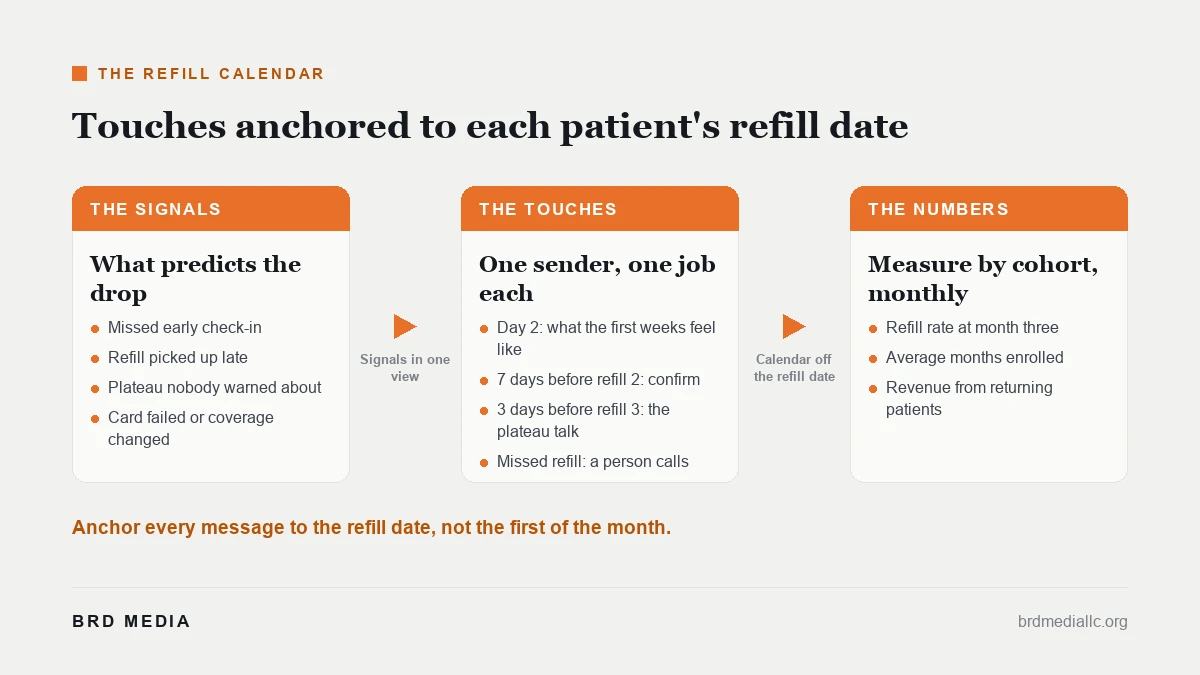
The mistake in most clinics is a monthly newsletter that goes to everyone on the first of the month. A patient who refilled on the 28th and one who is nine days late get the same message on the same day. Anchor every touch to the individual refill date instead. Here is the calendar, with the trigger, the sender and the one thing each message has to do.
| When (relative to refill) | Trigger | Who sends | What the message does | Signal it worked |
|---|---|---|---|---|
| Day 2 after the first fill | First fill recorded | The clinician, in their name | Says what the first weeks usually feel like and when to call, in the clinic's own words | Reply or a booked check-in |
| Day 7 before refill 2 | Refill date minus 7 | Front desk, by text | Confirms the refill is on order and offers a check-in slot | Refill picked up on time |
| Day 3 before refill 3 | Refill date minus 3, month three | The clinician | Names the plateau before the patient does, invites a visit | Visit booked or a reply |
| Day 3 after a missed refill | No pickup, no ship | A named person, by phone | Asks what happened, offers the refill conversation below | Call answered, outcome logged |
| Day 14 after a missed refill | Still no pickup | Front desk, by text and email | Open door: the program is still theirs, here is how to restart | Restart booked within 30 days |
| Month 6, on time | Sixth fill recorded | The clinician | Marks the milestone and asks for a review, labeled as a review request | Review posted, referral asked |
Two rules make this work. Every message has one sender who is a real person, and the message says something the patient could not have guessed. "We hope you are doing well" is not a touch. "Your third refill is due Thursday, and month three is when a lot of patients have questions about pace; Dr. Patel has time on Wednesday if you want to talk about it" is.
The plateau is the moment the program is judged. What the clinician says about it is clinical and is not this post's business. What the clinic offers around it is a marketing decision, and the operator pages on page one skip it entirely. The offer that goes with a month-three conversation is not a discount. It is a change in what the patient is paying for: a visit cadence that increases for a month, a coaching call, a nutrition session, a check-in with a named person every week until the next refill. The patient who stays because the clinic paid more attention stays for the program. The patient who stays because it got cheaper leaves when the price goes back up.
If the clinic packages any of that as a standing plan, the structure matters more than the price point. Our post on structuring memberships in a med spa covers how a recurring plan is built so it retains rather than discounts, and the same logic applies here.
Sometimes the plateau is not the reason. The card failed, the employer changed plans, the pre-authorization was declined. Motivation content does nothing for that patient, and sending it reads as not listening. The billing signal has to route to a different conversation: what the options are, what the clinic can do about timing, whether a different cadence changes the monthly number. Whether a different medication or approach is appropriate is the clinician's decision and never part of a marketing message. The marketing job is to make sure that conversation happens with a person, within days, rather than with a payment-failed email that goes unanswered.
Three numbers, monthly, by enrollment cohort:
When the first number moves, the calendar is working. When it does not move and the acquisition numbers are healthy, the drop is happening in the visit itself, and that is a clinical or an experience problem the marketing cannot paper over. The order to look at these in is the same order our how to get more patients post uses for acquisition: fix the step closest to the revenue first.
The honest take: retention work is premature for a program with fewer than a few dozen active patients. At that size every patient is already known by name, and the money is better spent on the acquisition system. Build the calendar when the front desk can no longer tell you, from memory, who is due to refill this week.
Premier IV is the one we point to. A compliant, multi-location GLP-1 patient acquisition engine with the follow-up built in delivered 99 qualified leads, 12 or more new patients at roughly a 12 percent lead-to-patient rate, and $80,496 or more in cohort lifetime value at $6,708 per patient over twelve months. Lifetime value is a retention number. The detail is on the Premier IV case study.
Export every patient who started in the last ninety days with their refill dates. Mark the ones who are late, the ones who missed a check-in and the ones whose card failed. Put one name next to each. Write the month-three message in the clinician's voice and send it to the patients whose third refill is due in the next ten days. That is the whole first version of a glp-1 patient retention month three system, and it takes an afternoon. The launch sequence post covers what to build before this; our weight loss clinic marketing services build the acquisition and the retention side as one system.
Engagements start at $2,500 a month on a six-month term; the three tiers are on our pricing page. Ad spend is separate and belongs to you.
We will map your refill data against a touch calendar and show you where the revenue is leaving.
Book a consultSee BRD Media first in Google
Add us as a preferred source and our SEO breakdowns rank higher in your own Search results, AI Mode and AI Overviews.