
Ask ten people how to market a medical practice and you get ten strategy lists with no order and no numbers. Order is the whole game. Every step below builds the audience for the next one, and the free work compounds while ad spend evaporates. Here is the 90-day sequence we run for medical clients, with what to do, what it costs, and what to skip.
Before anything else, claim and finish your Google Business Profile. Most new-patient calls in a local market start in the map pack, not on page one of the organic results. The checklist:
This costs nothing and outperforms most paid campaigns for a local practice. It also sets the foundation the next two steps build on.
Reviews are the deciding factor for a patient choosing between two nearby practices, and Google rewards fresh activity. The target is steady velocity: a practice adding six reviews a month for a year will outrank a competitor with 200 reviews and zero new ones.
Make the ask systematic. The front desk asks at checkout, a same-day text carries the direct review link, and a QR card sits at the desk. The checkout script that works: “Glad we could get you taken care of today. If you have a minute, a Google review helps neighbors find us. I can text you the direct link right now.” Every patient gets the same ask, no cherry-picking. Keep every script free of protected health information and never confirm anyone is a patient when you respond. We published the word-for-word scripts and the 24-hour automation in our guide to HIPAA-safe Google reviews.
Most practice websites are digital business cards. Yours needs to do one job: turn a visitor into a booked appointment. That means a page for every service you want to be found for, online scheduling or a two-field request form above the fold, load time under three seconds on a phone, and the phone number clickable everywhere. One clear action per page.
Structure matters for search too: dedicated treatment pages are what rank for “service near me” searches, and they are the backbone of any serious medical practice SEO program.
| Monthly budget | Where it goes | What to expect |
|---|---|---|
| $0 | GBP buildout, review engine, staff scripts | Map-pack movement in 30–60 days; the highest ROI work in this list |
| ~$1,000 | Website conversion fixes, review automation, citation cleanup | More booked appointments from traffic you already have |
| $2,500–$5,000 | Full local SEO plus content, then paid search once the site converts | Compounding rankings in 3–6 months; ads produce from week one but stop when you stop |
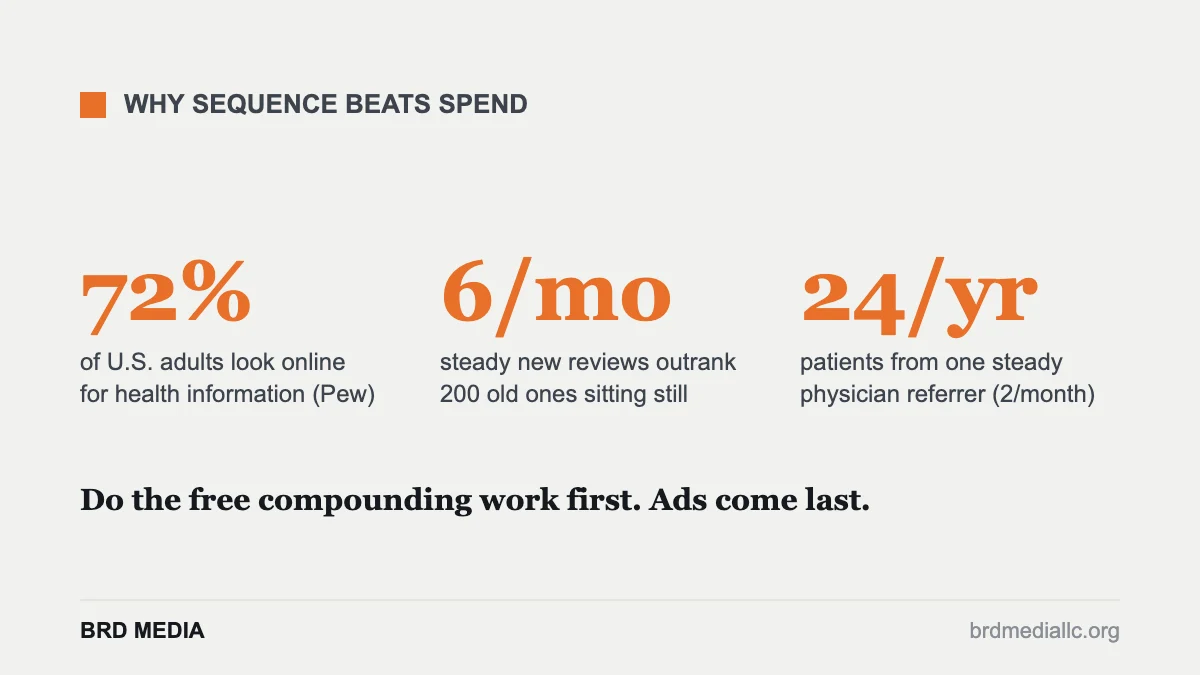
Patients research before they book, and 72% of U.S. adults look online for health information. Write one page or post a week answering the exact questions your front desk hears: what a procedure feels like, recovery time, whether insurance covers it, how to prepare. Each one ranks for a question your competitors ignore and feeds authority to your service pages.
Month three is also when you build the referral asset most practices never create: a dedicated page and intake path for referring physicians. One steady referrer sending two patients a month is worth about 24 patients a year, and the whole system is laid out in our physician referral pipeline guide.
Paid search works for a practice, but only in month three or later, after the site converts and reviews carry social proof. Two cautions. First, some specialties face ad-platform restrictions and certification requirements, so verify your category before promising yourself ad volume. Second, the default tracking setup on most medical websites violates HIPAA: ad pixels on scheduling or condition pages can transmit patient data to platforms that will never sign a BAA. Read our HIPAA-compliant marketing guide before the first dollar of spend.
Med spas run the same playbook with different economics; see sequencing med spa marketing strategies by growth stage for that version of the system.
Ninety days gets the foundation in. What comes after that is a channel-by-channel decision, and the full channel playbook for doctors is written for exactly that call. If the problem is closer to the ground and the schedule simply has gaps, the ordered sequence for getting more patients starts a step earlier.
A weight loss program launches on its own schedule because of the prescriber constraint and the subscription economics; the ninety-day launch sequence is that version of this plan.
If your model includes prescribing online, check eligibility before you build anything. Here is what the platforms require and who it applies to.
Running a telehealth weight loss program across state lines? Read how to match campaign targeting to clinician licensure before adding a state.
Practices that treat patients at home or on site work with a different local search setup. How a mobile IV clinic builds its service area and city pages walks through it.
Weight loss programs lose patients on a fairly predictable schedule. Retaining GLP-1 patients past month three covers the signals a clinic already holds and the messages that go with them.
We handle medical practice marketing end to end: map pack, reviews, a site that books, and HIPAA-clean patient acquisition.
Book a Strategy CallSources: American Medical Association, Marketing a Physician Private Practice · Pew Research Center, Health Online · HHS, Online Tracking Technologies Bulletin
See BRD Media first in Google
Add us as a preferred source and our SEO breakdowns rank higher in your own Search results, AI Mode and AI Overviews.