
Search for med spa marketing strategies and you get channel surveys: do SEO, post on social, send emails. All true, none of it a strategy. A strategy tells you what to run at YOUR stage, in what order, and how to prove which piece is paying. This guide lays out the five-layer system we run for med spa clients: positioning, offer architecture, channel selection by growth stage, follow-up automation, and the measurement math that keeps everyone honest.
A med spa doing $30k a month has different math than one doing $150k. The strategy table below is the stage map we use before recommending anything. Find your row before you spend a dollar.
| Growth stage | Strategic focus | Primary channels | The number to watch |
|---|---|---|---|
| New (first year) | Get found, get first patients, collect proof | Google Business Profile, one intro offer, referral asks, paid social in month two | Booked consults per week |
| Established, uneven books | Smooth demand and stop leakage | Follow-up automation, recall campaigns, slow-day promos, retargeting | Show rate and rebook rate |
| Busy, ready to scale | Raise patient value and own the market | Memberships, treatment-page SEO, expanded paid social, second-location groundwork | Revenue per patient per year |
Positioning is a decision, not a tagline. Do this in one working session: pull your last 100 patients, mark the 20 you would clone (spend, loyalty, referrals), and write down what they have in common and which treatment brought them in. That patient and that treatment become the face of your marketing. Everything downstream sharpens: your offer speaks to one person, your ads stop competing on price, and your reviews start repeating the same story. A spa that markets every treatment to everyone within twenty miles is invisible; a spa known as the injectables authority or the body-contouring specialists gets the exact patients it wants and full-price everything else as the relationship deepens.
One offer is not an architecture. You need three, wired together: an entry offer on your signature treatment that gets a stranger into a consult without gutting margin, a conversion path that ladders the first visit into a package or plan at the moment results are visible, and a membership that turns episodic visits into recurring revenue. Write the ladder down and train the front desk to walk every new patient up it. The spas with full books are not better at attracting strangers; they are better at keeping the second and tenth visit.
Channels are the layer everyone starts with and the third thing that actually matters. Two rules govern the choice. First, capture existing demand before you create new demand: people searching for treatments near you this week are cheaper to win than people who need convincing, which is why local search and your profile come before awareness ads. Second, match the channel to your stage using the table above rather than a competitor's playbook. For the tactical play-by-play inside each channel, the checklists live in our companion piece on med spa marketing ideas; this post stays at the system level, and our med spa lead generation service exists for owners who want the whole layer run for them.
Follow-up is where med spa marketing quietly dies. An inquiry that waits a day goes cold; a patient whose Botox cycle lapses without a recall message books wherever the next Instagram ad sends her. The machine needs four automations, built once: instant reply to every form fill and missed call, a booking-nudge sequence for inquiries that have not scheduled, a recall message timed to each treatment's cycle, and a review-plus-referral ask that fires after visits. We built exactly this stack in the Dr. Mo wellness case study, and it is the reason paid spend there kept working: the ads filled a funnel that no longer leaked.
Likes are not a number. The system runs on three: cost per lead by channel, cost per booked appointment by channel, and revenue per patient per year. Getting them takes an afternoon: install conversion tracking on every booking action, give each channel its own tracking number or form source, and put the three numbers in one sheet reviewed monthly. Then optimize the weakest ratio instead of guessing. This layer is where the 28% cost-per-lead drop on one of our med spa accounts came from: same budget, same channels, but measured offer and creative tests replacing opinions. Most owners spend within the range the SBA's marketing guidance describes for service businesses; the measurement layer is what determines whether that budget compounds or evaporates.
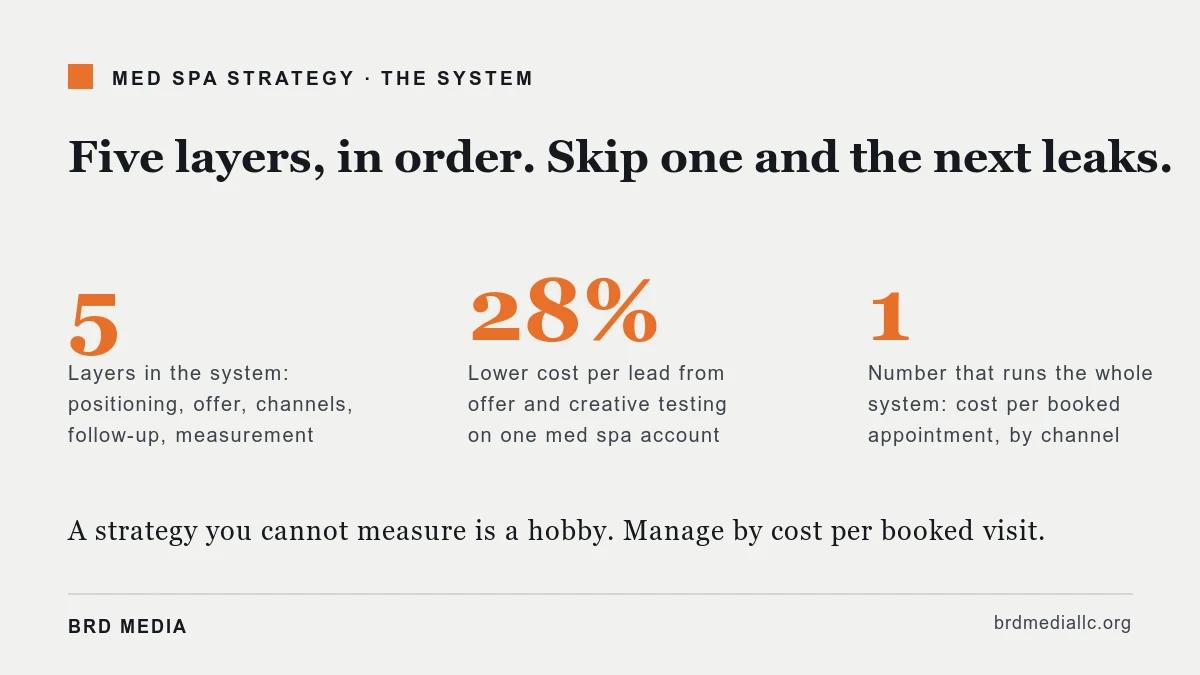
Find your row in the stage table. Spend one session on positioning, one on the offer ladder, one wiring follow-up. Only then touch channels, and give the system ninety days before you judge it on cost per booked visit. If you want a team that already runs this system across med spas, that is precisely what our med spa marketing agency services are: the five layers, built, run, and reported on one number you can take to the bank.
Layer three is channel selection. When paid is the channel you land on, how to build the two-channel med spa ad account takes it down to ad groups, negatives and radius.
Follow-up is the stage most strategies skip. How a med spa gets more booked consults to show up walks through the first reply, the confirmation and the reminder sequence.
Local search is the channel where a strong profile does most of the work. What keeps a med spa out of the map pack covers the fixes in order.
Authority is one layer of the system, and how a med spa earns links goes through the assets that attract them.
The site layer works best with a clear tree, laid out in this guide to treatment page structure.
On the paid side, before and after photo alternatives for Meta ads lists creative formats to test when the split screen stalls.
Bring your booking numbers. We will show you which layer is leaking, what to fix first, and live results from med spas we run.
Talk to the teamSources: Google Ads conversion tracking documentation; U.S. Small Business Administration, marketing and sales guidance. The 28% cost-per-lead figure is from a BRD Media med spa client account; ranking claims reflect BRD Media's own tracked positions.
See BRD Media first in Google
Add us as a preferred source and our SEO breakdowns rank higher in your own Search results, AI Mode and AI Overviews.