
Most lists of med spa marketing ideas read the same way: twenty-five channels, zero instructions, and no opinion about what to run first. This one is different. We rank the ideas that reliably book appointments, tell you the order to run them in, and show the numbers behind the ones we run for our own med spa clients. If you only have a few hours a week and a modest budget, you will leave this page knowing exactly which three plays to start Monday.
Every idea below earns its slot by one test: does it put a new patient in a treatment room? Here is the ranked table we wish someone had handed us, with the effort and the typical payback window stated plainly.
| Idea | Effort | Typical payback | Run it when |
|---|---|---|---|
| Google Business Profile buildout and weekly posts | Low | 2 to 8 weeks | Day one, always |
| Intro offer that ladders into a membership | Low | First promotion cycle | Day one, always |
| Follow-up and recall automation (SMS plus email) | Medium, one-time setup | Immediately on missed inquiries | Week one |
| Before-and-after content with written consent | Medium, ongoing | 4 to 12 weeks | As soon as you have results to show |
| Paid social with offer testing | Medium | 2 to 6 weeks | After profile, offer, and follow-up work |
| Referral and review engine | Low, ongoing | Compounds over months | Month two onward |
| Local SEO content for treatment terms | High | 3 to 9 months | When you want growth that compounds |
Your profile is the highest-intent surface you own, and most med spas leave it half-finished. Do these four things this week:
Discounting Botox forever trains patients to wait for the discount. The fix is offer architecture, not deeper cuts:
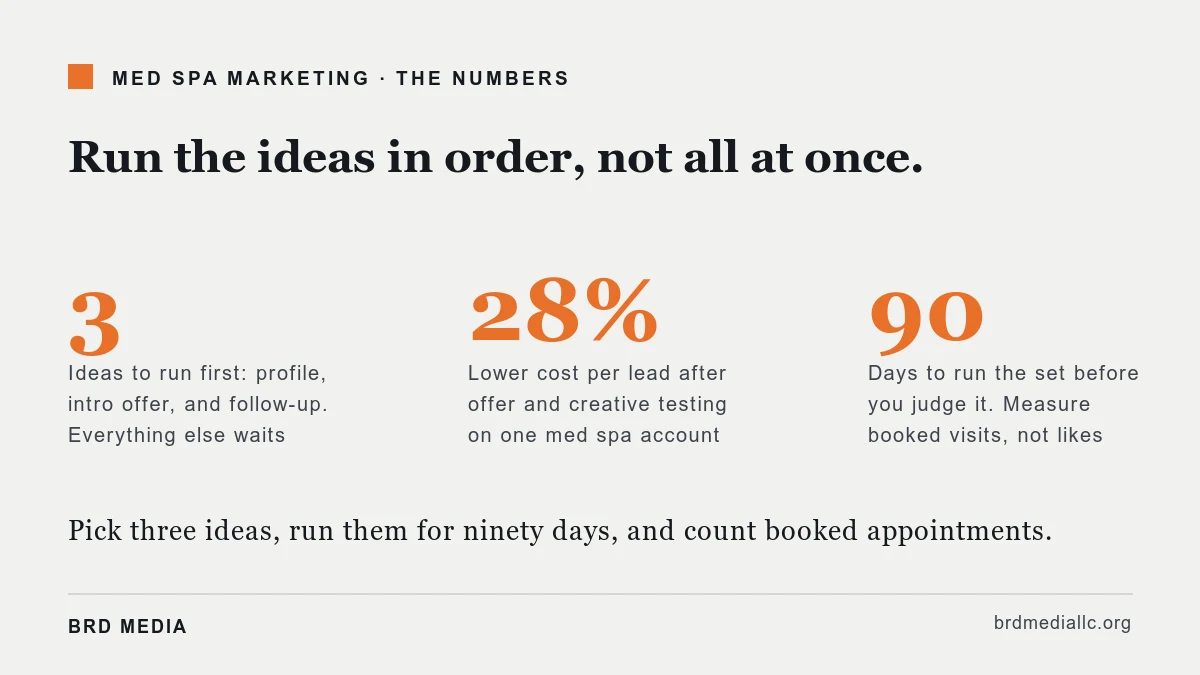
Ads amplify whatever they point at, so run them after your profile, offer, and follow-up are in place. Start with paid social: aesthetics is visual, and Meta's feed formats fit before-and-after storytelling better than search text ads do. Test one offer against one audience and change a single variable at a time. On one of our med spa accounts, offer and creative testing alone cut cost per lead 28% with no budget increase. That is the boring, repeatable version of ad success, and it is the method behind our Facebook ads management for med spas. Two rules keep you out of trouble: never run a claim you cannot document, since the FTC's endorsement guides treat before-and-after imagery and testimonials as advertising claims, and never send ad clicks to your homepage when a treatment-specific page with the offer, proof, and a booking form will convert twice as well.
The plays above fill this month. These three build the flywheel that fills next year:
Pick one demand-capture play (profile plus offer), one conversion play (follow-up automation), and one growth play (content or ads). Run them for 90 days and count booked appointments, not impressions. If you would rather have a team that has already made these mistakes on someone else's budget, our med spa marketing agency services cover the whole stack, and the sister post to this one covers med spa marketing strategies at the system level: sequencing, budgets by growth stage, and the measurement math.
Ideas are the what. If the paid side is where you want to start, the paid playbook for Google and Meta covers ad group structure by treatment and the creative rules that decide whether an ad ever runs.
If your menu includes IV drips, the best idea on this list may be the least exciting one: a written repeat-visit protocol with a trigger, a message and an owner.
An idea only pays off when the inquiry it creates turns into a patient in the chair. Raising your med spa consult show rate covers the speed, deposit and reminder steps that sit between the form fill and the appointment.
A profile and review plan only works once the listing is set up to rank. Why a med spa loses the map pack lists the causes to check first.
Offers and events become more useful when they also give local sites a reason to mention you, which is the idea behind earning links as a med spa.
Each idea here needs a page to land on, and how to structure treatment pages shows how to set those up without twenty thin ones.
If your before and after posts have stopped performing, these creative options for Meta ads are worth a test.
Bring your booking calendar and your current numbers. We will tell you which three plays to run first and show you live results from spas like yours.
Talk to the teamSources: Google Business Profile photo guidance; FTC Endorsement Guides. The 28% cost-per-lead figure is from a BRD Media med spa client account; ranking claims reflect BRD Media's own tracked positions.
See BRD Media first in Google
Add us as a preferred source and our SEO breakdowns rank higher in your own Search results, AI Mode and AI Overviews.