
The advice on this subject has one consensus, and it is right: give each treatment its own page instead of listing twelve on a single services page. Page one of a search for this topic will also hand you a content checklist for each page. What it will not give you is the architecture underneath: how to group the pages, which ones to split, which to combine, how they connect to the profile on Google and to each other. That is the med spa treatment page structure problem, and it is where most clinic sites that "have a page for everything" still lose.
This post is the architecture. What goes on a single treatment page, and why it sells, is covered in our med spa SEO guide, and we will not repeat it here.
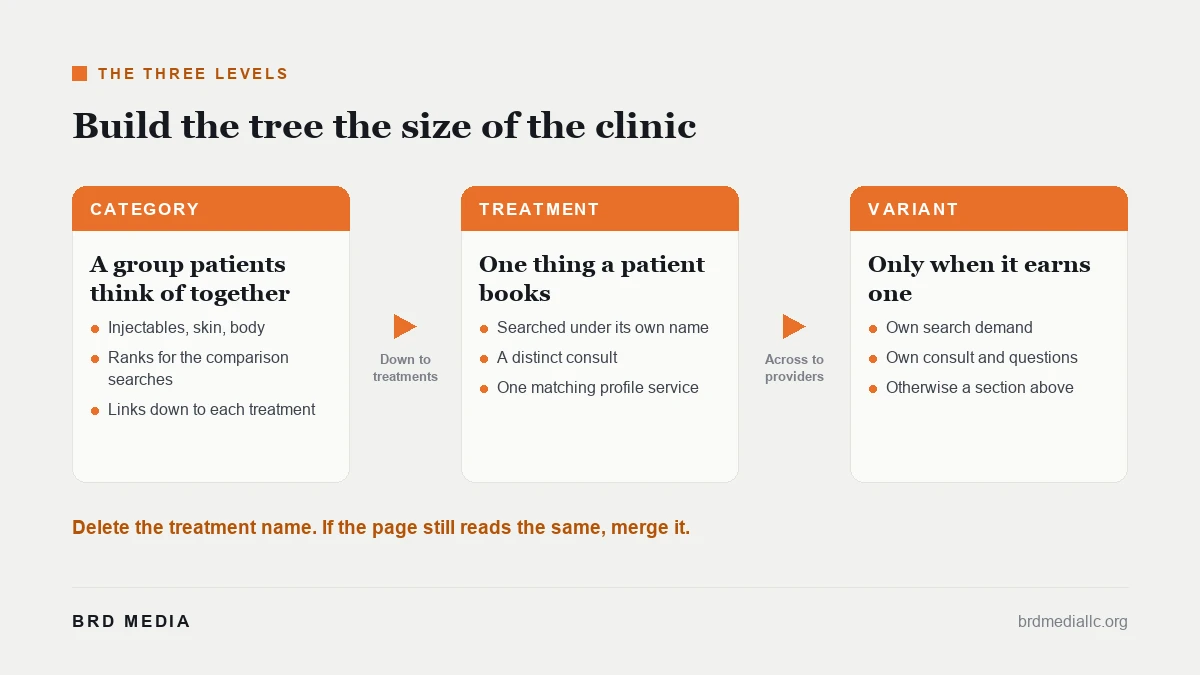
Think in a tree with three levels. The first is the category: a page for a group of treatments that a patient thinks of together, such as injectables, skin treatments or body contouring. The second is the treatment: one page for one thing a patient books. The third is the variant: a page for a specific version of a treatment, only when that version has its own search demand and its own consult.
On the site the tree reads in the URL, and Google's own URL guidance asks for exactly that: readable words rather than ID numbers, hyphens between words, and a structure that is "most intelligible to humans." A clinic with a clean tree might look like this.
/injectables/ is the category page, written for someone choosing between treatments./injectables/botox/ and /injectables/dermal-filler/ are treatment pages./injectables/dermal-filler/lip-filler/ is a variant, justified only if people search for it on its own and the consult differs./skin/microneedling/ and /body/body-contouring/ sit under their own categories.The category page is the one clinics skip, and it does real work. It ranks for the comparison searches ("filler or Botox"), it gives the visitor who does not know which treatment they want somewhere to land, and it passes internal links down to the treatment pages beneath it.
Two tests decide it, and both have to pass. First, is the treatment, or the variant, searched for under its own name? Check a keyword tool and your own Search Console; the answer is on the screen, not in your head. Second, is the consult different? If a patient who asks about it needs different questions answered, a different provider, a different length of appointment or a different price structure, it deserves a page of its own. If the answer to either is no, fold it into a section of the page above it.
| Example | Split or combine | Why |
|---|---|---|
| Botox and Dysport | Combine on one neuromodulator page, with an H2 for each brand name, unless you can write a page for each that would stand alone | Same consult, same provider, similar questions. Two thin pages compete with each other |
| Dermal filler by area (lips, cheeks, jawline) | Split only where the area is searched on its own and the consult differs | Lip filler is commonly searched by that name; "mid-face volume" may not be. Let demand decide |
| Microneedling and microneedling with PRP | Combine, with a section for the add-on | One consult, one provider. The add-on is a choice inside the visit |
| Laser hair removal and laser skin resurfacing | Split | Different patients, different questions, different recovery and different number of visits |
| Body contouring device and the body areas it treats | One treatment page, a section per body area | The device is the thing booked. Area pages only if each is searched on its own |
Patients search for what they want done, and some also search for the device by name. Most clinics are better served by treatment pages that name the device inside the page than by a page per device. A treatment page titled for the result a patient wants, with the device named in the body, serves both searches. A device page makes sense when the device is the thing people search for by name and the clinic can say something specific about owning it: the provider training, the treatment protocol, who the device suits. If all the page can say is what the manufacturer's brochure says, it is a thin page with a logo on it.
The same applies to brand names of products. Use the brand name where patients use it, and keep the page about the treatment. Anything clinical, such as who a treatment suits or what to expect, should come from the provider and the product's own labeling. This post is about structure and makes no clinical claims.
The profile and the site should list the same things in the same words. Google's help page on managing your services lets a business, where its category supports a services list, choose services, group them into categories, add a custom service when one is missing, and add a description and price to each. That is the same tree as the site, and the match should be one to one: each treatment page has a service entry with the same name, and each service entry's description says what the page says in two sentences.
Two mismatches recur. The first is a profile that lists many services while the site has a single page for all of them, so the profile promises what the site cannot back up. The second is the reverse: a page for every treatment, but only the same three services on the profile, so most of those pages have no matching entry. Put the two lists side by side and close the gaps. Google also notes that custom services that violate its policy are rejected automatically, and it asks you to keep prices, phone numbers and personal information out of custom service names, so put those in the description field, not the name.
A page that nothing links to is invisible to the visitor and the crawler. Build three paths on purpose. Down: every category page links to each treatment beneath it, with the treatment's real name as the anchor. Across: each treatment page links to the providers who perform it, and each provider page links back to the treatments. Out: every page has a route to booking that does not require scrolling to the footer.
Then add the sideways links a patient would want: from a filler page to the neuromodulator page ("not sure which? compare them here"), from a treatment page to the aftercare page, from a blog answer to the treatment it explains. Our post on why a med spa loses the map pack covers the profile side of the same match.
The failure mode of "a page for every treatment" is twenty pages that share an intro, a benefits list and a generic FAQ, with the treatment name swapped. Google's guidance on helpful, people-first content asks whether a page offers original information and substantial value compared with others on the topic. A page whose only difference from its neighbor is the title does not.
Run one check before publishing each page: delete the treatment name and read what is left. If it could be pasted onto another treatment page without anyone noticing, the page is not ready. The fix is provider-specific material that cannot be pasted: who performs it and their training, what the consult covers at this clinic, what to prepare, what the follow-up is, the questions this clinic's front desk hears. If a treatment has nothing specific to say, merge it into its parent. One strong page beats two weak ones, and merging is easier before launch than after, because a published page that has to be redirected needs a permanent redirect and its links updated.
Do not build the whole tree in a month. Start with the two or three treatments that book the most and have the best search demand, and build each as a complete page with a provider attached. Add the category page that holds them. Wire the profile services to match. Then add one treatment at a time, in order of demand, and watch which ones start to appear in Search Console before you invest in the next. The structure is built for growth: new pages slot into the tree without changing the pages around them.
If the site is old and the services page has been ranking for years, treat it with care. Keep it as the hub, link out to the new pages from it, and change one thing at a time. Our web design team builds these trees into the site from the start, and our med spa SEO service is where the pages get tied to the profile, the links and the measurement.
The honest take: a small clinic with four treatments and one provider does not need a three-level tree. It needs four strong pages and a simple home page that links to them. Structure is a tool for a clinic with enough treatments that a visitor can get lost. Build the tree the size of the clinic, not the size of the tutorial.
Dr. Mo's Wellness Home is the med spa client we point to for the full picture. The build covered the website, landing pages, paid media and the CRM system behind the booking flow, and it produced 144.9 percent year-over-year active-user growth and roughly 20 new patients a month. We cannot attribute that result to page structure, and we do not claim it. The measure it was held to, patients in chairs, is the one to hold your own treatment pages to.
List every treatment the clinic books, with the name patients use. Next to each, write whether it is searched on its own and whether the consult differs. Mark each one as a page, a section of a page, or a variant. Then compare that list to the services on your Business Profile and close the gaps. By Friday you will have the tree, the build order and the list of pages to merge, which is the med spa treatment page structure on one sheet. For the wider picture of how a clinic fills its book, see our med spa marketing agency page.
Engagements start at $2,500 a month on a six-month term; the three tiers are on our pricing page. Ad spend is separate and belongs to you.
Send us your treatment list and your current services page. We will show you which treatments earn a page, which share one, and how each one maps to your profile.
Book a consultSources: Google Search Central, URL structure best practices · Google Business Profile Help, manage your services · Google Search Central, creating helpful, reliable, people-first content
See BRD Media first in Google
Add us as a preferred source and our SEO breakdowns rank higher in your own Search results, AI Mode and AI Overviews.