How to Choose a Chicago Law Firm Marketing Agency
UpdatedTL;DR
- Most agencies pitch services. Few help you understand what you're actually buying.
- The right Chicago law firm marketing agency understands your practice area, your intake process, and the Chicago market, not just SEO and Google Ads in the abstract.
- Budget reality for Chicago: $2,500–$10,000/month in agency fees, plus media spend that can hit $5K–$25K/month for personal injury firms.
- I'd estimate 60% of what most lawyers pay agencies gets wasted on agencies that don't understand intake. That's the single biggest leak in legal marketing.
- The decision framework below covers 7 questions, 3 red flags, and real pricing. It's what I'd want if I were on your side of the table.
If you've spent more than ten minutes searching for a Chicago law firm marketing agency, you've already noticed the pattern. Every agency homepage reads the same. "Custom strategy." "Proven results." "We understand attorneys." Then you get on a sales call and somehow the pitch is the same one they'd give a plumber or a dentist. If you are weighing paid search, see how we run law firm PPC management.
I run a Chicago-area digital advertising agency in Villa Park, and I've sat across the table from a lot of law firm owners who got burned by their last marketing agency. The pattern is always the same: they didn't get burned because they picked the wrong service. They got burned because they didn't know what questions to ask before signing. This post fixes that.
Why do firms pick wrong?
The Chicago legal market is brutal. 108 firms in Chicago are spending more than $7.3 million per month on advertising. That's the spend you're competing against, every day, on the same keywords. Walk past Daley Plaza on a Tuesday afternoon and half the billboards you see are lawyer billboards. The LaSalle Street corridor is dense with firms fighting for the same searches, the same intake calls, the same signed cases.
Here's what gets most lawyers in trouble. They pick an agency based on a sales call. The agency rep is sharp, the deck looks polished, the pricing seems reasonable, the case studies sound legit. Three months later, the firm is paying $5,000 a month for "SEO services" and the calls aren't coming in. Six months later, they're locked into a twelve-month contract and the agency is reporting on rankings nobody asked for.
The actual problem isn't that the agency is incompetent. It's that the agency was never built for law. Strong opinion: I'd estimate 60% of what most lawyers pay generalist marketing agencies gets wasted on people who've never run an intake call, never written an attorney-client engagement letter, and don't know what "no fee unless you win" means in Google's ad policy enforcement system.
Law isn't e-commerce. Law isn't home services. Law has its own rules, its own conversion math, and its own client psychology. An agency that can't speak to all three is selling you generic traffic and hoping you don't notice the leak.
The Chicago Law Firm Market Reality (By the Numbers)
Before you talk to any agency, understand what you're competing in.
96% of people seeking legal advice start with a search engine. That number comes from Law Firm Marketing Pros' 2024 analysis, and it's the single statistic that determines everything else in your marketing strategy. If you're not visible on search (paid, organic, or map pack), you're not in the conversation.
Chicago personal injury Google Ads clicks routinely cost $150–$500. Some PI keywords exceed $300 per click in dense metros like Chicago. That means a single click (not a lead, not a case, a click) can cost more than a tank of gas. Legal services have the highest average CPC of any industry on Google, and PI sits at the top of legal.
Only 40% of law firms actually answered their phones during a secret-shopper study in Clio's 2024 Legal Trends Report. That's down from 56% in 2019. So 60% of firms are paying for marketing that generates calls they never answer. If you fix nothing else, fix this.
Law firms responding within 5 minutes see a 400% higher conversion rate than firms that respond later. Speed beats budget. Fast intake is half of any lead generation strategy for law firms. An agency that doesn't ask about your intake response time isn't optimizing for the metric that actually matters.
That's the market. Now here's how to pick someone who can actually move you through it.
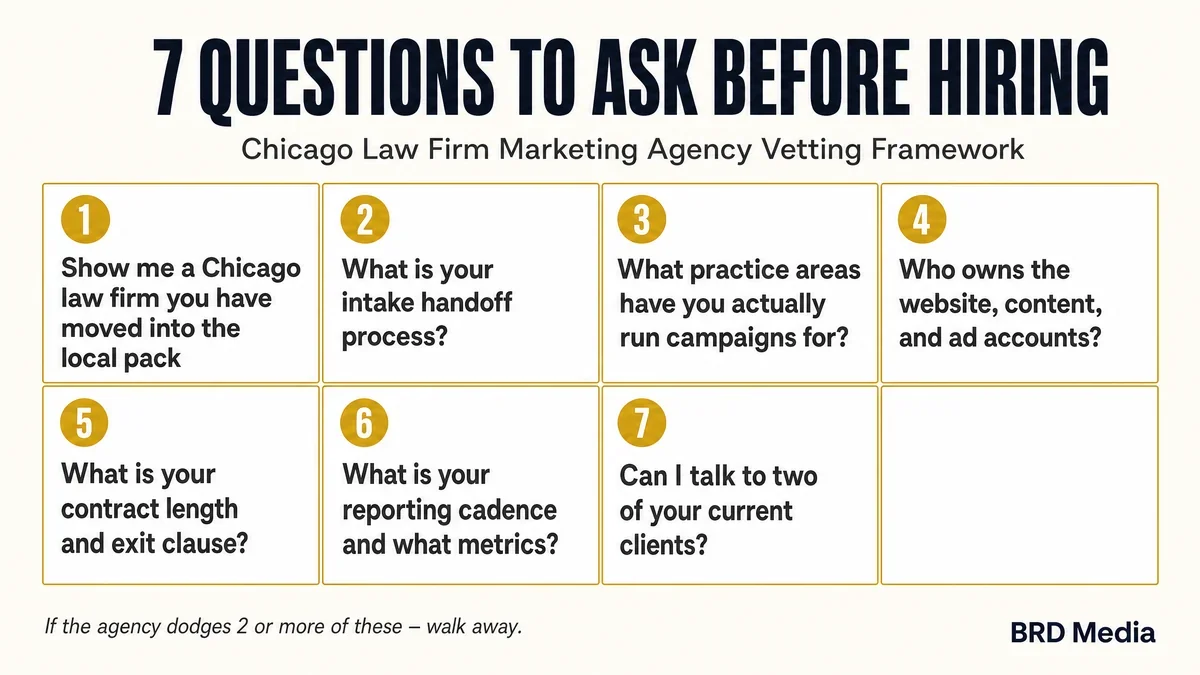
7 Questions to Ask Before Hiring a Chicago Law Firm Marketing Agency
Forget the standard "tell me about your process" question. That's a softball every agency has rehearsed. These seven questions separate signal from noise. The same vetting questions apply when hiring an SEO expert, not just an agency.
1. "Show me a Chicago law firm you've moved into the local pack."
The Google local pack (those three Google Business Profile listings that show up with a map for searches like "personal injury lawyer Chicago" or "divorce attorney near me") is where most qualified Chicago calls originate. If an agency can't show you a Chicago law firm they've moved into the local pack, they don't have the geographic experience to do it for you.
Ask for the firm name. Ask for the search term. Open Google in your browser, search the term, and verify. Agencies that ace this question are rare. The ones who do are worth talking to.
2. "What's your intake handoff process?"
This is the question almost no agency expects. Most agencies pitch traffic. They show you lead volume. But volume without a lead generation strategy that actually converts is just expensive noise. They show you click-through rates. But marketing without an intake plan is a leaky bucket. And the leak is the agency's problem, not just yours.
A good agency will ask you about your intake: who answers the phone, what your after-hours coverage looks like, how lead data flows into your case management system, whether you use a chat tool or a callback widget. If the agency doesn't bring this up before signing, they're selling clicks, not cases.
3. "What practice areas have you actually run campaigns for?"
Personal injury, family law, criminal defense, immigration, estate planning. Each has wildly different CPCs, search intent, and ad-policy restrictions. A PI Google Ads campaign and an immigration campaign run on completely different cost structures, and the messaging that converts in one will get rejected by Google in the other.
A generalist agency learning your practice area on your dime is a red flag. Ask for case studies in your specific practice area. If they don't have them, you're paying for their education.
4. "Who owns the website, the content, and the ad accounts?"
This is the asset-ownership question, and it kills more deals than any other when asked properly. Industry standard answer: the client owns everything. Your website, your content, your Google Ads account, your Google Analytics, your Google Business Profile, your hosting. If you fire the agency tomorrow, you walk away with all of it.
Some agencies hold ad accounts hostage. Some retain ownership of "their" content. Some rebuild your website on a proprietary platform you can't migrate off. These setups exist to make leaving expensive. Walk away from any agency that won't put asset ownership in writing.
5. "What's your contract length and exit clause?"
Twelve-month contracts with no performance benchmarks carry meaningfully higher risk than terms tied to a written performance milestone. A confident agency puts that milestone in the contract, because they expect to earn the renewal on results.
If the agency requires a year up front, ask why. The legitimate answer is something like, "SEO results take six to twelve months to materialize, so we need runway to deliver." The illegitimate answer is anything that hints at locking you in regardless of performance.
6. "What's your reporting cadence, and what metrics do you actually report?"
Bad answer: "We send a monthly rankings report."
Rankings don't pay your associates. The right answer involves attribution to signed cases, not just leads. Monthly reporting calls. Direct access to your Google Search Console, your Google Ads dashboard, and your call tracking platform. The agency reports on cost per signed case, not just cost per click.
If the only thing they show you is traffic numbers, you're being managed for impressions instead of cases.
7. "Can I talk to two of your current clients?"
Not testimonials. Not case studies. Real, current clients you can call.
An agency with a healthy book of business will introduce you to two clients without flinching. An agency that hedges, delays, or offers "we'll have to ask them first and circle back" is telling you something. Healthy client relationships produce reference calls in 48 hours, not two weeks.
Which red flags kill a deal?
If any of these come up in the sales process, end the call.
Anyone who guarantees first-page Google rankings is either misleading you or planning to use tactics that will get the firm penalized. Google's own webmaster guidelines explicitly state that no one, including Google itself, can guarantee rankings. An agency willing to put that in a contract is willing to put your domain at risk.
If the deck they show you is interchangeable between a family law firm and a personal injury firm, they're selling templates. The strategy for a divorce attorney targeting Naperville is fundamentally different from a PI firm targeting downtown Chicago. Templates produce template results.
An agency that doesn't ask "what happens when a lead comes in?" before quoting you is going to send leads into a black hole and blame your conversion rate when calls don't turn into cases. Intake is half the system. If they don't care about it, they don't understand law firm marketing.
What does it actually cost?
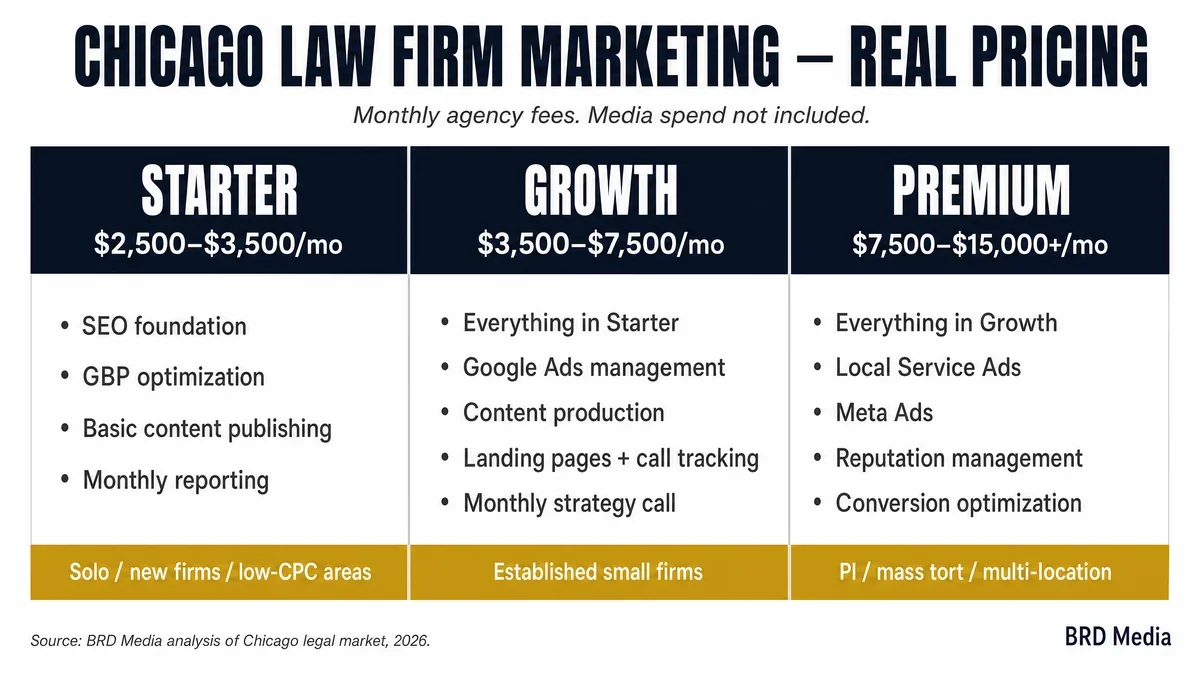
Real pricing, broken down by tier. These are agency-fee ranges, not media spend. Add Google Ads budget on top. For personal injury, that media spend can dwarf the agency fee.
| Tier | Monthly Agency Fee | What's Typically Included | Best Fit For |
|---|---|---|---|
| Starter | $2,500–$3,500 | SEO foundation, Google Business Profile optimization, basic content publishing, monthly reporting | Solo firms, new firms, lower-CPC practice areas (estate planning, employment, immigration) |
| Growth | $3,500–$7,500 | SEO + Google Ads management + content production + landing pages + call tracking + monthly strategy call | Established small firms, family law, criminal defense, mid-volume PI |
| Premium | $7,500–$15,000+ | Aggressive multi-channel SEO + Google Ads + Local Service Ads + Meta Ads + reputation management + conversion optimization | Personal injury firms competing in the Chicago map pack, mass tort, multi-location firms |
Where BRD typically engages. Our law firm clients usually start at $3,000+/month in agency fees, with the right tier determined by practice area, geographic competition, and existing intake infrastructure. We don't take on engagements where the firm's intake can't keep up with the lead volume we'll generate. That's not a discount, it's a structural mismatch.
Media spend reality check. If your firm runs Google Ads in Chicago for personal injury, expect to budget $5,000–$25,000+ per month in media on top of the agency fee. A click on "car accident lawyer Chicago" can run $150–$300+. Lower-CPC practice areas like estate planning or immigration can run profitable campaigns on $1,500–$3,000/month in media. Get the agency to model the budget for your specific practice area before signing, not after.
The Generalist Agency Problem (Why Specialization Matters)
Generalist agencies win on cost. They lose on understanding.
Here's what specialized law firm agencies know that generalists don't. Attorney advertising rules vary by state, and Illinois has its own. Practice area regulation affects what you can claim in ad copy. The American Bar Association's Tech Report tracks how legal-specific platforms behave differently from generic small-business marketing tools. Google's "your money or your life" (YMYL) classification gives legal content extra scrutiny, which means your content strategy has to clear a higher bar than a restaurant blog. Intake handoff into a legal case management system isn't the same as routing a lead to a HubSpot pipeline.
None of this is rocket science. But it's all stuff you only know if you've actually worked with law firms. A generalist agency learning these constraints in real time will cost you twelve months and a five-figure budget before they're competent.
I came into digital advertising from general contracting and real estate. I built customer acquisition systems that had to actually work because I was signing the front of paychecks, not the back. That operator background is why I'm allergic to agencies pitching template strategies. When you've run a real business, you can spot an agency that's never had to make payroll from a mile away.
Case Study: A Chicago Personal Injury Firm
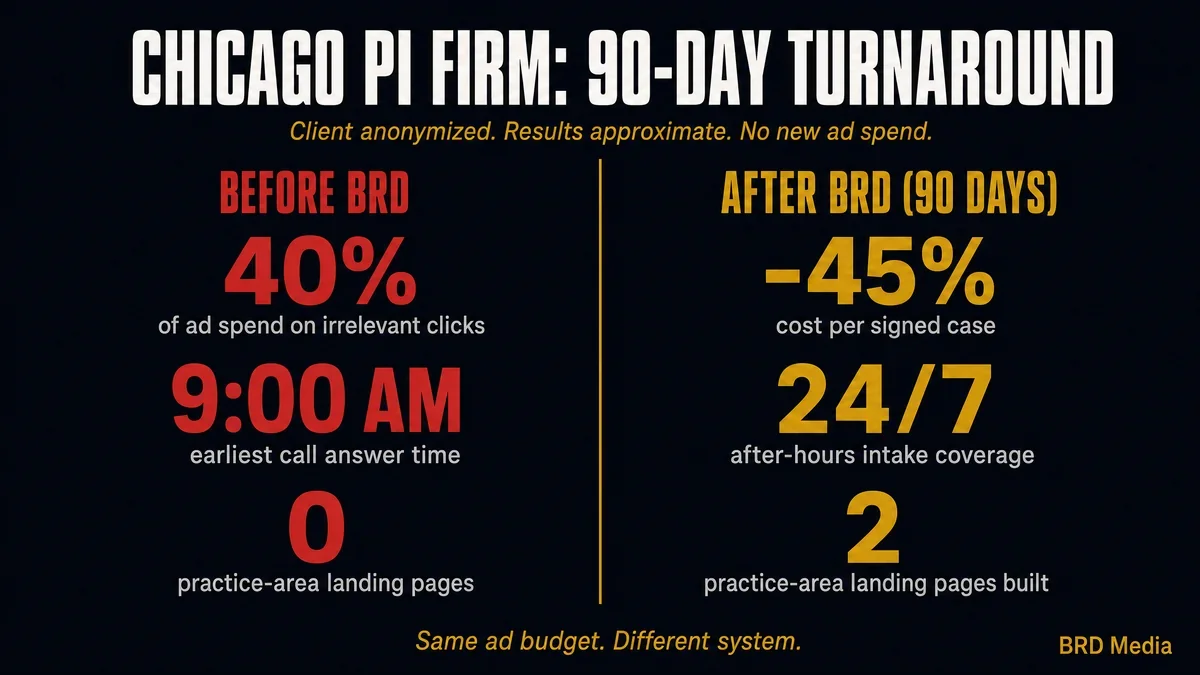
A Chicago personal injury firm came to us after spending eighteen months with a generalist marketing agency. The agency had built them a website on a proprietary CMS, run Google Ads campaigns with broad-match keywords, and reported monthly on traffic and rankings.
Here's what we found when we audited the situation. Their Google Ads account was burning roughly 40% of spend on irrelevant clicks: "lawyer salary" searches, "free legal advice" queries, and competitor brand searches that produced zero signed cases. Their landing pages were homepage clones with no practice-area specificity. Their Google Business Profile had no recent reviews, no photos from the last twelve months, and was missing two of their three practice areas entirely.
The biggest leak was intake. Calls were going to a shared front-desk line that didn't open until 9:00 AM. Anyone calling about a car accident at 7:30 AM, which is peak time for accident-related searches, went to voicemail. The agency had never mentioned it.
The first thirty days, we didn't add a single dollar of ad spend. We rebuilt the Google Ads keyword structure with negative keyword lists, built two practice-area landing pages, set up call tracking, and worked with the firm to install an after-hours intake protocol. Inside ninety days, cost per signed case dropped roughly 45% and signed-case volume increased by a meaningful margin, without changing the budget.
What changed wasn't the ad spend. What changed was the system around the ad spend. That's the difference between an agency that understands law firm marketing and one that just runs Google Ads campaigns.
The Real Bottom Line
A marketing agency isn't a vendor. It's a partner in your case acquisition system. The wrong agency costs you twelve months and $30,000–$120,000 in fees and media before you realize the problem isn't your conversion rate. The problem is that nobody designed the system around the leads in the first place.
Don't pick the cheapest. Don't pick the flashiest. Pick the agency that asks the most uncomfortable questions about your business. The ones who want to know your intake response time, your after-hours coverage, your average case value, your historical signed-case-to-lead ratio. The ones who would rather lose the deal than oversell what they can deliver.
That's the partner you want. Anyone selling you traffic without asking about cases is selling you the wrong thing.
Related reading: DUI lawyer marketing and criminal defense attorney marketing. · Personal Injury SEO: How PI Firms Win Cases From Google · BRD Media vs SmartSites: an honest comparison
Also: BRD Media vs Hibu: An Honest Comparison for Local Business Owners
This isn't a marketing problem. It's a case acquisition problem.
Book a free 30-minute strategy call. We'll walk through your current marketing, your intake process, and where the leaks are. No pitch. No contract. Just an honest read on what's working and what isn't.
Book a Free Strategy Call →Related: One question most firms forget: whether your marketing agency carries cyber insurance.