
The average personal injury case is worth more than most firms spend on marketing in a month. And the person who files it almost always starts with a Google search. About 87% of accident victims begin their attorney search online, most within 48 hours of the incident. Personal injury SEO is how your firm shows up in that window without paying $150 a click for the privilege.
Most firms get this backwards. They rent every lead from Google Ads, treat their website like a digital brochure, and wonder why the cost per signed case keeps climbing. The firms winning organic search built an asset instead.
The U.S. personal injury market is projected to pass $63 billion in 2026. There are roughly 164,000 PI lawyers spread across 60,000 firms, and a huge share of them are bidding on the same handful of keywords.
That bidding war is why injury clicks run $85 to $175 in competitive markets. The settlement mills with six-figure ad budgets are happy to keep paying. You probably shouldn't be.
The firms that win organic search aren't smarter than you. They started earlier and stayed consistent. That's the entire trick.
Law firms that invest in SEO see an average 526% return over three years. Top-performing injury firms report 600% to 800%. Compare that to paid search, where the cost per lead for PI keywords runs $1,700 to $5,800 and resets to zero the moment you stop paying.
Lead quality tells the same story. SEO leads convert to clients at 14.6%, versus 3.75% for paid search leads. Someone who finds you in organic results already trusts you more than someone who clicked an ad.
And position matters. The top three organic spots capture more than 75% of all clicks. Page two is a parking lot.
The short version: SEO isn't cheap. It's the only channel where your cost per signed case goes down every year instead of up.
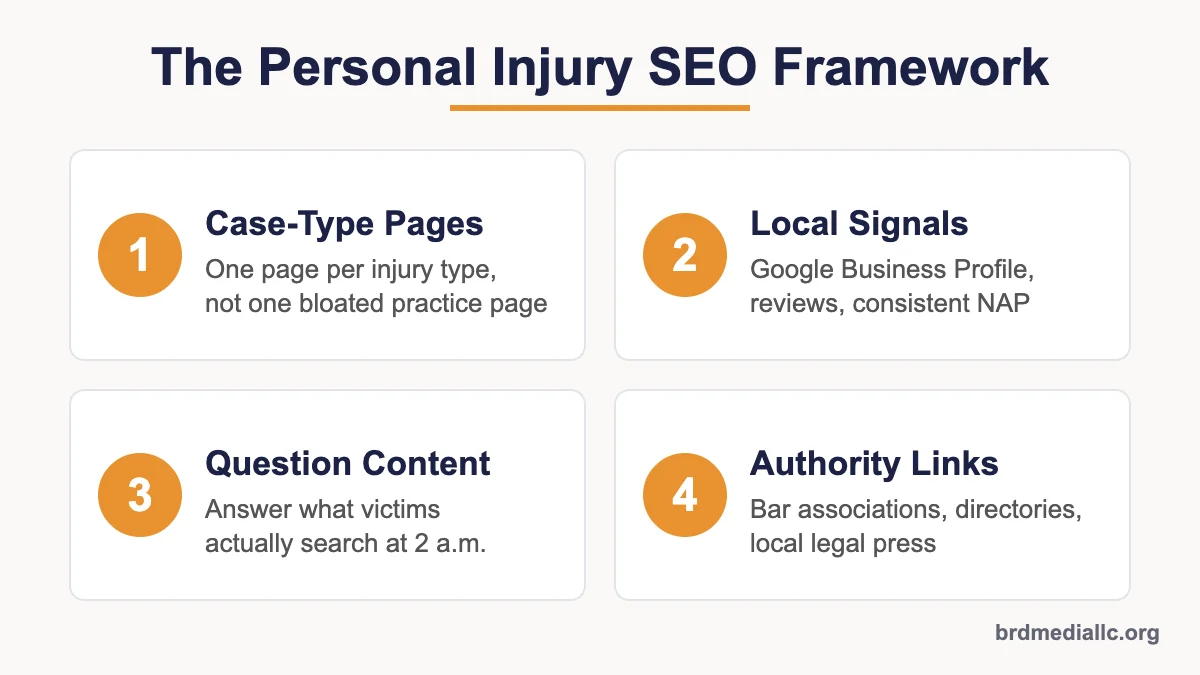
Four things move rankings for injury firms. Everything else is decoration.
Car accidents. Truck accidents. Motorcycle. Slip and fall. Dog bites. Wrongful death. Each one is its own search market with its own intent, and one bloated "Practice Areas" page ranks for none of them. Build a dedicated, substantial page per case type and Google has something to rank.
Injury searches are local and mobile. Your Google Business Profile, review velocity, and consistent name-address-phone data across the web decide whether you appear in the map pack, where a huge share of calls actually happen. Reviews that mention case types and outcomes pull double duty.
"How much is my case worth." "Should I talk to the insurance adjuster." "How long do I have to file." These long-tail searches have lower competition and higher trust than any head term, and the firm that answers them earns the consult. We broke down the local version of this in why personal injury law firms in Chicago need SEO.
Google treats legal content as high-stakes, so it leans hard on credibility. Links from bar associations, legal directories, and local press carry far more weight than generic link-building. A handful of real legal citations beats a hundred junk links.
Firms chase "personal injury lawyer [city]" and nothing else. Six months later there's no movement on the one keyword they watch, so they quit and call SEO a scam.
Run this diagnostic instead:
This isn't a religious war. Paid search wins the emergency moment, organic wins the research phase, and personal injury is the most research-heavy practice area there is. Prospects compare firms for days before calling.
| SEO | PPC | |
|---|---|---|
| Cost per lead | Drops every year as rankings build | $1,700–$5,800 for PI keywords |
| Time to results | 4–14 months | Days |
| Lead conversion | 14.6% | 3.75% |
| When you stop paying | Keeps ranking | Disappears |
| Best for | Research-heavy injury cases | Emergency, urgent-need searches |
The smart play: run tightly managed paid campaigns to cover the gap while organic builds, then shift budget as rankings land. That's exactly how we structure law firm PPC management alongside organic work. For urgent practice areas, the math flips — we covered that in our DUI lawyer marketing breakdown.
Ranking is half the job. Leads contacted within 60 seconds convert at dramatically higher rates than leads that sit until Monday, and most firms let them sit.
That intake system is the difference between traffic and retainers. When we ran paid social for a personal injury firm, the funnel behind the click drove 250+ qualified leads at 3.8x return on ad spend. The full numbers are in the Marlon Law case study, and the same intake machinery is what turns organic visitors into signed cases.
If you want the complete picture of how rankings, ads, and intake fit together for injury firms, that's our personal injury lawyer marketing system.
Every page you publish, every review you earn, and every legal citation you pick up keeps working without another invoice. Firms that live on ads disappear the day the card declines. Firms that invested in personal injury SEO keep signing cases from pages they built two years ago.
You take cases on contingency because you're confident in the outcome and patient enough to wait for it. Treat your search presence the same way. Our law firm SEO service is built on exactly that math, and it sits inside everything else we do for law firm marketing.
Your next big case is searching right now.
BRD Media builds the whole organic system for injury firms — case-type pages, local signals, content, and the intake that converts it — so you stop renting every lead from Google.
Book a Free Strategy Call →
Founder of BRD Media LLC, a Villa Park, IL digital marketing agency helping Chicago-area service businesses get organized, get found, and get more leads. Chris builds CRM and automation systems for local businesses across DuPage and Cook County.
See BRD Media first in Google
Add us as a preferred source and our SEO breakdowns rank higher in your own Search results, AI Mode and AI Overviews.