
Most practices and firms vet a marketing agency on price, portfolio, and promises. Almost none ask whether that agency carries cyber liability insurance. It's the one question that decides who pays when something breaks, and whether you run a clinic or a law office, something breaking is not hypothetical. Your agency handles the most sensitive data you own. Here is why that quietly sits on your balance sheet as a liability, and how to check it before you sign.
An anti-aging client of ours came to us after a disaster most owners never see coming. Their previous agency made one careless error, the kind that trips a platform's fraud detection, and their Google, Meta, and Instagram accounts were shut down for good. At the same time, a data breach exposed patient information.
The damage ran past $3 million in lost revenue. The practice filed a large claim on its own insurance. The agency that caused all of it dissolved its LLC and disappeared. No accountability. No settlement. Nothing to recover. And a law firm in the same spot would face the identical problem, only with client confidentiality on the line instead of patient records.
That client did almost everything right. It just never asked whether the company running its marketing could survive its own mistake.
You are not handing over a logo and a budget. Whether you run a clinic or a firm, your agency routinely touches:
Each one is a liability the second it is mishandled. In medicine and law, mishandled gets expensive fast.
This is not a rare edge case for either industry.
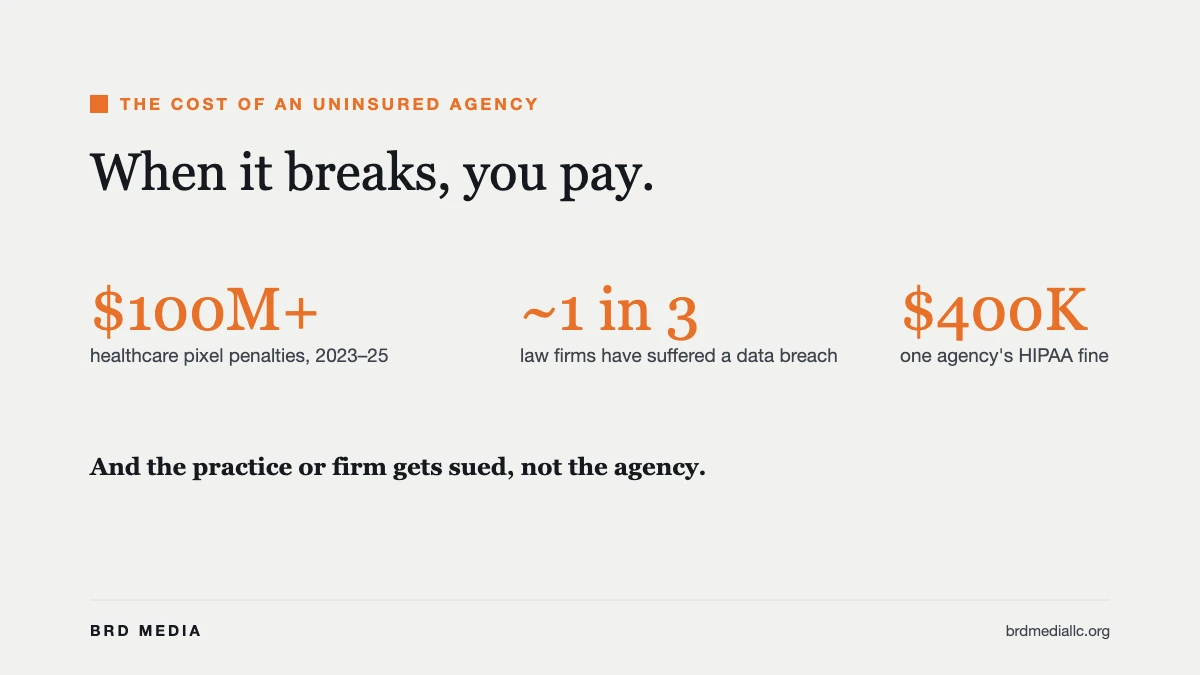
For medical practices: an agency that handles patient data is a "business associate" under HIPAA, legally responsible for protecting it. One agency was fined $400,000 for storing patient records without proper safeguards, and tracking-pixel violations have cost healthcare more than $100 million across 19 cases (2023–2025). Healthcare also has the most expensive breaches of any industry, averaging roughly $10 million each (IBM).
For law firms: nearly 1 in 3 firms (29%) have already suffered a security breach, and among those breached, most exposed client data (American Bar Association). Lawyers are bound by client confidentiality and, in many matters, privilege, so a breach isn't just costly. It can trigger malpractice exposure and bar complaints.
In both cases, here's the part that should change how you hire: the practice or firm usually gets sued, not the agency.
The frameworks differ. Medical practices answer to HIPAA. Law firms answer to bar confidentiality rules and state privacy laws, including call-recording consent laws that change from state to state. But the outcome is identical: your agency holds the data, and you carry the liability when it leaks.
Mistakes happen. The only question that matters is what happens next. When a healthy agency makes an error, insurance and a real business stand behind it. When a cheap, uninsured one makes the same error, it closes the LLC and walks, exactly like the company that torched our client. There is no fixing a seven-figure loss after the fact.
The only real backstops are two things: an agency that carries cyber liability insurance, and an agency that is a stable business that will still exist next year to answer for its work. One caveat worth knowing: insurers have started adding tracking-pixel exclusions to cyber policies, so how an agency handles your data matters as much as whether it holds a policy. You want both, real coverage and clean data practices.
We publish real numbers. Our engagements run in three tiers, with web and SEO folded into every one:
Part of what you pay for at that level is an agency that treats your data like a shared liability, carries insurance against it, and will still be here if anything ever goes wrong. Cheap marketing that torches your practice or firm is not cheap.
The right partner also protects what patients and clients see about you. See how we protect your reputation, and how it fits your broader medical practice marketing and law firm marketing.
We'll audit exactly where your setup is exposed, from data handling to account ownership, and show you what to fix first.
Book a free strategy callSee BRD Media first in Google
Add us as a preferred source and our SEO breakdowns rank higher in your own Search results, AI Mode and AI Overviews.