
Med spa advertising gets sold as a channel argument. Google or Meta. Search or social. That framing is wrong, and it is the reason so many clinics burn a quarter of budget before they learn anything. Both channels belong in one account, doing two different jobs, feeding one booking path. The hard part was never picking the channel. The hard part is the restrictions sitting on top of both platforms, and nobody explains those until an ad gets disapproved on a Friday afternoon.
So here is the version we would give a clinic owner over coffee, including the parts that are annoying.
The consensus is real and it is worth stating plainly. A med spa needs a claimed and filled-out Google Business Profile, treatment pages that match what people search, paid search for the high-intent terms where a booked treatment is worth the click, paid social for awareness and offers, and follow-up behind the consult. Nobody credible disagrees with any of that.
Where the agreement stops is the mechanics. Page one of a search for this topic will hand you nine channels and a paragraph each. It will not tell you how to split ad groups, what to do when Meta kills your best-performing creative, or how to tell a good lead from a warm body who lives forty minutes away. That is the part below.
Start from the truth that people do not search for "med spa." They search for the thing they want done. Botox near me. Lip filler. CoolSculpting. Morpheus8. Each of those is a different price, a different buyer, and a different consult length, so each one gets its own ad group with its own copy and its own landing page.
Four things carry most of the weight:
One more thing worth knowing before launch: Google restricts advertising around online prescribing and dispensing of prescription drugs, and it requires certification for telemedicine providers and online pharmacies through LegitScript. If your clinic only treats in person, this usually does not bite. If you prescribe online, read the healthcare and medicines policy before you build the account, not after. Our med spa PPC management work treats eligibility as a pre-launch checklist item rather than a surprise in week three, and the account build itself is covered on our Google Ads for med spas page.
Because of what the ad says about the reader, not what it sells.
Meta's standards prohibit ads that assert or imply personal attributes, including someone's physical or mental health, and its health rules bar statements of inferiority about a person's appearance. That single idea explains most med spa disapprovals. "Tired of your double chin?" attacks the reader's body. "Kybella dissolves submental fat in two to four sessions" describes the treatment. Same service, two different outcomes at review.
Before-and-after imagery is allowed, and the permission is narrower than people think. Meta's health and wellness standards list general cosmetic products, procedures and surgeries depicting before and after transformation as permitted, with the ad targeted to people 18 and over. What gets an ad pulled is the wording wrapped around the image: statements of inferiority about appearance, a close-up pinching fat on a body part, and clickbait promises of a specific outcome inside a set timeframe with no qualifier. Show the transformation, describe the treatment, set the audience to 18 plus, and drop the countdown-to-results language.
Targeting is the other trap. Do not build audiences on health interests or body-related behaviors. Build on geography, age, lookalikes from your own patient list, and retargeting of people who already visited the treatment page. That is where Facebook advertising for med spas stops being a coin flip. The source rules are on Meta's health and wellness standards page, and they are short enough to read in one sitting.
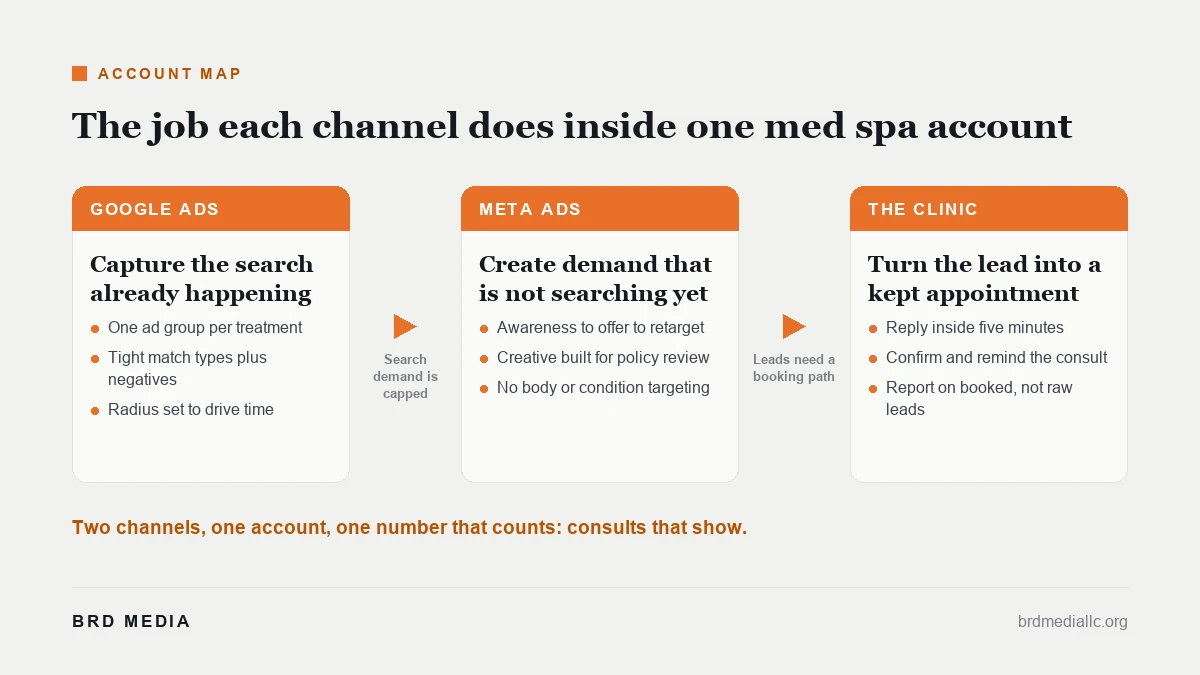
This is not a verdict on which platform is better. It is a division of labor. If you want the head-to-head comparison instead, that argument lives on our Facebook ads versus Google ads for med spas page.
| Channel | The job it does | Time to first lead | Main rejection risk |
|---|---|---|---|
| Google Search | Captures demand that already exists, at treatment level | Days | Prescribing and telehealth policy, if you prescribe online |
| Meta (Facebook and Instagram) | Creates demand and re-engages people who did not book | One to three weeks | Personal attributes, statements of inferiority, exaggerated outcome claims |
| Retargeting on both | Recovers the treatment-page visitor who left | Immediate, once traffic exists | Audience definitions built on health interests |
| The clinic's own follow-up | Turns a lead into a consult that shows | Same day | No policy risk, and the biggest single lever |
A $22 lead from thirty-five miles out who never shows is worse than a $60 lead from four miles away who books a series. Cost per lead rewards the wrong behavior, because the cheapest leads are almost always the furthest away and the least committed.
Three numbers tell you more than cost per lead ever will. Consult show rate, by channel. Median distance from the clinic, by channel. Revenue per booked consult in the first ninety days, by treatment. Once you have those, the budget question answers itself, and you stop moving money around based on which campaign looked cheapest last Tuesday.
Tracking has to exist before any of that is measurable. A form that emails the front desk is not tracking. You want the lead landing in a CRM with its source attached, and a booked or not-booked field a human fills in. That is a week of setup and it changes every decision afterwards.
The honest take: paid is the wrong first move for a fair number of clinics. If nobody answers the phone inside a few minutes, if the Google Business Profile is half-built, or if there is no page for the treatment you want to sell, ads will simply buy you a faster version of the current problem. Fix the booking path, then open the account. We have told clinics to wait, and it has never once cost us the relationship.
Premier IV came to us to run compliant advertising in a category where most accounts get throttled. That work produced more than $80,496 in cohort lifetime value from the campaigns we ran, on GLP-1 and IV offers built to survive policy review rather than fight it. A separate full-funnel build for a med spa client produced 144.9% active-user growth year over year.
Neither number came from clever bidding. Both came from creative that passed review, a treatment-level account structure, and follow-up that ran inside minutes rather than days. If you want the ideas-level version of this, the med spa marketing ideas post covers the plays that fill next month's book, and the question of what share of revenue to commit is handled in med spa marketing strategies.
On budget: our engagements run at three levels, starting at $2,500 a month on a six-month term and moving up as the market and the number of treatments you are pushing demand it. The current tiers and what sits in each are published on our pricing page. Ad spend sits on top of that and belongs to you.
Pick two treatments, not six. Build a real landing page for each. Open Google Search on those two with a tight radius and a negative list. Give Meta one awareness angle and one retargeting audience built from that traffic. Put every lead in a CRM with a source and a booked field. Then leave it alone for six weeks and read the show rates. That is the whole of med spa advertising done properly for a first quarter, and it beats a nine-channel plan every time.
We will map the treatments worth advertising in your market and show you where the current spend leaks.
Book a consultSources: Google Ads healthcare and medicines policy · Meta advertising standards, health and wellness · Meta advertising standards, personal attributes
See BRD Media first in Google
Add us as a preferred source and our SEO breakdowns rank higher in your own Search results, AI Mode and AI Overviews.