
A physician referral pipeline is the system that turns other doctors into a steady source of new patients. Most medical practices still run it the way they did in 1995: a fax machine, a stack of business cards, and the hope that a colleague remembers the name. In 2026 the pipeline is built online. The referring physician looks you up, decides in seconds whether to trust you, and either sends the patient or moves on. This guide covers how medical practices build a physician referral pipeline online, from the referral landing page to the secure intake form to the nurture that keeps existing referrers active.
The consensus in medical marketing is not complicated. A referred patient arrives already trusting you, because a doctor they trust vouched for you. That patient converts at a higher rate, shows up more reliably, and tends to stay longer. Referrals deliver a higher return and a steadier patient flow than cold acquisition, and nurturing a referrer who already sends you patients beats chasing a new one almost every time.
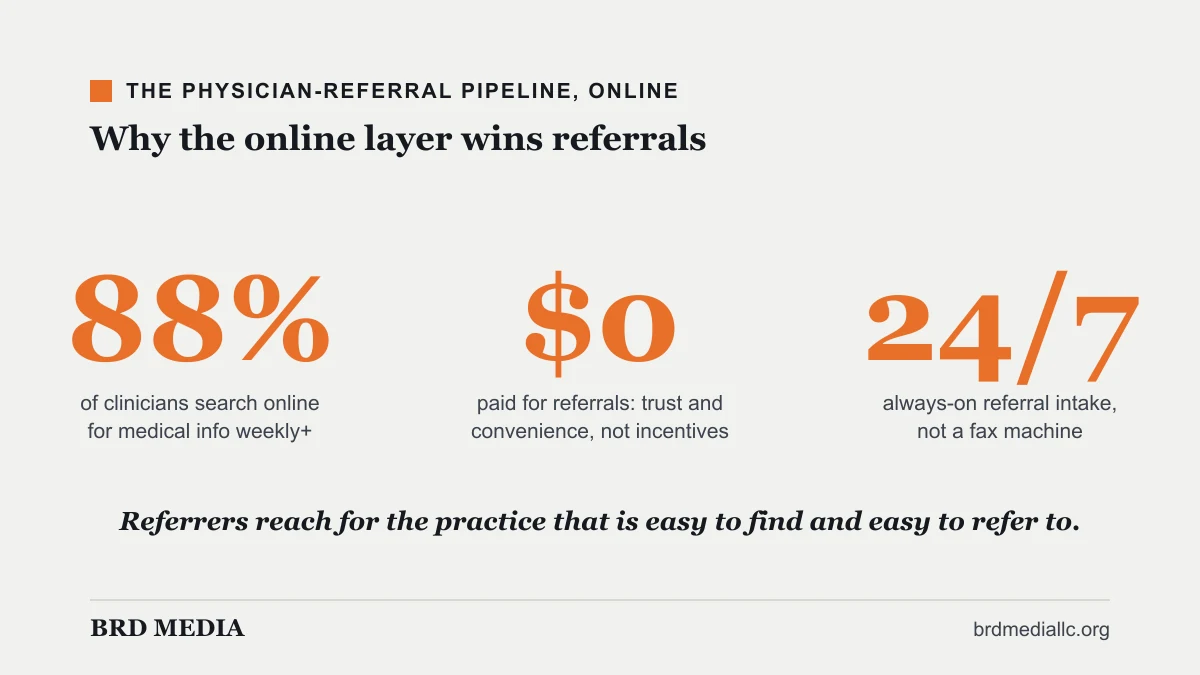
Here is where offline-only leaves money on the table. Before a physician refers a patient today, they check you online. Clinicians search the web for medical information every day, and a large share do it more than once a day (NIH survey of health care professionals). If your practice is hard to find, thin on credibility, or a pain to refer to, the referral quietly goes to whoever is easier. The trust-building and the friction-removal that used to happen at a lunch or a conference now happen online. That is the layer most practices skip, and it is exactly what strong medical practice marketing for Chicago physicians is built to fix.
Almost no practice has one. A referral landing page is a single page built for referring physicians, not for patients and not your homepage. It answers, fast, the only questions a referrer actually has: who do you treat, are you credible, and how do I send a patient without friction. Build it as part of your conversion-focused landing page design and make it match the quality of the rest of your medical practice website design, because a sloppy page reads as a sloppy practice.
| Section on the page | What the referring physician needs | Why it drives the referral |
|---|---|---|
| Scope of care | The exact conditions, procedures, and sub-specialties you handle | A referrer only sends patients they are sure you treat |
| Credentials and outcomes | Board certifications, hospital affiliations, and real results | Removes the reputation risk of referring to you |
| How to refer | A one-click secure form, plus fax and a direct line | Friction kills referrals; the easy path gets used |
| Turnaround and communication | Typical wait time and when the referrer hears back | Referrers are protecting their own patient relationship |
| Who to reach | A named intake contact and a direct number | A real person beats a phone tree every time |
The referral landing page gets the doctor to say yes. The submission and scheduling layer is what turns that yes into a booked patient. Three parts matter.
A secure, HIPAA-compliant referral form. Any online form that transmits patient information has to be HIPAA-secure: a signed business associate agreement with your form or CRM provider, and encryption in transit and at rest. A generic contact form is not acceptable for protected health information.
Scheduling access for the referring office. Let the referring staff request or book the appointment directly instead of playing phone tag. Every extra step is a chance for the referral to stall.
Loop-closing status-back. This is the part practices forget and the part that earns the next referral. The referring physician wants to know the patient was seen and what happened. An automated status-back to the referrer, wired into your CRM, is what keeps them sending. This is exactly the kind of workflow a CRM and marketing automation system is meant to run.
Why this is infrastructure, not incentives. Provider-to-provider referral relationships are regulated. Stark Law and the federal Anti-Kickback Statute prohibit paying, rewarding, or offering anything of value to induce referrals of care covered by federal programs (HHS Office of Inspector General; CMS physician self-referral). So none of this is about buying referrals. It is about being the practice that is easiest to trust and easiest to refer to. That is a compliance-safe advantage you build once and keep. Confirm your own arrangements with healthcare counsel.
A referring doctor rarely takes your word for it. They search your name, your practice, and your specialty, then decide. Physician-facing SEO and content make sure that when they look, you show up and you look credible. That means answer content on the conditions and procedures you treat, clear proof of expertise, and a fully built Google Business Profile so the basics are correct. The same content that gets you found by patients gets you vetted by referrers. If you want the fuller playbook, our guide on how a medical practice marketing agency builds patient volume walks through the visibility side in depth.
Reviews are not just a patient thing. A physician about to refer will glance at your reputation, because their patient's experience reflects back on them. A steady stream of recent, specific reviews tells a referrer you are safe to send people to. Building that stream on purpose, and responding the right way, is a discipline of its own; our reputation management service for medical practices handles the ask-and-respond system so reviews become an asset your referrers can see. (Reviews that mention patient details also carry their own HIPAA rules, which is worth a policy of its own.)
A referral pipeline is a set of relationships, and relationships go cold without contact. The practices that win are not the ones with the biggest referrer list. They are the ones whose existing referrers never forget them, because a light, consistent touch keeps them top of mind. Map every referrer to a stage and let your automation platform carry the routine touches so your team can spend its time on the human ones.
The math is what makes nurture urgent. Say one active referrer sends you two patients a month. That is twenty-four new patients a year from a single relationship. A practice with fifteen active referrers that quietly lets three go cold has not lost three names on a list; it has lost roughly seventy new patients a year to whichever competitor stayed in touch. Replacing them means winning three brand-new referrers from scratch, which takes far more effort than the light quarterly touch that would have kept the three you already had. That gap, kept versus replaced, is the financial case for the stages below.
| Referrer stage | Digital touch | Asset |
|---|---|---|
| New referrer | Same-day thank-you and report-back on the first patient | Automated status email from your platform |
| Active referrer | Quarterly outcome summary on patients they sent | Branded update or short newsletter |
| Slipping referrer | A re-engagement check-in before they go quiet | Personal note plus a new-service alert |
| Dormant referrer | A win-back sequence with an easy re-referral link | Case highlight and one-click referral form |
| Champion referrer | An invitation to collaborate | Co-authored content or a joint event |
We do not promise a referral number we cannot prove, and neither should anyone pitching you. What we can show is the mechanism working. For one client we took to the number one organic position in a competitive category, the same visibility-plus-conversion infrastructure lifted their on-site conversion rate by 30 percent. A physician referral pipeline runs on the exact same parts: get found, earn trust, remove friction. Build those online and the referrals follow.
Referrals are the highest-value channel most specialty practices have, and they are still only one of several. The five channels that carry a physician practice covers the rest of the mix, and where referrals sit in the patient acquisition order says when to build this one relative to the cheaper fixes.
Get a free audit and we will show you where your referral funnel leaks and what to build first.
Get a Free AuditSources: NIH / PMC, Preferences for Accessing Medical Information in the Digital Age (health care professional survey); HHS Office of Inspector General, Fraud and Abuse Laws (Stark and Anti-Kickback); CMS, Physician Self-Referral (Stark Law).
See BRD Media first in Google
Add us as a preferred source and our SEO breakdowns rank higher in your own Search results, AI Mode and AI Overviews.