
This post is general information for clinics and is not legal advice. Talk to your own counsel about your state's rules.
Much of what is written about chiropractors and attorneys tells the chiropractor how to court the attorney: send lunch, introduce yourself, ask for referrals. It is written from the clinic's side of the desk. This one is written from the other side. An attorney who sends a client to a provider is putting that client's case in the provider's hands, and what an injury attorney checks before referring is a short, practical list. If the clinic knows the list, it can meet it before the first call.
Availability is the first check, and it is the one clinics lose on most often. A person injured in a crash is in pain, stressed and often talking to an insurer already. An attorney who refers that client wants a first visit within days. A clinic with a long wait for new patients gives the attorney a reason to look elsewhere before reading a single record.
The fix is a structure, not heroics. Hold a few new-patient slots each week for referred cases and tell the referring office exactly when they open. Give the attorney's staff one person and one direct number or inbox for referrals, and promise a reply the same business day. Put the same details on a simple page for referring offices, so an attorney's assistant can find them without a call. Our guide to the referral intake process covers the page and the intake mechanics; this post does not rebuild them.
When a case moves forward, the attorney will ask for a narrative report from the treating clinician. The report summarizes the story of the care: the patient's history as given, the findings at the first visit, the diagnosis, the treatment plan, how the patient responded, and the clinician's opinion on what comes next. How a causation opinion is worded, and whether the clinician offers one at all, is a decision for the clinician and, where needed, counsel. Marketing has no part in it.
What the clinic can control is whether the report is easy to write well. That depends on the notes behind it. Notes that follow the same structure at every visit, that record the patient's own words and the objective findings, and that show progress or lack of it over time give the clinician what they need to write an accurate report in an hour. Notes that are thin, copied forward, or inconsistent make the report slow and invite questions. An attorney who has waited months for a report on a referred case will think twice about the next one.
Some of these cases end with the treating clinician answering questions under oath, and the clinic's records are part of that day. The rule most lawyers know is the business-records exception in Federal Rule of Evidence 803(6). It asks, in plain terms, whether the record was made at or near the time by someone with knowledge, whether it was kept in the course of a regularly conducted activity, and whether making it was a regular practice. State courts have their own versions, and this is an illustration, not a legal standard for your state.
The practical habits that follow are simple.
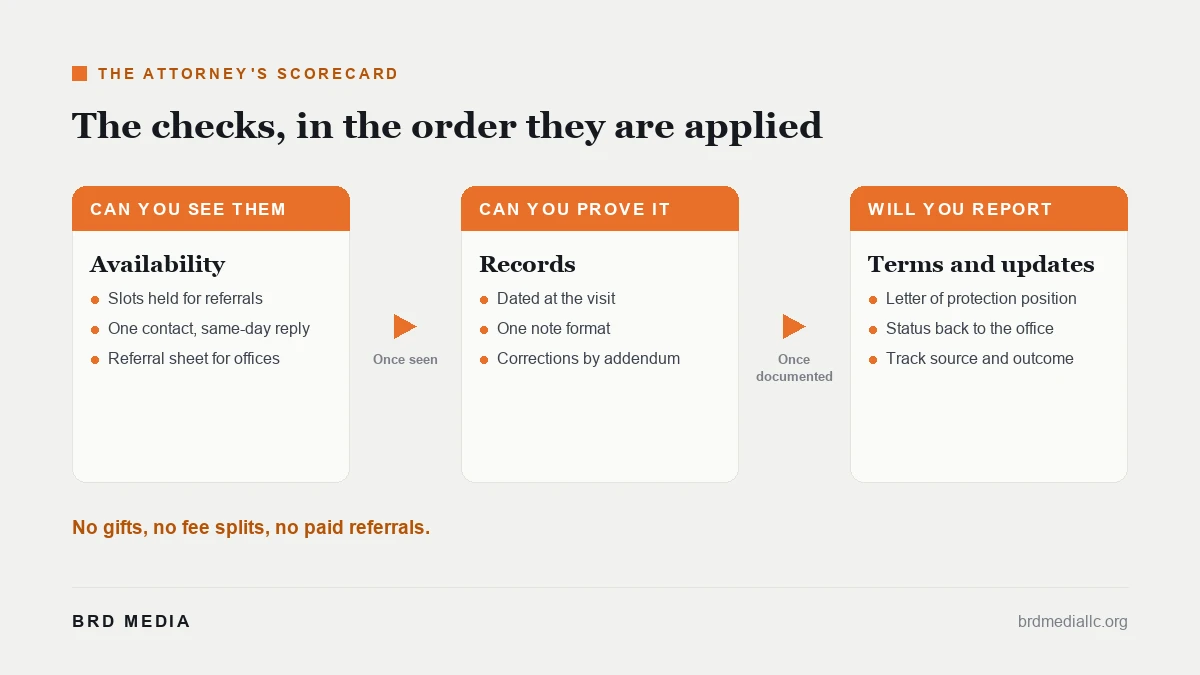
A letter of protection is generally an agreement in which the patient's attorney tells the provider that the provider's bill will be paid from any settlement or recovery in the case. The terms differ by state and by letter, and it is not health insurance: payment depends on the outcome of the case. A clinic that treats on this basis is extending credit for the length of the case, which may be many months.
The decision is the clinic's, and it belongs before the first visit, not after the bills pile up. Have your counsel and your accountant look at the template you will accept. Decide in advance how many open cases you can carry, what you require in the letter, who signs, and how you will follow up on balances. Attorneys notice a clinic that has a position and applies it the same way each time. It makes the clinic easy to work with and keeps the cash picture predictable.
Once a client is referred, the attorney is waiting to hear how it is going. A referral that goes without an update is another reason an attorney may look elsewhere. The loop that works is short and repeatable: confirm receipt of the referral the same day, send the date of the first appointment, tell the office when the patient attended or missed it, and send an update at agreed points in care. Everything that includes patient information goes out only under a signed authorization, through a channel your compliance process allows.
This is a place where a CRM does real work. A referred case is a record with a status, and the status triggers a message to the referring office. Nobody has to remember. The same record feeds the numbers in the next section.
Ask every new patient how they found the clinic and record the referring office by name in your own system. Then keep one table, updated monthly.
| Referring office | Referrals received | First visits kept | Cases closed | What it tells you |
|---|---|---|---|---|
| Office A | From the intake log | From the schedule | From the case record | Whether the referral path from this office works |
| Office B | From the intake log | From the schedule | From the case record | Whether response time is losing referrals |
| Walk-ins and online searches | From the intake log | From the schedule | From the case record | A comparison for the accident-case channel |
The ratio to watch is referrals received against first visits kept. If it is low for an office, the problem is usually speed or scheduling, not the quality of the relationship. Add a column for the days from referral to first visit and you will see it quickly.
One rule needs to be stated plainly. Avoid paying, gifting or splitting fees with anyone in exchange for referrals, avoid intermediaries who solicit patients for you, and confirm any arrangement with counsel first. For lawyers, Illinois Rule of Professional Conduct 7.2(b) provides that a lawyer shall not give anything of value to a person for recommending the lawyer's services, with a few narrow exceptions. That rule binds attorneys, and it is the reason a careful attorney will not take lunch-for-referrals arrangements seriously. Your own state's practice act and board rules for chiropractors say their own things about fee splitting and referral payments, so check yours with counsel.
In practice, the clinic that wins referrals does it by being easy to refer to: available, documented, responsive and fair. That is the entire pitch.
The honest take: this takes real operational change. A clinic that cannot hold slots for referred patients or write consistent notes will not fix that with marketing. What marketing can do is make the clinic easy to find and easy to refer to, then show which offices send patients who come back for treatment. The rest is the clinic's work.
Our personal injury case study came from the law firm's side. The firm had been buying clicks and getting few booked consultations. The firm moved its budget from Google Ads to Meta Ads with lead forms and retargeting, and reported 250-plus qualified leads in four months and 45 percent more booked consultations. It is a law firm and not a clinic, and it says nothing about chiropractic results. It does show the lens a firm like this brings to any partner: did the appointment happen, and what came of it. A clinic that tracks the same things speaks the language of the person it wants referrals from.
Count how many days it takes to get a new accident patient in. Write the one-page referral sheet for attorneys' offices: slots, contact, reply time. Pull your last ten referred cases and check each note for date, format and corrections. Then set up the table above. The chiropractor marketing page shows how we build the patient side, and our personal injury lawyer SEO work shows the attorney side we work on.
Engagements start at $2,500 a month on a six-month term; the three tiers are on our pricing page. Ad spend is separate and belongs to you.
Send us your intake process and your last quarter of referral sources. We will show you where referred patients are lost and what the referral page should say.
Book a consultSources: Illinois Rules of Professional Conduct, Rule 7.2 Advertising · Cornell Legal Information Institute, Federal Rule of Evidence 803
See BRD Media first in Google
Add us as a preferred source and our SEO breakdowns rank higher in your own Search results, AI Mode and AI Overviews.