
GH
★★★★★
BRD Media is hands down the best marketing team for med spas. They understand the industry and what converts.
Gina HargisMed Spa Marketing
Reach Chicago audiences where they actually listen. Spotify, Pandora, iHeartRadio, and podcast advertising with precise geo-targeting.
See where your ad spend is leaking.
We review what you are running now, what is working, and what to fix first.
Free 30-minute call. No obligation.
BRD Media is hands down the best marketing team for med spas. They understand the industry and what converts.
Chris and his team got us to #1 on Google for our service area. Excellent experience.
They review our data and KPIs every month to make sure we are spending the best way possible.
Click-throughs were amazing and the price was well worth it. Amazing ROI.
They understand our marketing and are a trusted partner in driving results.
The targeting is so much better than traditional methods.
Such a professional and responsive team. Made the process simple and stress-free.
BRD Media is hands down the best marketing team for med spas. They understand the industry and what converts.
Chris and his team got us to #1 on Google for our service area. Excellent experience.
They review our data and KPIs every month to make sure we are spending the best way possible.
Click-throughs were amazing and the price was well worth it. Amazing ROI.
They understand our marketing and are a trusted partner in driving results.
The targeting is so much better than traditional methods.
Such a professional and responsive team. Made the process simple and stress-free.
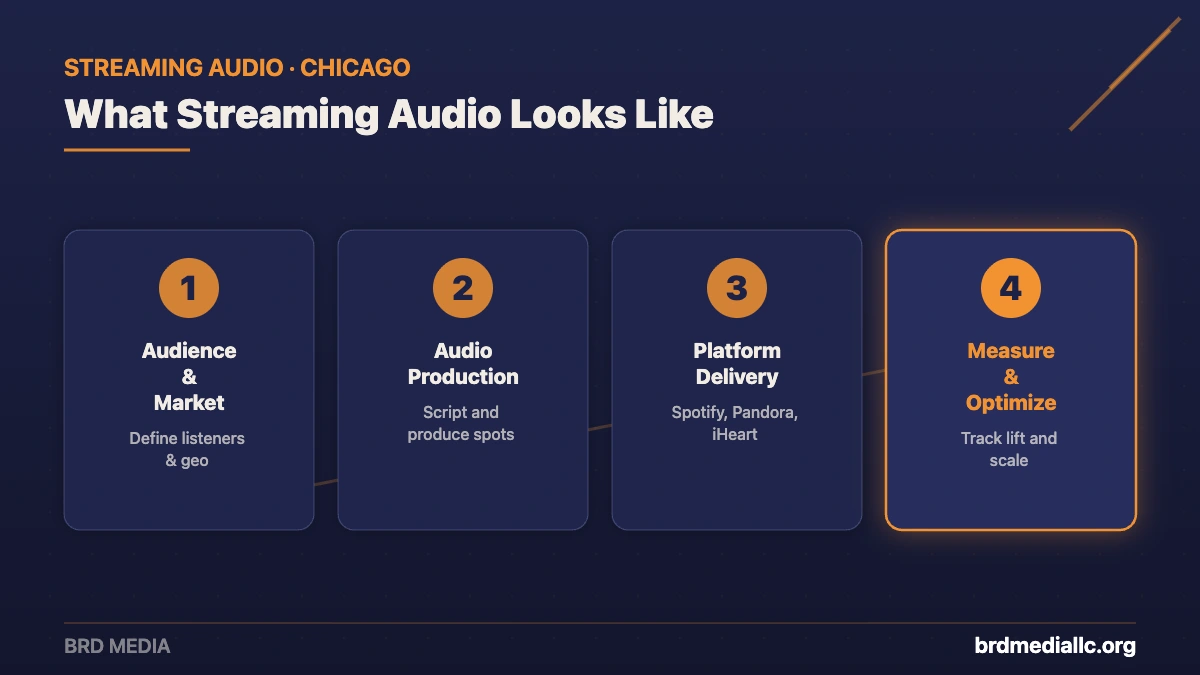
Streaming audio advertising runs your brand’s audio message across the platforms where people actually listen — Spotify, Pandora, iHeartRadio, Apple Music, Amazon Music, and thousands of podcasts.
BRD Media has been running streaming audio campaigns longer than most Chicago agencies have existed.
Audio works because it reaches people when other ad formats cannot. Commutes, workouts, cleaning the house — audio fills all those moments.
with a defined geographic service area
→ Our Chicago service areas(HVAC, roofing, plumbing) running seasonal awareness
→ Home services marketingbuilding brand recognition in specific neighborhoods
→ Medical practice marketingexpanding across Chicagoland suburbs
→ Our Chicago service areasdriving foot traffic
Your radio spots produce no attributable leads.
Traditional radio has no targeting. Streaming audio adds geo-targeting and conversion tracking. See how streaming audio compares to traditional radio in detail.
Your brand has no presence outside paid search.
Google Ads captures existing demand. Streaming audio builds demand before they search.
Your podcast sponsorship did not work.
Usually wrong placement or weak creative. We select shows based on audience fit.
You have a seasonal business.
Streaming audio can launch in days. Perfect for storm season, summer heat, winter cold.
Same reach. Better targeting. Lower cost. Measurable results.
Chicago has one of the most competitive radio markets in the country — WGN, WBBM, 93XRT, B96, KISS FM, 101.9 The Mix. Radio works. It always has. But traditional radio has a problem: you cannot control who hears your ad. A 30-second morning drive spot on a major Chicago station costs $1,000 to $5,000. You have no idea how many of those listeners are in your target demo, in your service area, or actually paying attention. Streaming audio fixes that.
| Factor | Traditional Radio | Streaming Audio (BRD) |
|---|---|---|
| Cost | $1,000–$5,000 per morning drive spot | Fraction of radio costs with zero waste. Custom packages. |
| Geographic Control | Entire station coverage area | Target by zip code, city, or custom radius |
| Measurement | Estimated reach. No click tracking. | Exact impressions, completion rate, conversion attribution |
| Completion | Unknown. Listeners change stations. | 91% average. Ads play one at a time. |
| Commitment | Multi-week contracts, station minimums | No long-term contracts. Month to month. |
| Retargeting | Not possible | Retarget listeners on Facebook, Instagram, Google |
| Production | $300–$1,000 extra. Quality varies. | Professional voiceover included. No extra cost. |
If you came here looking for radio advertising in Chicago, you came to the right place — we just do it better than radio does. BRD Media runs radio lead generation services through streaming audio platforms (Spotify, Pandora, iHeartRadio, podcasts) instead of broadcast radio, because every metric that matters for lead generation favors streaming: precise audience targeting, zip-code-level geographic control, full conversion attribution, retargeting across Facebook and Google, and no wasted spend on listeners outside your service area.
We work with local and service-based businesses across the metro — med spas and wellness clinics, law firms, roofing, plumbing, HVAC companies, mortgage brokers and real estate teams, restaurants and retailers. If your customers are in Chicago and you want them to hear your name, streaming audio is the modern way to do what radio used to do — but with the measurement infrastructure radio never had.
We review your GA4, ad accounts, CRM, and lead flow to identify what is driving results and what is draining budget.
We build a focused 90-day plan around the right channels, the right budget allocation, and clear conversion targets.
We develop the campaigns, landing pages, tracking, and automation needed to go live the right way from day one.
We make weekly adjustments based on actual performance data, not assumptions, opinions, or platform spin.
Once a system proves it can produce results, we increase spend with confidence and expand what is working.
BRD Media is a Chicago digital advertising agency built for local and regional service businesses that need more than disconnected freelancers and partial solutions. We manage the full growth stack under one roof — paid media, SEO, streaming audio, landing pages, CRM automation, and conversion tracking — so owners can stop guessing, start measuring, and build marketing that compounds over time.
See this in practice: our Keller Real Estate case study turned $1,000 in audio into $39,400 in revenue, and our Dr. Mo case study used audio as the demand-creation layer of a full funnel.
Streaming audio works well for automotive, home services, and law firms.
BRD Media’s audio work spans Chicago home services businesses running seasonal awareness campaigns, medical practices building brand recognition, and regional retailers driving foot traffic.
Traditional radio broadcasts to everyone. Streaming audio targets specific listeners by location and demographics.
Spotify, Pandora, iHeartRadio, Apple Music, Amazon Music, SoundCloud, and thousands of podcasts.
Yes. Script writing, voiceover, music licensing, and mixing are all handled in-house.
$2,000-3,000 per month for meaningful reach in a major metro.
Traditional radio runs $200–$5,000/week. A single morning drive spot costs $1,000–$5,000. Streaming audio through BRD Media gives you better targeting, measurable results, and zero wasted impressions for a fraction of that. Book a strategy call and we will build a custom plan based on your market and budget.
For targeting and measurement, yes. Radio reaches everyone on a station. Streaming lets you target by zip code, demographics, interests, and behavior. You only pay to reach people who match your customer profile.
Yes. Spotify, Pandora, and podcast networks allow targeting down to the zip code. Lincoln Park, Naperville, Schaumburg, Oak Park — any combination of neighborhoods and suburbs.
Streaming audio. Same format, same engagement, but with precision targeting, lower entry costs, and measurable results. Pair it with Facebook ads and Google Ads for a complete lead generation system.
No. We write the script, handle professional voiceover production, and deliver a finished ad. You approve it before anything goes live. No extra production costs.
Also serving: Home Services Marketing · Automotive Marketing · Roofing Marketing · Plumbing Marketing
In: Chicago, IL · Chicagoland
Tell us what you are running now. We will show you exactly what to fix and what it is worth.