
Law firms · Map pack
What Google compares between two offices, and what you can fix.
UpdatedA law firm with multiple offices on a Google Business Profile often finds that one office wins the map and the other barely shows. It starts when a firm opens a second office and expects a second source of calls. A few months later the original office keeps showing in the local results and the new one barely appears. The partners ask why, and the answer is not "Google likes the first office better." Google compares the listings on the same factors it uses for every business, but the two offices differ on some of them. This post explains what Google compares between two law offices and gives a seven-point check you can run office by office. It also covers the office page each profile should point to, and says plainly what you cannot change. It uses one composite example, labeled as illustrative.
Google's guidelines for representing your business say not to create more than one page for each location of your business. They also say that a service business with separate staff at each site can have one profile for each location. Your team should also staff the location, and it should be able to receive customers during its stated hours. A rented mailing address where you do not operate is not eligible. A co-working space qualifies only if it maintains clear signage, receives customers during business hours and is staffed by your team during those hours.
The same page treats lawyers as individual practitioners. A practitioner in a public-facing role whom people can contact directly at the verified location during stated hours can have a profile. A practitioner should not create several profiles for different specialties, and support staff should not create their own. When several lawyers share a location, the guidelines say the organization should have its own profile for that location, separate from the practitioners' profiles.
The takeaway: one profile per real, staffed office is the baseline. Everything below assumes both offices clear that bar.
Google's help page on improving your local ranking names three factors. Relevance is how well a profile matches what someone searched. Distance is how far the business is from the searcher. If the searcher does not share a location, Google uses what it knows about it. Prominence is how well known the business is, and the page says more reviews and positive ratings can help.
Google judges each office on those factors on its own. Here is an illustrative composite. A firm has an established office near the center of a city and a newer office in a suburb. The central office has years of reviews, a few well-chosen secondary categories and a page of its own on the website. The suburban profile has a handful of reviews, fewer secondary categories and a link to the home page. Searchers near the city center see the central office. Searchers in the suburb, however, may see the suburban office or a neighbor firm, and the suburban office rarely appears for city-wide searches. So nothing is broken. The two profiles are simply different on several inputs, and some of those inputs are fixable.
Run the same list on each profile and write the answers side by side. The differences between the columns point to the work.
| Factor | What to look at | Who can fix it |
|---|---|---|
| 1. Proximity | Where the office sits relative to the searcher and to the area's center | No one. Plan around it. |
| 2. Categories | Primary category should match across offices doing the same work; secondary categories reflect real services | The firm, in the profile |
| 3. Reviews | Count, rating and recency per office, not combined | The firm, through a steady request routine |
| 4. Office page | The page the profile links to, and whether it is unique to that office | The firm and its web team |
| 5. Name, address, phone match | The same details on the site, the profile and directories | The firm and its web team |
| 6. Local phone | A number that reaches that office, consistent everywhere it appears | The firm |
| 7. Compliance | Profile name, address type and any signs of a duplicate or virtual office | The firm, before Google flags it |
Two of these deserve a closer look. For reviews, Google's page says more reviews and positive ratings can help local ranking, and reviews belong to a specific profile. So a firm that asks clients at the central office and not at the new one will see the difference widen over time. For categories, Google's guidelines say all locations must have the same category if they provide the same service. So the primary category should match across offices doing the same work, and the name should match too. Differences belong in the secondary categories, and only where an office really offers a different service. A lone lawyer at a branded office is a special case. The guidelines say a practitioner who is the only public-facing one at a location should share one profile with the firm. They name the format as firm name, colon, lawyer name.
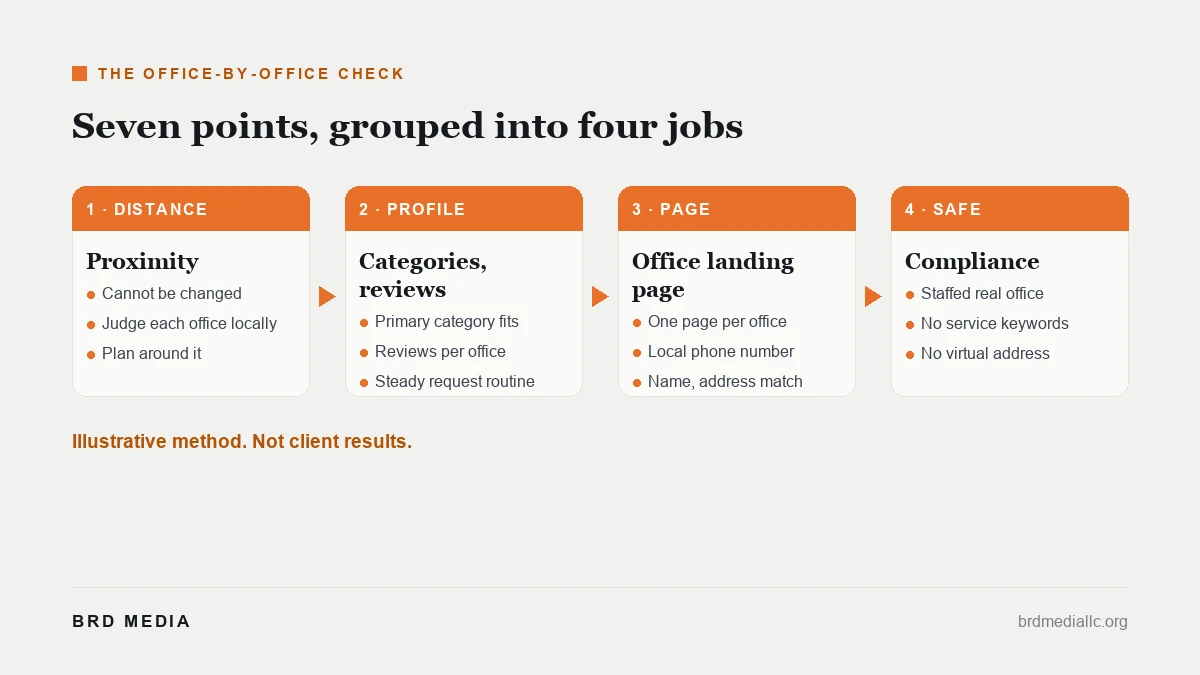
A profile's website link is a signal about what that office offers. If the suburban profile links to the home page, Google sees a generic firm page. A client also sees a page that does not mention the office they are about to drive to. A dedicated page for each office works better: the address, hours, the lawyers who work there, parking and transit, the practice areas handled at that office, and a phone number that reaches it.
Make the office page different from the others in more than the address. Describe what that office does, who works there and what a first visit looks like. That way the page does not read like a copy with the town swapped. Our guide on content marketing for law firms explains why practice-area pages come before blog posts, and the same logic applies to office pages. A matching practice-area page for each key service helps the right office page earn its place. For a firm in injury work, our personal injury SEO playbook covers local signals Google can verify, which is the job an office page does.
Distance. If the suburban office is nine miles from the city center and a competing firm sits two blocks from it, a searcher at the center is closer to the competitor. No profile edit, review count or page rewrite moves a building. Read this as a rule for planning, not a verdict. A firm can still win searches from people near that office, and from searches that name the town. Meanwhile it builds review depth and a strong office page to compete further out.
That also sets the right goal for each office. Judge the suburban office on the area around it. Do not expect it to beat the central office for searches made at the central office. A firm that reads the map this way avoids the expensive mistake of opening more profiles to cover areas it does not serve.
Google's help page on fixing suspended or disabled profiles says it may suspend or disable profiles that do not follow its guidelines. The guidelines say a virtual office is not eligible and that unnecessary information in a name could result in the suspension of your Business Profile. They also say you should not create more than one page for a location. Never use an address where the firm does not operate. A suspension ends the comparison, and the same page says you can submit an appeal only once.
Name practice-area words with care. The guidelines say the name should reflect the real-world name as used on the storefront, and they do not permit unnecessary information. A firm name on the door is the name to use. Rules on how lawyers describe their services vary by state, so ask your state bar or counsel to review the wording of any profile text that describes the firm.
The honest take: A newer office losing to an older one is normal. It rarely means someone set up a profile wrong. It usually means the older office has more reviews, a better page behind it and a location that suits the search. Fix what you can, accept what you cannot, and measure each office against its own neighborhood rather than against the other office.
Local results sit alongside intake, reviews and practice-area pages. Our law firm marketing strategies guide covers how local search fits with the rest of the system. If you run more than one office and want each profile and page built to be compared fairly, law firm SEO includes Google Business Profile work, and its Scale step extends to additional offices ranking in their own markets. The law firm marketing overview shows where it fits. Engagements start at $2,500 a month on a six-month term; the three tiers are on our pricing page. Ad spend is separate and belongs to you.
Send us the offices and the practice areas each one handles. We will run the seven-point check and tell you what to fix first.
Book a consultSources: Guidelines for representing your business on Google · Tips to improve your local ranking · Fix suspended or disabled profiles
Cite this page. Credit BRD Media with a dofollow link to this page: https://brdmediallc.org/law-firm-multiple-offices-one-wins-the-map/
See BRD Media first in Google
Add us as a preferred source and our SEO breakdowns rank higher in your own Search results, AI Mode and AI Overviews.