
Content marketing for law firms has a terrible reputation, and most of it is deserved. Firms pay for a blog, publish legal news nobody searches, watch traffic stay flat, and conclude content does not work. The problem is not content. The problem is publishing what the firm wants to say instead of what a potential client actually types into Google at 11 PM after a car accident. Done in the right order, content is the cheapest case-acquisition channel a firm can own.
Legal clients research more than almost any other buyer. Before anyone calls a firm, they have searched their situation, read about their options, and formed an opinion about who sounds credible. Clio's Legal Trends research has documented this for years: clients shortlist firms based on what they find, and firms that respond fast and look authoritative win the call. Content is how you show up during that research window, and increasingly it is how you get cited when that research happens inside ChatGPT or Google's AI Overviews instead of a traditional results page.
The order matters more than the volume. A commercial page for each practice area, built around the terms people search when they are ready to hire, is the foundation. These are the pages that carry proof, answer objections, and hold the contact form. The blog exists to feed them: it earns rankings on question searches, then passes trust and internal links to the page that converts. Firms that start with a blog and never build the practice-area layer are pouring water into a bucket with no bottom. This is the core of how we structure law firm marketing services for every firm we work with.
The best content plan is sitting in your intake notes. The questions clients ask on the first call are the questions thousands of people type into Google every month: what happens if, do I need a lawyer for, how do I choose, what should I bring. Build one honest guide per question cluster, written the way an attorney would explain it across a desk. Skip the legal-news posts and statute summaries. Nobody searching for help cares about the amendment; they care about their situation. This question-first approach is also the engine behind law firm SEO: the guides earn the rankings, the practice-area pages sign the cases.
| Content type | What it is for | Searcher intent | What it feeds |
|---|---|---|---|
| Practice-area page | Convert ready-to-hire searchers | "personal injury lawyer Chicago" | Signed cases directly |
| Question guide | Capture research-phase demand | "what happens if the other driver has no insurance" | Practice-area pages |
| Case result page | Proof that you win | Shortlist validation | Trust on every page |
| Blog post | Opinion, updates, E-E-A-T | Brand and topical authority | The cluster as a whole |
A growing share of legal research now starts in AI tools, and AI engines do not read pages the way people do. They cite sources that answer the question directly in the first sentences, use real structure, and back claims with specifics. That means answer-first paragraphs, FAQ schema on every guide, and HTML tables instead of infographic images for anything comparative. Google's own helpful content guidance says the same thing in different words: write for the person with the problem, demonstrate first-hand expertise, and the systems will follow.
Publishing is the midpoint, not the finish line. Every new piece needs an internal link pass: links in from established pages, links out to the practice-area page it feeds, and a link back from older related content. Then it gets an index request, a Google Business Profile post, and a slot in the client email. Content wired into a cluster compounds. Content dropped onto a blog feed and abandoned is why most firm blogs are graveyards. If your firm does not have the bandwidth to run that system, that is exactly what a content marketing agency in Chicago is for.
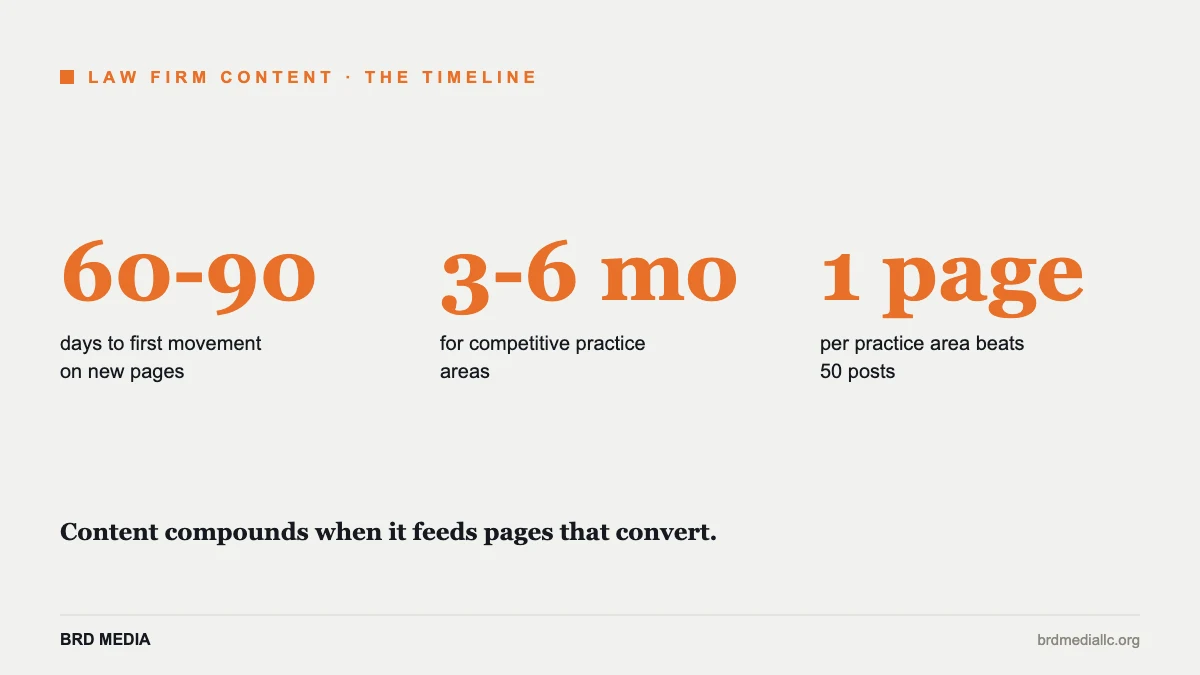
The honest take: ten pages that answer real questions will outperform a hundred posts of legal news, every time. If an agency pitches you a content calendar without showing you which searches each piece targets and which practice-area page it feeds, they are selling you decoration.
When we rebuilt the web presence for Chris J. Aiello, P.C., a DuPage County litigation and probate practice, the content plan was the architecture: eight practice-area pages, each mapped to its own keyword cluster, FAQ schema on every page, and geo-targeted content covering personal injury, family law, criminal defense, real estate, and estate planning. No filler posts. The internal linking compounds rankings across the whole site, and each page competes for its own commercial terms.
Real programs run on cadence, not one-off posts. Expect $1,500 to $4,000 per month depending on volume and how competitive your practice areas are: two pieces a month with full distribution is a different program than eight. Per-word pricing is the red flag. Content is priced by what it ranks for and converts, not its word count.
Get a free content audit. We will show you what clients in your practice areas actually search, what you are missing, and what it is worth.
Get the free auditSources: Clio Legal Trends Report · Google Search Central: helpful content guidance · Google Business Profile Help
See BRD Media first in Google
Add us as a preferred source and our SEO breakdowns rank higher in your own Search results, AI Mode and AI Overviews.