
A marketing vendor pitches a firm a set of small sites: one for car accidents, one for each suburb, one for a campaign. The pitch sounds sensible, because more sites should mean more chances to appear in search. The honest answer to law firm microsites seo questions is that it depends, and the reasons are specific. This post compares three site structures, lists when a microsite is justified and when it splits your effort, covers the advertising rules, and ends with a checklist you can run before you agree to anything.
A firm that wants a separate home for a practice area or a campaign has three choices. Each one trades authority against separation.
| Structure | Standing it starts with | Upkeep | Main risk |
|---|---|---|---|
| A folder on the main site | Shares the main site's domain, so links and history stay in one place | One site, one set of tools | Less room for a distinct look and brand |
| A subdomain of the main site | Easy to separate, but we cannot promise it shares the main site's standing, and we do not rely on it | A second site on the same domain | Effort and links divide between two properties |
| A separate domain | Nothing of its own: no links, reviews or track record | A second site, hosting, listings and annual fees | Starts from zero, and can look like a funnel to the main site |
Google's guidance on structuring multi-regional sites lists the same structures with plain tradeoffs. Subdirectories are easy to set up and low maintenance. Subdomains are easy to set up and easy to separate. A separate country-specific domain is clearly geotargeted, but it is expensive and needs more infrastructure. That page is about international sites, and it does not rank the options by ranking power. It is in Google Search Central, and it is a useful reminder that the case for each structure rests on setup and upkeep, not on a trick.
A second site is justified when it does a job the main site cannot do without harm to it. Three situations qualify.
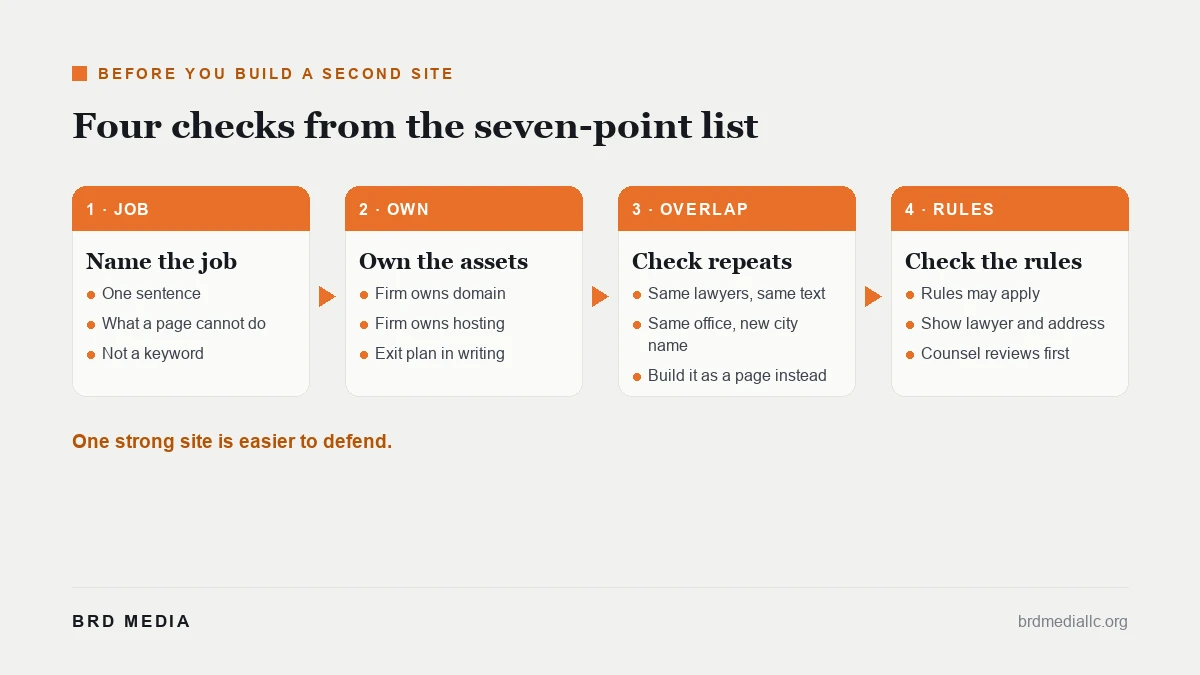
Notice what is missing: a keyword. Wanting a site named for a search phrase is not a reason by itself. If the main site already ranks for the phrase, a second site competes with it. If it does not, the page that needs work is on the main site.
Splits happen when the second site repeats the first. Typical cases are one small site per practice area with the same attorneys and the same address, or one per suburb with the same text and a changed city name. The costs add up in ways the pitch never mentions.
There is also a policy risk. Google's spam policies define doorway abuse as sites or pages created to rank for specific, similar search queries that lead users to intermediate pages less useful than the destination. The listed examples include multiple domain names or pages aimed at specific regions or cities that funnel users to one page. A set of city sites that all point to the main site's contact page matches that description. We do not say every microsite is a doorway, only that the pattern is one to avoid. A firm that wants local reach is better served by a strong page for each office on the main site, along the lines of our guide to law firm SEO services.
Links and reviews are the slow part of a law firm's search presence, which is why splitting them hurts. A link from a bar association page or a local news story points to one address. If the story names your main site, the microsite gets nothing from it, and the other way around. Reviews work the same way: a client who leaves a review for the firm leaves it on one profile, not on every site you run.
Practice-area depth is the better use of that scarce attention. A firm that handles injury cases can give the topic a full section on the main site, as our personal injury SEO guide describes, with pages for each case type and each common question. Every link, review and bit of history the firm earns then supports the same address. If you are still deciding whether the firm needs a stronger site at all, do law firms need SEO is the place to start.
A fair question follows: what about a microsite built to capture a very specific search, such as a rare case type? Test the idea on the main site first. A single page for that case type, linked from the practice-area page, takes an afternoon and costs nothing in domain upkeep. If it ranks and brings calls, you have your answer. If it does not, a microsite is unlikely to do better, because the same content, the same lawyers and the same competition would face the same search results with less standing behind them.
A lawyer's website is a communication about the lawyer's services, and the same rules can apply to every site a firm runs. In Illinois, Rule 7.1 bars a false or misleading communication about the lawyer or the lawyer's services, which includes leaving out a fact that makes a statement misleading. Rule 7.2 requires an advertisement to include the name and office address of at least one lawyer or law firm responsible for its content.
Apply that to a microsite. A site that presents itself as an independent resource without saying the firm runs it can mislead. A site with no responsible lawyer or office address may leave out something the rule asks for. Other states differ and may regulate firm names and trade names in their own ways, so the checks below are a starting point. Your counsel decides what applies to your firm.
If a proposal passes all seven, it has earned a hearing. If it fails the first or fourth, the same budget usually does more on the main site. Our post on law firm marketing strategies shows where that budget tends to go first.
The honest take: no one outside Google can say how much a second site would help or hurt a given firm, and any vendor who gives a number is guessing. What can be said is that a new site must earn everything again, that duplicate sites divide effort, and that one strong site is easier to defend. If a microsite earns its place, treat it as a separate project with its own plan, not a shortcut.
Most firms get more from concentrating than from multiplying. We build practice-area and office pages on the main site and give them the links, reviews and content that a second site would have to rebuild, as part of our law firm SEO work. Engagements start at $2,500 a month on a six-month term; the three tiers are on our pricing page. Ad spend is separate and belongs to you.
Send us the pitch. We will run it against the checklist and tell you whether the main site can do the job.
Book a consultSources: Google Search Central, Managing multi-regional and multilingual sites · Google Search Central, Spam policies (doorway abuse) · Illinois Rule 7.1 · Illinois Rule 7.2
See BRD Media first in Google
Add us as a preferred source and our SEO breakdowns rank higher in your own Search results, AI Mode and AI Overviews.