
This post is general marketing information for clinics. It is not legal or medical advice, and the clinic's own clinicians and counsel decide what applies to each patient and each case.
Most chiropractic marketing treats every new patient as one person: someone with a stiff back who would like to feel better and has time to compare options. Car accident patient search behavior is different enough that it needs its own plan. This patient did not plan the visit. Something happened on the road, and now they are sore, worried, and dealing with insurers and paperwork at the same time. The way they search, what they need to see, and how fast they decide all follow from that.
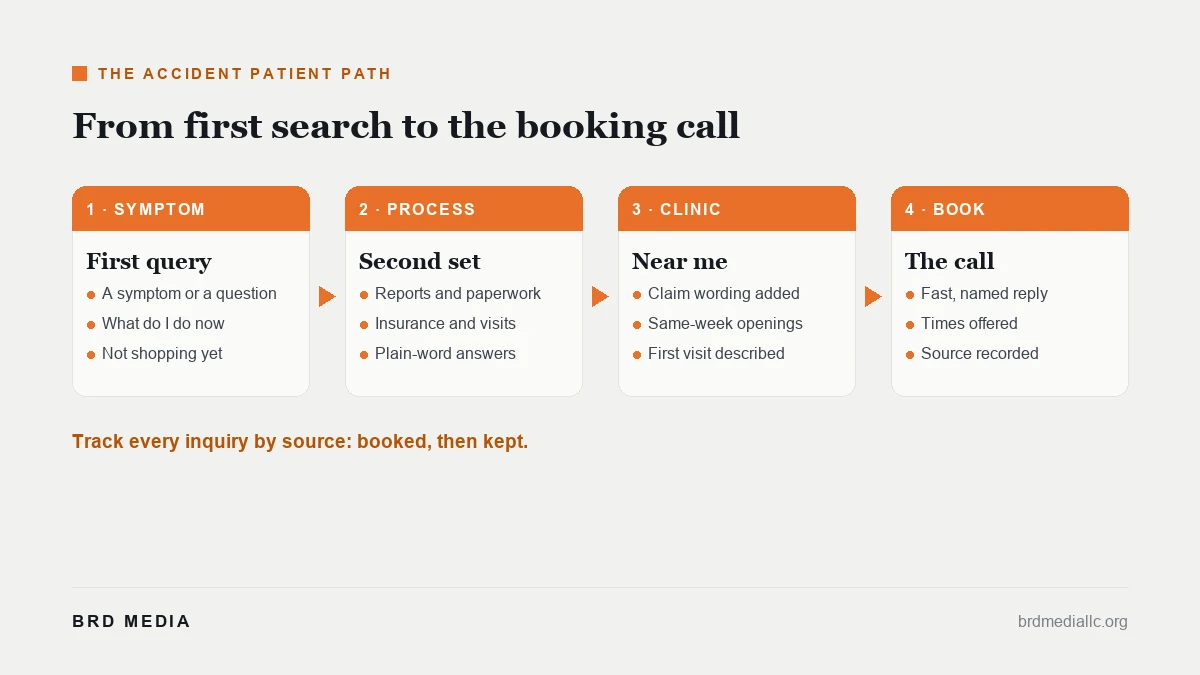
Pages written by clinics tend to describe what the clinic offers. They rarely describe the order in which a hurt person actually types. Below is the sequence we plan around. It is a working model built from how these queries are shaped, not a measured benchmark, and your own search console and call data should confirm or correct it.
The practical point is that a clinic whose only accident-related page is a service description shows up at the end of this path and misses the start. A short, plain page for the first two stages gives a clinic a way to be found while the person is still deciding what to do.
A person in this situation is not browsing. They want to know three things and will leave if they cannot find them in a few seconds.
Availability. Say when new accident patients can be seen, in days, not in adjectives. If the clinic holds slots each week for new injuries, say so. A long wait gives someone in pain a reason to call the next listing.
Claim handling, in plain words. Explain what the front desk will do and what the patient will do, such as which documents to bring and who handles billing questions. Do not promise outcomes of a claim and do not give legal advice. A clinic can describe its own process without describing anyone's case. For the legal side, point to an official source. The Illinois State Police crash report page explains how crash reports are obtained, and the clinic can link to it for patients who ask.
The first visit. Describe it step by step: what the patient is asked, what the exam involves, how long it takes, and what happens afterward. Leave out claims about injuries or recovery. The page should say once, in plain terms, that the clinician decides what care fits each person.
This also fits how your site handles patient information. If the page includes a form, keep it short, and review our HIPAA-compliant marketing primer before adding any tracking to a page where people describe an injury.
A wellness campaign talks about feeling better, staying active and long-term care. Those messages assume time and choice. The accident patient has neither, and a headline about a "relaxing spine tune-up" reads as if it belongs to someone else. Three differences matter.
The same holds for the landing page behind the ad. Sending an accident search to a general homepage forces the patient to hunt for the answers above. Some will not.
Many accident patients arrive through attorney or physician referral, which the guides below cover. This post is about the patients who search for themselves, and for them the answer is a separate path. In practice that means one page for accident patients with its own headline, the three answers from the section above, a short form, and a phone number that is easy to reach. Use a tracking number or a source field on the form so the clinic can tell where each inquiry came from.
If you also take referrals from other offices, keep that on its own page as well. Our guides on the physician-referral pipeline and on what an injury attorney checks before referring cover the referral side, so this post does not repeat them. Never pay for a referral or offer something of value in exchange for one, and check any arrangement with counsel first.
The page earns the inquiry, and the first reply decides whether it becomes a visit. A person who filled out a form after a crash may contact more than one clinic, so speed and clarity both count. The reply should confirm that the message arrived, offer two or three appointment times, say what to bring, and name one person at the front desk. Keep it short enough to read on a phone while standing in a parking lot.
Decide who owns the reply and when. An automatic text and email can confirm receipt right away, and a person can call during business hours the same day. Write the standard down and measure it in the table below. A promise the clinic meets every time is worth more than a faster one it misses.
Also look at what the confirmation says about the visit itself. A message that explains the first visit in three plain sentences removes some of the reasons to cancel. It should state the length of the appointment, the paperwork to bring, and a number to call if plans change.
Accident patients come from several places, and they behave differently by source. Keep one table and update it every month.
| Source | Inquiries | Booked | Kept | What it tells you |
|---|---|---|---|---|
| Accident landing page (organic search) | From the form and call log | From the schedule | From the schedule | Whether the symptom and process content is being found |
| Paid search to the accident page | From the form and call log | From the schedule | From the schedule | Whether the ad and the page match the urgency |
| Google Business Profile | Calls and direction requests | From the schedule | From the schedule | Whether the profile describes accident care in plain words |
| Referring offices | From the intake log | From the schedule | From the schedule | Whether the referral path works |
The column to watch is booked against kept. If many people book and few arrive, the problem is usually the speed of the first reply or a confirmation that does not say what to expect. Fix those before spending more on traffic.
The honest take: a page cannot fix a clinic that cannot see new patients quickly. If the schedule is full for two weeks, the clinic needs to change the schedule first. What marketing can do is make sure that when a hurt person searches, the clinic is findable, the answers are plain, and each inquiry is tracked back to its source.
The accident path is one part of a chiropractic practice's online presence. Our chiropractor marketing page shows how we build the whole patient side, and our personal injury SEO guide shows how PI firms approach the accident-victim side of search. Engagements start at $2,500 a month on a six-month term; the three tiers are on our pricing page. Ad spend is separate and belongs to you.
Send us your current accident page and your last quarter of inquiry sources. We will show you where the path breaks and what the new page should say.
Book a consultSources: Illinois State Police, Crash Reports
See BRD Media first in Google
Add us as a preferred source and our SEO breakdowns rank higher in your own Search results, AI Mode and AI Overviews.