
 Chris DeWilde
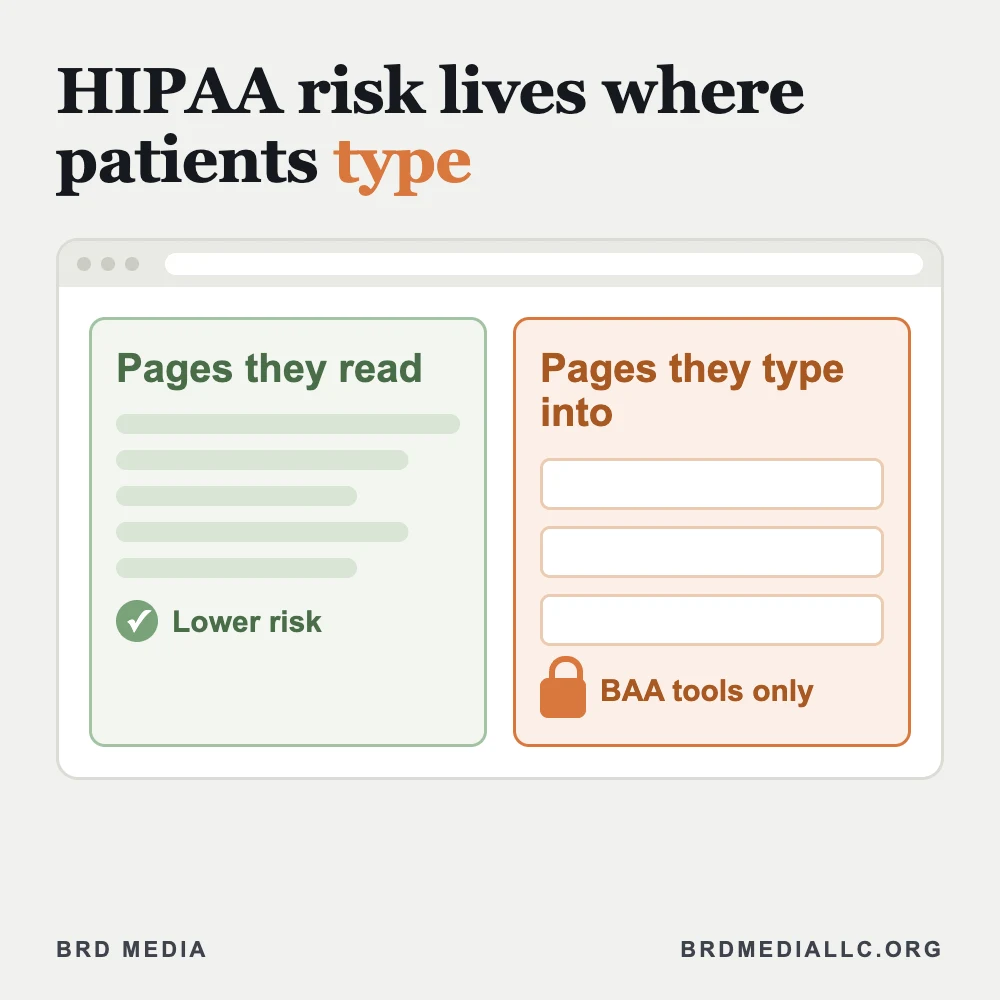
A HIPAA compliant website protects the health information patients type into it, and it keeps tracking tools from passing that information to companies that have not signed a business associate agreement (BAA).
Most guides on this are written by companies that sell hosting or compliance software, so the answer usually comes back to "buy HIPAA hosting." Hosting matters for some sites. But the problem that has cost health systems and health companies real money over the last few years is the tracking code on their own pages.
We build websites and run the SEO and ads for dental, medical and med spa practices, so we sit on both sides of this. The marketing side wants every lead tracked. The practice cannot afford a privacy problem. Here is how a practice site handles both.
HIPAA applies to covered entities and their business associates. Covered entities are health plans, health care clearinghouses, and providers that send health information electronically in standard transactions, like insurance claims. That describes most dental and medical practices that bill insurance. A business associate is a vendor that handles protected health information for one of them: your form tool, your booking software, your email host.
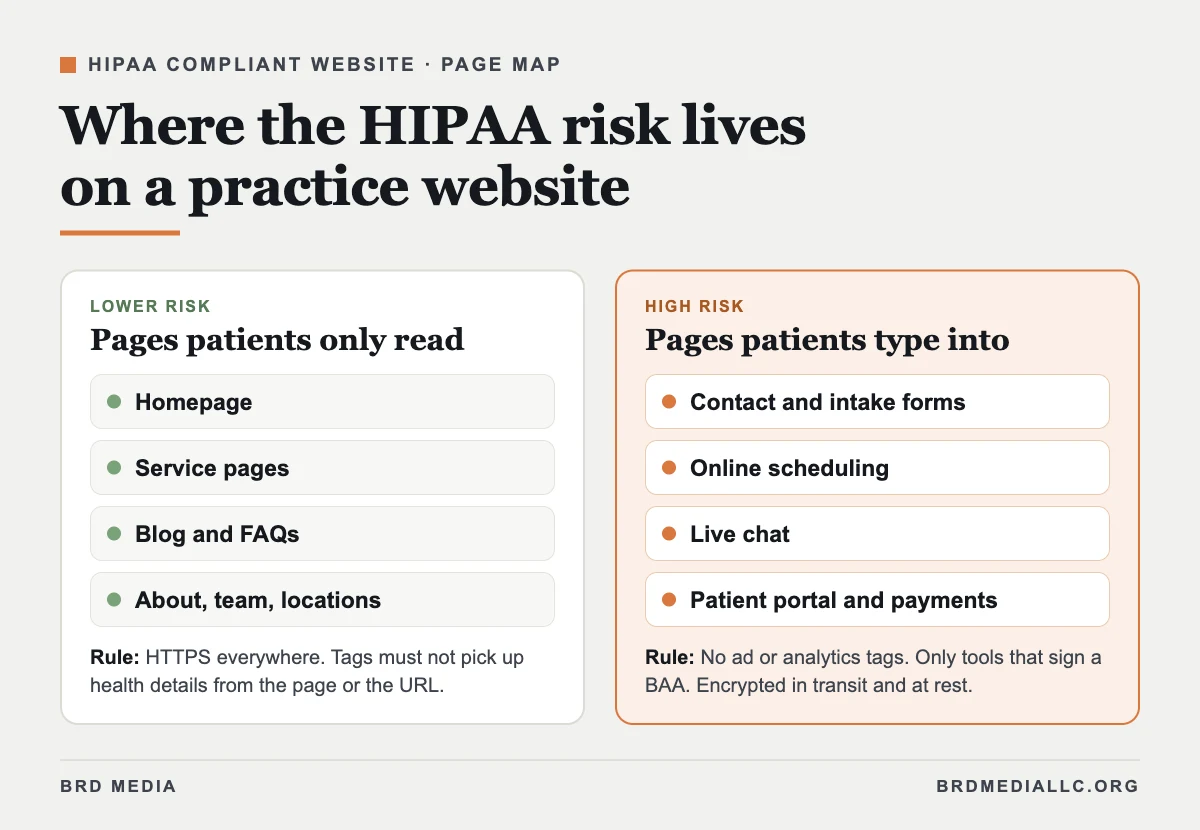
If your practice is a covered entity, the parts of your website that collect or pass along patient information fall under HIPAA. The pages people only read are a different story.
There is also no official HIPAA certification for a website. HHS has said it will not certify software or products, so a vendor badge that says "HIPAA certified" is a private company's claim, not a government approval.
Ad pixels and analytics tags record what visitors do and send it to the ad platform. On an About page or a general blog post, the risk is low. On a booking page, it can mean the name of the treatment, the appointment request and the visitor's IP address all go to a company with no agreement to protect them.
In December 2022, the HHS Office for Civil Rights published guidance on online tracking technologies, and revised it in March 2024. In June 2024, a federal court in Texas struck down one part of it in a case brought by the American Hospital Association: the idea that an IP address plus a visit to a public page about a health condition or a provider counts as protected health information on its own. HHS dropped its appeal that August.
What the court left alone matters more for a practice. Logged-in pages, like a patient portal, and pages where patients enter information, like booking, intake and symptom checkers, can still involve protected health information. A tag vendor that receives patient information on those pages needs a BAA or the patient's authorization.
This is not theoretical. In July 2023, the FTC and HHS sent a joint letter to about 130 hospital systems and telehealth providers warning them about tracking tools. Here is what tracking problems have cost so far:
HIPAA's own civil penalties run from $145 to $2,190,294 per violation in 2026, capped at $2,190,294 a year for violations of the same requirement. We found no HHS settlement over pixels yet. So far the money has come from class actions, the FTC and state attorneys general: New York's attorney general secured $300,000 from NewYork-Presbyterian Hospital in December 2023 over tracking pixels.
Google says it does not offer business associate agreements for Google Analytics, and Meta's business terms bar sending health information through its tools. So neither belongs on a page where patients type health details.
These are the pages where patients hand you information, so this is where the rules bite.
If your website builder will not sign a BAA, you do not have to move the whole site. Keep the builder for the pages people read, and put the form, the booking and the chat in a tool that will sign, embedded on the page.
This is the question at the top of the search results for this topic, and most guides skip it. Here is where the common platforms stand as of November 2026. Vendors change their terms, so confirm with the vendor before you rely on this.
Website builders
| Platform | Signs a BAA? | What that means for you |
|---|---|---|
| Wix | Yes, on the eligible paid plans Wix lists | Turn on its HIPAA setting and confirm your plan qualifies. |
| Squarespace | Only for Acuity Scheduling, on its Powerhouse or Premium plans | Squarespace form blocks are not covered. Book through Acuity and use a covered form tool. |
| Webflow | No. Its terms do not allow collecting protected health information | Fine for pages people read. Embed a covered form and booking tool. |
| WordPress.com | No BAA offer found | Same approach: read-only pages, covered tools embedded. |
| Self-hosted WordPress | Depends on your host and plugins | The host must sign, and so must any form or booking service that stores patient data on its own servers. |
| Duda | No HIPAA plan found, and it will not sign a BAA for its booking tool | Use a covered booking and form tool instead. |
Forms, booking and CRM tools
| Tool | Signs a BAA? |
|---|---|
| Jotform | Yes, on Gold and Enterprise plans |
| Formstack | Yes. Confirm which plan with Formstack |
| Typeform | Yes, on Enterprise. Confirm the plan with Typeform |
| Google Forms | Yes, under a signed Google Workspace BAA |
| HubSpot | Yes, on Enterprise tiers, under its Sensitive Data Terms |
| HighLevel | Yes, with its HIPAA add-on, switched on per sub-account, or on its Enterprise plan |
You still need to know which searches and ads bring in patients. You can, without the patient details.
On the practice sites we build, third-party tags stay off the patient portal, intake forms and scheduling pages, and call and form counts report into GA4 and the CRM. Our guide to HIPAA-compliant marketing covers the ads side in more detail.
| Page | Ad and analytics tags | Forms, chat and booking | Check |
|---|---|---|---|
| Homepage, service pages, blog, about | Allowed, with no condition or treatment names in event names, conversions or audiences | Link or embed a covered tool | No form field capture or session recording; no retargeting lists built from treatment pages |
| Contact and intake forms | None | Tool that signs a BAA on your plan | Fewest fields possible; notification email covered |
| Online scheduling | None | Covered booking tool | Reminder texts and emails sent through the covered tool |
| Live chat | None on the chat itself | Chat tool that signs a BAA | Transcripts stay in the tool, not your inbox |
| Patient portal and payments | None, login page included | The vendor's portal, under its BAA | Link to it; do not rebuild it on your site |
| Thank-you page | Conversion count only | None | One generic URL and title for every form |
Site-wide, keep the basics hosting guides cover: HTTPS, updates for your CMS and plugins, multi-factor login for anyone with admin access, and off-site backups.
Only the parts that handle patient information, if your practice is a covered entity. Pages people only read do not need HIPAA hosting, but the tags on them still should not pick up health details. Forms, booking, chat and portals need tools that sign a BAA.
List the pages where patients type or log in. Move those forms, bookings and chats into tools that sign a BAA, keep ad and analytics tags off those pages, track leads as counts, and keep HTTPS, updates, multi-factor login and backups in place across the site.
Parts of it. Google Workspace and Google Cloud offer a BAA, and Google Forms is covered under a signed Workspace BAA. Google Analytics is not: Google says it does not offer BAAs for it.
The U.S. Department of Health and Human Services runs it at hhs.gov/hipaa. Its Office for Civil Rights enforces HIPAA and publishes the guidance on tracking technologies there.
No. HHS does not certify websites, software or vendors. A "HIPAA certified" badge is a private company's claim.
A form is only as compliant as the tool behind it. If patients can type health details into it, the form tool needs to sign a BAA, the connection needs HTTPS, and the notification email needs to be covered or left out.
We build practice sites with HIPAA-aware forms, and with third-party tags kept off the patient portal, intake forms and scheduling pages. See how our medical website design works, or send us your current site and we will tell you which pages need attention.
This is general information, not legal advice. Your counsel decides how HIPAA applies to your practice.
Sources: 45 CFR 160.103 (covered entity, business associate) · HHS Security Rule, 68 FR 8334 (no certification) · AHA v. Becerra opinion, N.D. Tex., June 20, 2024 · HHS drops its appeal, Aug. 2024 · FTC and HHS joint warning, July 2023 · FTC on GoodRx · FTC on BetterHelp · Advocate Aurora settlement order · Novant Health settlement agreement · Kaiser Permanente notice, May 2024 · The Register on Kaiser, April 2024 · New York AG on NewYork-Presbyterian, Dec. 2023 · HIPAA penalty amounts, 91 FR 3665 · Google Analytics and HIPAA · Google Workspace HIPAA · Meta Business Tools Terms · Wix HIPAA · Acuity Scheduling and HIPAA · Webflow terms · Duda terms · Jotform HIPAA · Formstack HIPAA · Typeform healthcare · HubSpot sensitive data · HighLevel HIPAA
See BRD Media first in Google
Add us as a preferred source and our SEO breakdowns rank higher in your own Search results, AI Mode and AI Overviews.