
Most of what is written on this subject agrees on two points, and both are right: acceptance of a full-arch plan is won or lost in the consult, and the size of the commitment is the barrier. Page one of a search for full arch implant case acceptance is almost entirely sales training, seminars and podcasts about the close room: how to present the plan, how to handle the objection, how to frame the payment. That material is the territory of the clinical and treatment-coordination team, and we will not rewrite it here.
What it leaves out is everything that happens before the patient walks in. By the time the consult starts, the patient has already read something, been called back or not, and booked through a path that either prepared them or didn't. Those steps are marketing, and they change what the consult begins with. This post is about that half.
A patient who searches for a specific solution, such as replacing all the teeth in an arch, has usually read a good deal before filling out a form. A patient who answers a broad ad about a smile, or comes through a community event, may be curious and not yet ready. Neither is better. They simply arrive at different points, and a consult built for the first will feel rushed to the second.
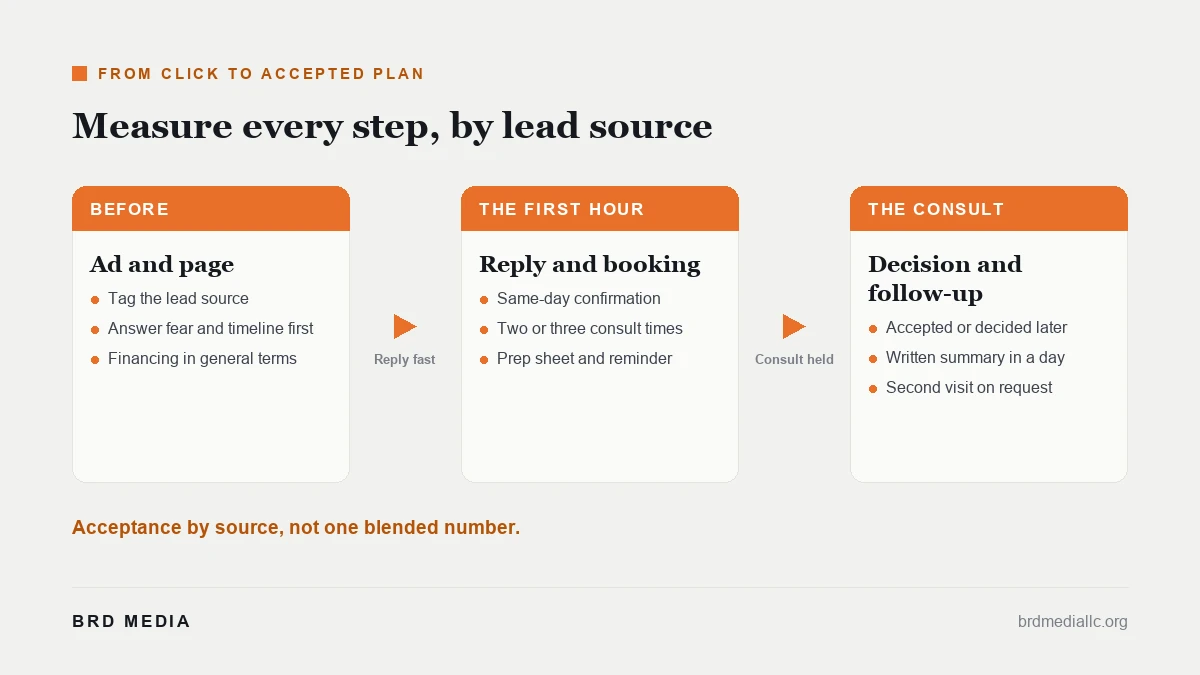
That is why the source matters more than the volume. Tag every inquiry with where it came from: a search ad, the map listing, organic search, a patient referral, a lead ad, an event. Then follow it all the way to the consult and the decision. Practices that look only at cost per lead can keep the channel that produces the most forms, which is often not the channel that produces the most accepted plans. Our post on dental Google Ads covers how to build the campaign itself; here the point is what you do with the results.
The first questions on a full-arch inquiry are rarely about technique. They are about fear, time and what the result will be like to live with. A patient who still has those questions at the consult spends the appointment on them, and the decision waits for a second visit. A page that answers them first moves the conversation forward.
Every clinical statement on that page should come from your clinicians, not from marketing copy, and none of it should promise an outcome. Google's guidance on helpful, people-first content asks whether a page gives a complete answer that leaves the reader satisfied. A treatment page that does this is also the right landing page for paid traffic. Our dental marketing strategies guide gives the general skeleton for a treatment page, including pricing and financing; the financing section below explains why we would keep financing general on a full-arch page until after the exam.
A high-ticket inquiry deserves a different path from a cleaning request, and the difference is design, not effort. Decide in advance what happens in the first hour: an automatic text and email that confirm receipt, a call during business hours from the person who will meet the patient, and one question that moves the conversation to a time slot. Then make the booking itself simple. Offer two or three consult times, send a confirmation with the address, the length of the visit and what to bring, and send a reminder the day before.
Written down, this is a short checklist that any member of the team can run. That matters, because the point is to remove variation. When a path depends on whoever happens to be free, results vary by day. When it is a documented sequence in the practice's CRM, each inquiry gets the same first hour. The same logic applies to the consult itself: a patient who knows the visit includes imaging and a review of options arrives expecting a plan, not a sales conversation.
Plan for the patient who does not decide at the consult, because with a commitment this size many will not, and that is reasonable. The ADA statement encourages patients to ask about alternatives and to seek a second opinion if they are uncomfortable with a recommendation. Send a written summary of the visit within a day, invite questions by phone or text, and offer a second visit with the provider. Record those patients separately. A source whose patients decide two weeks later is a different source from one whose patients never come back, and the table below only shows it if you track the date of the decision.
Many practices want to show a monthly payment on the treatment page, and it is worth being careful about how. The American Dental Association, in a statement on implant practices, said, about the conversation in the practice, that any discussion of financing for complex procedures should take place only after patients have discussed the range of treatment options with their dentists, and that patients should first expect a full exam. The statement is about in-office conversations and says nothing about websites, so what follows is our recommendation, built on the same sequence.
We would separate two things. A general explanation on the page, that payment options exist, how a monthly plan works in principle, and that the team will review the options after the exam, answers the cost fear without pre-selling a plan. The individual discussion of a figure belongs after the exam and the options review. Where the general skeleton in our strategies guide calls for a published price range with financing under it, the ADA's in-office position is a reason to keep full-arch financing general until after the exam. Rate promises do not belong on the page either; they belong to your practice and your lender, and they change.
You need one table, kept monthly, and it takes an hour to build from the CRM and the schedule. Each row is a source. Each column is a step in the path.
| Lead source | Consults held | Plans accepted | Accepted share | What it tells you |
|---|---|---|---|---|
| Search ads to the treatment page | From the schedule | From the treatment record | Accepted divided by held | Whether paid intent turns into decisions |
| Map listing and organic search | From the schedule | From the treatment record | Accepted divided by held | Whether the page and profile prepare the patient |
| Patient and professional referrals | From the schedule | From the treatment record | Accepted divided by held | The benchmark the other rows are measured against |
| Lead ads and events | From the schedule | From the treatment record | Accepted divided by held | Whether curiosity converts, and how long it takes |
Add one more column when you can: the time from inquiry to consult. If a source has a high accepted share and a long wait, the problem is booking speed, not the source. And hold off on conclusions until a row has enough consults to mean something. A practice that holds a few full-arch consults a month should read quarters, not weeks. Public benchmarks for full-arch acceptance exist, but the figures come from training companies using their own definitions, so the number that matters is your own, by source, over time.
Review the table with the clinical team present. The marketing view says which sources bring informed patients; the clinical view says what those patients ask in the consult and which questions the page should have answered. Each month, change one thing, such as a line on the treatment page or the wording of the first reply, and watch whether the next month's row for that source moves. One change at a time is slow, and it is the only way to know what worked.
The honest take: if acceptance is low across every source, the cause may sit in the consult itself, and that is for the clinical and coordination team to work through. Marketing can only fix what comes before the chair. What it can do is give the team patients who arrive informed, on time and prepared, and show them which channels those patients come from.
We follow leads through to booked patients for a GLP-1 weight-loss practice. The Premier IV case study reports 99 qualified leads and 12 or more new patients, about 12 percent lead-to-patient, each worth $6,708 over twelve months. It is a different service and a different patient, and it does not predict an implant practice's numbers. It shows what the chain looks like when every step is recorded: you can say how many leads became patients.
If you want that picture for your own practice, the work starts with the dental marketing page and the dental SEO service that puts the treatment page in front of researching patients.
Engagements start at $2,500 a month on a six-month term; the three tiers are on our pricing page. Ad spend is separate and belongs to you.
Send us your consult counts by source. We will show you which channels bring decisions and what the treatment page should answer first.
Book a consultSources: American Dental Association, statement on dental implant practices in the news · Google Search Central, creating helpful, reliable, people-first content
The same outcome-first framing applies to elective work: see how cosmetic cases come in without a discount for the version of this playbook built for veneers and whitening.
See BRD Media first in Google
Add us as a preferred source and our SEO breakdowns rank higher in your own Search results, AI Mode and AI Overviews.