
Practice-management writing on this topic agrees on one point, and it is sound: cosmetic patients tend to be moved by results, reputation and trust, and chairside discipline in how a fee is presented matters. Most of what ranks is about the consult room, how to hold a fee, how to present a plan, how to respond when someone asks for a lower number. That is real and it belongs to the clinical team.
The marketing side is thinner. If you want cosmetic dentistry cases without discounting, most of the work happens upstream, in who you attract and what they have already seen before they call. This post covers that, and gives chairside scripting only the space it deserves: one paragraph, in the section on offers.
An offer is a message about the practice. A visible price cut on elective work tells the market that the number is negotiable, and it teaches patients who were already interested to wait for the next one. It also changes who calls. People who respond to a deal are comparing numbers, so the consult starts as a comparison of numbers, and the team spends the appointment defending a fee instead of discussing the smile.
None of this makes a fee fixed forever or says other approaches are wrong. It means that if your goal is patients who choose on the outcome, the offer is one of the first places the practice either shows that or doesn't. Keep the message consistent from the ad to the consult: this practice does careful work, and the visit begins with listening.
Positioning is a decision about what the practice is known for, written down in plain words and then repeated on every surface. Three choices do most of the work.
These choices belong on the treatment page and the profile, in the practice's own voice. Our dental marketing strategies guide gives the general skeleton for a treatment page; this post is about what the page says about who the practice is for.
A cosmetic patient wants evidence of what the practice can do, and the best evidence is specific. Three kinds carry the most weight.
First, a gallery of real cases, each with written consent from the patient, grouped by case type so a visitor finds ones that resemble theirs. Show the range, not only the best. Second, the provider on video, answering the two or three questions every new patient asks, in a calm voice and without a script that sounds like an ad. Third, reviews, quoted with their source and date, like this: "Google review · Month Year." The FTC's Endorsement Guides, 16 CFR Part 255, are the reason to be careful here: a review you feature is a statement you are responsible for, so keep it accurate, current and clearly attributed. Our reputation management service builds the steady stream of real reviews that this kind of proof depends on.
A practical way to build the provider video is to list the five questions a new cosmetic patient asks most often, then have the provider answer each in under a minute, standing in the practice. Post the clips on the treatment page and the profile, and cut the best into short ads. For the gallery, agree on a standard for what a case needs before it is shown: written consent, the same lighting and angle before and after, and a one-line description of what the patient wanted. A gallery with a standard looks like the work of a practice that has one.
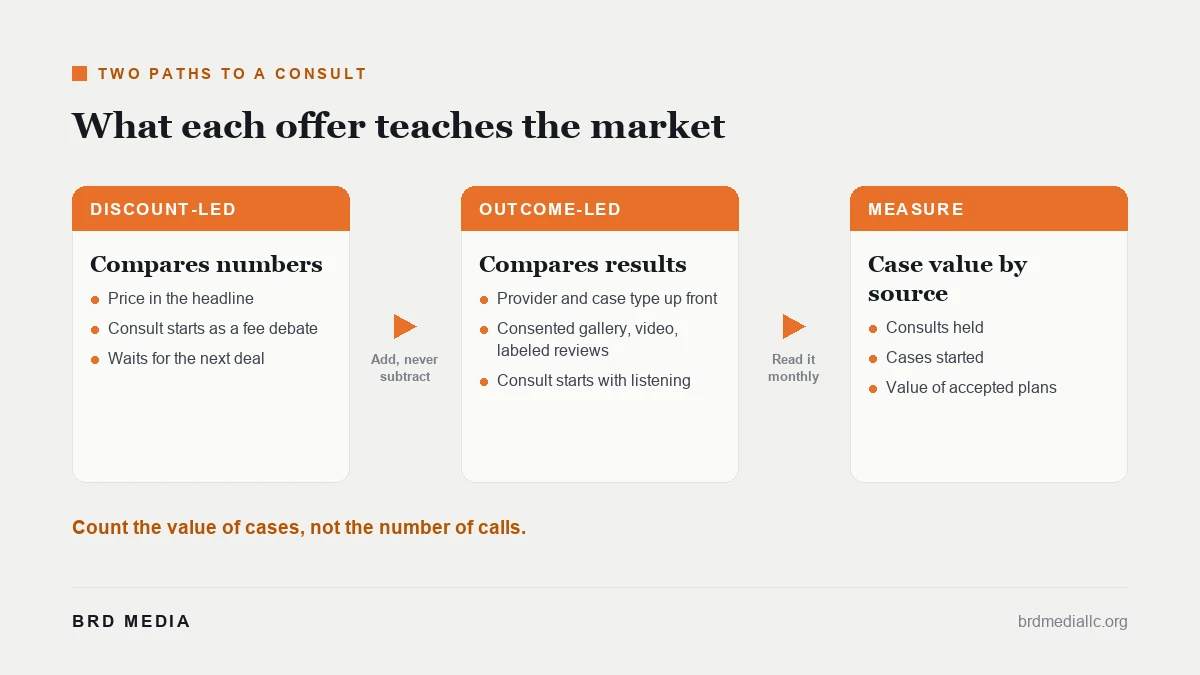
A practice can still make an offer. It should be one that adds something and takes nothing off the work. Three work well.
On the chairside side, one paragraph is enough: when a patient asks for a lower number, the practice that holds its fee usually has an answer ready that is about the value of the plan and the options that fit the patient's situation, such as phasing the work. The team should agree on that answer once, together, and write it down. Everything else about the close belongs in training with the clinical team, not in this post.
Paid media for elective work should speak to the outcome and the provider, and leave the price out of the headline. Send the click to the treatment page, not the home page, so the proof described above is the first thing the visitor sees. Use audiences and search terms that signal an interest in the result, such as smile redesign, veneers or whitening consultations, and keep a separate campaign for each so you can see which brings the larger cases.
Write the copy as you would describe the practice to a friend. Name the provider, name the kind of work, and invite the visitor to a consult. Avoid before-and-after claims that promise a result, and check each platform's current advertising policy for health and cosmetic content before every launch, since these change. For the order to try channels in, our post on dental marketing ideas is the place to start.
Cosmetic work varies a great deal in size, so counting calls misses the point. Record, for each lead source, how many consults were held, how many became treatment, and the value of the accepted plans. Review it monthly.
| Lead source | Consults held | Cases started | Value of accepted plans | What it tells you |
|---|---|---|---|---|
| Search ads to a treatment page | From the schedule | From the treatment record | Sum of accepted plans | Whether paid intent brings elective cases |
| Map listing and organic search | From the schedule | From the treatment record | Sum of accepted plans | Whether the profile and page attract outcome-minded patients |
| Patient referrals | From the schedule | From the treatment record | Sum of accepted plans | The benchmark for case size |
| Offer-led campaigns | From the schedule | From the treatment record | Sum of accepted plans | Whether a promotion brings larger cases or only more calls |
If one source has the most calls and the smallest accepted plans, you have learned something a call count never shows. Reading it takes a few months, because elective consults are not numerous enough to judge in a week.
It also helps to sort accepted plans by case type, not only by source. A source that sends several small whitening cases and one large smile redesign looks the same as a source that sends five medium cases when you count calls, and very different when you add up the value. Once a quarter, look at which case types each source produces, and put the budget behind the combination of source and case type that matches the practice's positioning.
The honest take: positioning takes longer than a promotion. A discount can fill the schedule this month, and outcome-led marketing builds across a quarter or two. The practice that wants steady cosmetic cases has to be willing to run the slower plan and to read the source table before changing it.
The Dr. Mo case study is a wellness practice, not a dental one, and the service is elective in the same way: a patient decides to pay for it. The build covered the website, landing pages, paid media and the CRM follow-up behind them, and the case study reports 144.9 percent year-over-year active-user growth and roughly 20 new patients a month. We do not claim it predicts a dental result. It shows the shape of the approach: one connected path from the page a patient reads to the booked visit.
Write down the practice's positioning in three lines: the provider, the case type, the result. Check whether the treatment page says all three. Pull the last year's cosmetic consults and mark where each came from and what it was worth. Then pick one offer from the list above to replace any price-led one. The dental marketing page shows how we put this together for practices, and it begins with the same three lines.
Engagements start at $2,500 a month on a six-month term; the three tiers are on our pricing page. Ad spend is separate and belongs to you.
Send us your treatment page and your last twelve months of consults by source. We will show you what the page says about who you are for and which channel brings the larger cases.
Book a consultSources: eCFR, 16 CFR Part 255, Guides Concerning Use of Endorsements and Testimonials in Advertising
For the highest-ticket version of the same consult problem, read the full-arch implant case acceptance plan, which tracks acceptance by lead source.
See BRD Media first in Google
Add us as a preferred source and our SEO breakdowns rank higher in your own Search results, AI Mode and AI Overviews.