
Most monthly marketing reports lead with the same numbers: leads, cost per lead, lead volume up or down. The bank account does not count leads. It counts people who sat in a chair, heard a plan and said yes. Between the form fill and that chair sits the med spa consult show rate, and almost nobody measures it, which is how a clinic can hear the marketing is working while the schedule stays half empty.
This post reframes the unit of measurement to the shown consult, gives the response and reminder sequence that moves it, handles the deposit question honestly on both sides, and ends with the five numbers to watch each week and the order to fix them in.
The published figures are a starting point, not a standard, and every one of them belongs to the page that published it. A retention-software vendor's benchmark page puts new-client consultation no-shows at 25 to 35 percent, the highest of any appointment type, against 17 to 22 percent for the average appointment, and reports that practices running a three-touch reminder sequence or taking a $25 to $50 deposit sit at 8 to 12 percent. A practice-software vendor's journey-mapping piece says a deposit can bring consult no-shows down to that same 8 to 12 percent, and reports a median consult-to-treatment conversion near 38 percent, with stronger teams at 68 and above, and a 3.4 times higher booking rate when an inquiry is answered inside five minutes rather than after more than an hour.
None of those are BRD's numbers and none of them are yours. They tell you the shape of the funnel: the biggest drop is between the booking and the chair, and the second biggest is between the chair and the yes. Pull your own figures from the last two quarters before you believe any of them.
Define four events and make the front desk log all four. An inquiry is a form, call or message from someone new. A booked consult is a date on the calendar with a name attached. A shown consult is that person in the building. An accepted plan is a treatment plan agreed and paid for, or scheduled with a deposit, before they leave. The conversion that marketing should be judged on is the shown consult, because it is the first event the clinic fully controls and the first one that can turn into revenue the same day.
| Stage | What to measure | What a weak number usually means | The first fix |
|---|---|---|---|
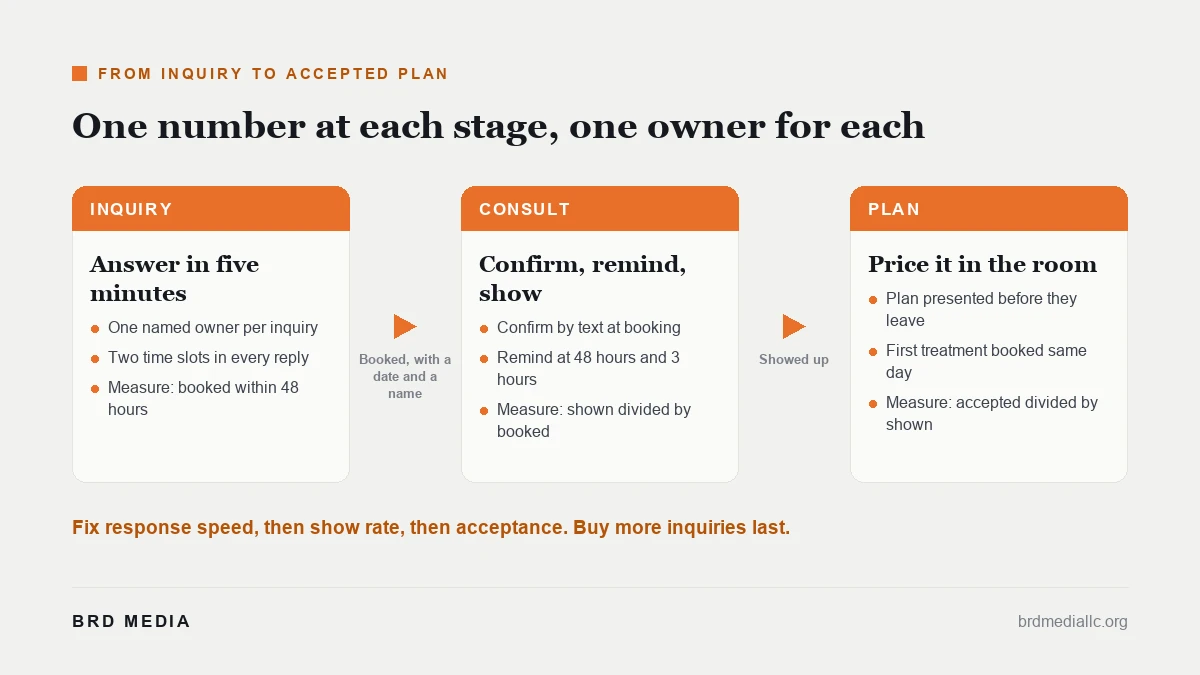
| Inquiry to booked | Share of new inquiries with a consult date within 48 hours | Slow first response, or a reply that answers the question and never names a time | One owner per inquiry, a reply inside five minutes in business hours, two time slots in every reply |
| Booked to shown | Shown consults divided by booked consults, by week | No confirmation at booking, no reminder in the final 24 hours, a free consult with nothing at stake | Confirm in the booking message, remind twice, decide the deposit question on your own numbers |
| Shown to accepted | Accepted plans divided by shown consults | The plan is emailed after the visit instead of presented in the room | Price and schedule inside the consult; the follow-up is for the ones who said not yet |
| Accepted to treated | Plans that start within 30 days | Scheduling friction after the yes | Book the first treatment before they leave |
| Not booked, 30 days | Share of unbooked consults recovered inside 30 days | Nobody owns the people who looked and left | A dated follow-up sequence with a person's name on it |
Each row has one number and one first fix. Resist fixing all five at once. The order matters and it is covered at the end.
Inside five minutes during business hours, and within an hour or two outside them. The vendor figure above puts a five-minute reply at 3.4 times the booking rate of a reply after more than an hour, and your own inquiry log will show whether that holds for your clinic. The person who filled out your form at 7:12pm has three tabs open. The clinic that replies first with a real time slot usually gets the booking.
What has to be true for that to happen: every inquiry lands in one place, one named person owns the reply, and the reply contains two specific times rather than a question. An auto-reply that says "thanks, we will be in touch" counts as a non-response. A text from a person saying "I have Thursday at 4 or Friday at 11, which works?" counts. This is the part of the funnel our CRM automation for clinics is built around: routing, the five-minute reply, and the reminder sequence below, so the front desk is finishing conversations instead of starting them.
The sequence that moves the show rate is short, and the timing matters more than the wording. Confirm at the moment of booking, by text, with the date, time, address, parking note and the name of the person they will see. Remind 48 hours out by text with a one-tap reply to confirm or reschedule. Remind again three hours out, text only, no reply required. If the 48-hour message gets no confirmation, a person calls on the day before. Anyone who reschedules re-enters the sequence from the confirmation step.
Two rules keep it honest. Every message carries the sender's name and a direct way back, because a reply to a no-reply number is a booking you lost. And the consent for appointment reminders is collected at booking, in the form or the call, with the wording your counsel and your messaging platform require. We are the marketing team, not your lawyers; the sequence is ours, the consent language is theirs.
Here is the honest version of both sides. A deposit raises the show rate and lowers the booking rate, and the vendor page that publishes the deposit benchmark says so in the same paragraph: deposits create friction that can reduce booking volume, especially for new clients. So the deposit is not a yes or no question. It is arithmetic.
Run it on your own two numbers. If 100 inquiries book 60 free consults and 40 of those show, you have 40 shown consults. If a $50 deposit drops bookings to 45 and 40 of those show, you have the same 40 shown consults with 15 fewer no-show slots to fill and $2,000 in deposits applied to the treatments of the 40 who came. If bookings drop to 30, you lost consults and the deposit cost you. Test it for six weeks on one service line, measure shown consults rather than bookings, and keep whichever produced more people in chairs. Whichever way it lands, apply the deposit to the first treatment, say so in the booking message, and refund it for a reschedule with 24 hours' notice.
Plenty of the people who inquire will not book on the first exchange. They are not lost, they are undecided, and most clinics have no system for them. The recovery sequence is four touches over 30 days, each from a named person: day two, a short note with one more open slot; day seven, an answer to the question they most likely still have, written in plain language about the visit itself and never about the treatment's results; day fourteen, a direct offer of a time; day thirty, a last message that leaves the door open. Then they move to the long-term list and stop hearing from you weekly.
Measure it as a share: of the people who inquired but did not book, how many booked inside 30 days. A clinic that moves that number from 5 percent to 15 percent has added consults with zero extra ad spend, which is why it belongs in the weekly scoreboard rather than in a quarterly review. The paid side of this, getting the inquiry in the first place, is covered in our med spa advertising playbook; this post starts where that click ends.
Five numbers, pulled every Monday for the previous week, on one page: new inquiries, share booked within 48 hours, show rate, plan acceptance rate, and 30-day recovery rate. Lead count stays on the sheet because it tells you whether the top of the funnel moved, but it is the last number read, not the first.
Fix in this order. Response speed first, because it is cheap, fast and upstream of everything. Show rate second, because every point of show rate is a consult you already paid for. Plan acceptance third, because it is a consult-room skill that takes longer to change. Recovery fourth. Only when all four are green do you buy more inquiries, because buying inquiries before the funnel converts them is the most expensive thing a clinic can do with a marketing budget. That is also how we judge our own work on a med spa lead generation engagement: consults that show up, not form fills.
The honest take: sometimes the show rate is fine and the offer is the problem. If 85 percent of booked consults show up and 25 percent accept a plan, the funnel is working; the consult is the problem. That is a pricing, positioning or presentation question, and no reminder sequence fixes it. Measure first so you know which problem you have.
Dr. Mo's Wellness Home is the proof we point to in this vertical. A full-funnel build, landing pages, paid demand, Google search and CRM automation that follows up on every new inquiry fast, produced roughly 20 new patients a month and 144.9 percent year-over-year active-user growth.
Pull the last 90 days of inquiries and mark each one booked, shown, accepted or none. Calculate the five numbers. Give every new inquiry one named owner and a five-minute reply target. Turn on the three-message reminder sequence. Decide the deposit question with your own arithmetic, not a rule. Then read your med spa consult show rate next Monday and the Monday after, and treat the lead count as the last column on the sheet. If the organic side of the funnel needs work too, the med spa SEO service is built to feed this same scoreboard.
Engagements start at $2,500 a month on a six-month term; the three tiers are on our pricing page. Ad spend is separate and belongs to you.
The other half of the same problem sits upstream, in search. Why a med spa loses the map pack covers how the consult requests get there in the first place.
Send us 90 days of inquiries and we will show you which number to fix first to book more consults.
Book a consultSources: Regulr, med spa no-show rate benchmarks · Prospyr, where med spas lose clients in journey mapping
See BRD Media first in Google
Add us as a preferred source and our SEO breakdowns rank higher in your own Search results, AI Mode and AI Overviews.