
Every guide to advertising an IV therapy clinic teaches you to build the campaign. Ad groups by drip, call tracking, offline conversion imports, negative keywords. All useful, and all of it assumes something nobody checks first: that you are allowed to open the account. For a fair number of clinics, that assumption is wrong, and the first they hear about it is a suspended account and a form asking for documents they have never seen.
This is the upstream version. Who the certification applies to, what the application asks for, what to run while a review is open, and how to tell the certification gate apart from the compliance gates it gets confused with.
IV therapy clinics advertise on Google and Meta with local intent, on top of a verified Google Business Profile, with a page per drip or treatment rather than a single services list, and with follow-up behind the consult. Memberships and packages are where the economics work. None of that is controversial, and our IV therapy and GLP-1 clinic marketing services page is where the campaign side of it lives. What follows sits above all of it.
Start with the platform rule rather than the vendor. Google's healthcare and medicines policy restricts the promotion of services related to the online prescribing, dispensing, and sale of prescription drugs. In the United States it allows online pharmacies only when they are accredited by LegitScript's Healthcare Merchant Certification Program or by the National Association of Boards of Pharmacy, and it allows telemedicine providers when they are accredited through the LegitScript program. You can read the requirement in Google's healthcare and medicines policy, which is the source that governs your account. LegitScript is not the last step: the same policy page says advertisers must also be certified with Google, which is a separate application filed from the ad account once the LegitScript certification is in hand.
Now map your clinic onto it. Three shapes come up constantly:
The certification attaches to the business entity and its prescribing model, not to a single campaign. Changing the ad copy does not move you out of scope, and neither does opening a second ad account. Certification decides whether a platform will let your ads serve, and HIPAA compliant marketing governs how you handle patient data, so clearing one says nothing about the other.
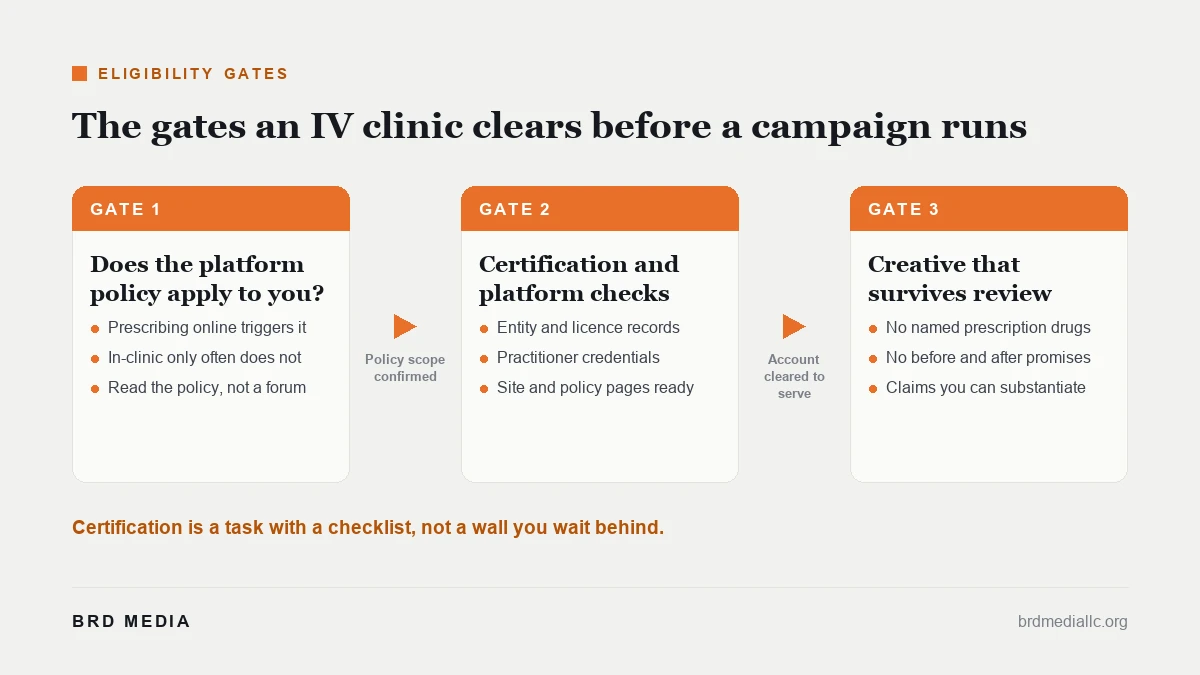
LegitScript describes the certification as a seal that lets a healthcare business show its compliance and open advertising and payment processing across the major platforms, and applications start through its own merchant portal. The review is a documentation exercise. Get the documents assembled before you open the application rather than during it, because a half-finished application that sits waiting on a license copy is the version that drags.
What a clinic should have ready:
We deliberately do not publish a fee figure or a review window here. LegitScript does not state either on its public certification page, and a number we cannot source is a number we will not print. Ask for both in writing when you open the application, and plan the quarter around the answer they give you rather than around a figure from a forum post.
| Gate | Who verifies it | What has to be ready | What the ad account can do meanwhile |
|---|---|---|---|
| Policy scope | You, against the platform's published policy | An honest description of your prescribing model | Everything, once you know the answer |
| Certification | LegitScript, for the platforms that require it | Entity, licensure, clinical model, site pages | Non-restricted campaigns, brand, and local |
| Platform verification | Google or Meta, after certification | Certification on file, Google's own healthcare certification applied for, account details matching | Serving, within the category rules |
| Creative review | The platform, on every ad | Claims you can substantiate, no named prescription drugs in copy | Per-ad, ongoing, forever |
A clinic does not have to sit dark for a quarter. The restricted lane is narrow, and most of what actually drives a first appointment sits outside it.
Local search is untouched. Profile posts, review generation, service pages per drip, and location content all keep working while an application is in review, and they are the things still paying you in year two. Brand search campaigns on your own clinic name are typically clear. Non-prescribing services, hydration drips, vitamin injections and recovery packages described without a prescription-only drug name, are a different policy surface from the prescribing one. Email and text to people who already came in cost nothing to keep running.
Paid social has its own review, and it is worth building the creative library during this window so that the Meta account is not starting from zero on the day you are cleared. The same goes for the search account: build it, structure it, leave it paused. Our Google Ads management engagements treat the waiting period as build time rather than dead time.
Almost none of them are dramatic. A license expired two months ago and nobody noticed. The address on the website does not match the address on the registration. The site lists a service the clinical model does not cover. A page makes a results claim that cannot be substantiated. The prescriber named in the application is not the prescriber named on the site.
Read your own website as a reviewer would before you apply. Most of what comes back is a mismatch between what the site says and what the paperwork says, and every one of those is fixable in an afternoon if you catch it first.
The honest take: some clinics are not ready to apply, and applying anyway wastes a month. If the clinical model is still changing, if a prescriber relationship is not documented, or if the website describes a service you are not yet delivering, settle those first. An application built on a moving target comes back for more information every time.
Premier IV is the clinic we point to on this. Their campaigns produced $80,496 or more in cohort lifetime value, on GLP-1 and IV advertising built to clear policy review rather than argue with it. The detail is on the Premier IV case study. The eligibility work came first, and it is the reason the campaigns ever got to run.
Our engagements start at $2,500 a month on a six-month term, and the eligibility review, the site fixes it turns up, and the account build all sit inside that rather than being billed as a separate project.
Write down your prescribing model in three sentences. Read Google's healthcare policy against it and decide whether you are in scope. If you are, name an owner for the application and give them a date. Pull the licenses, the registration, and the prescriber credentials into one folder. Then read your own website as if you were the reviewer. Getting LegitScript certification for an IV clinic settled is two weeks of unglamorous work, and it is the difference between a campaign that runs and an account that gets suspended in week three.
We will read your model against the platform policies and tell you what has to be true before an account opens.
Book a consultSources: Google Ads healthcare and medicines policy · Meta advertising standards, drugs and pharmaceuticals · FTC health products compliance guidance
See BRD Media first in Google
Add us as a preferred source and our SEO breakdowns rank higher in your own Search results, AI Mode and AI Overviews.