
Most advice about opening a weight loss clinic is a menu. Nine tips, ten channels, one line each. It tells you what exists and never tells you what goes first. A weight loss clinic launch has an order to it, and getting the order wrong is more expensive than picking the wrong channel, because the wrong order means you never find out which channel was working.
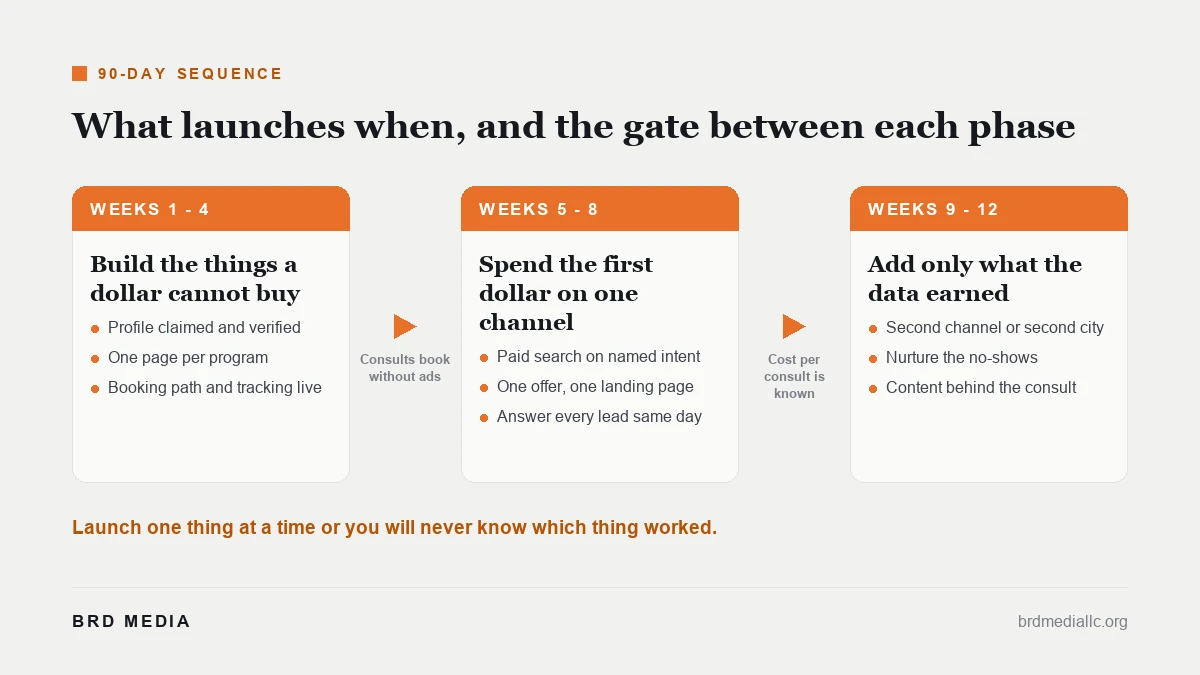
Here is the sequence we run, broken into three phases with a gate between each one. The gates matter more than the phases.
A clinic needs a verified Google Business Profile and local search presence as the base. It needs one page per program rather than one page listing everything. It needs paid search for the people typing the thing they want. It needs paid social for the people who have not thought about it yet. It needs email and text follow-up behind the consult. That is the consensus, and it is correct.
What the consensus does not say is that those five things have wildly different lead times, and three of them are worthless until the other two exist. So put them in order.
Nothing in this phase is optional and none of it is advertising.
Claim and finish the Google Business Profile. Verification alone can take days to weeks depending on the method Google offers you, which is exactly why it goes first. Categories, hours, service list, real photos of the actual room, and the booking link all belong here. Google's own guidelines are the source to follow, not a checklist from a forum.
Build one page per program. Semaglutide-based programs, tirzepatide-based programs, medically supervised plans, body composition, whatever you sell. One page each, with what is included, who it suits, what happens at the first appointment, and a price or price range if you are willing to publish one. A single "Weight Loss" page cannot rank for five different searches and cannot answer five different sets of questions.
Fix the booking path before it carries traffic. Count the clicks from the program page to a confirmed appointment. If it is more than three, cut something. Decide who answers a lead at 7pm and what they say. A clinic that replies in five minutes converts a different business than one that replies tomorrow, and that gap is not something ad spend can close.
Install tracking last in the phase and before the first dollar. Calls, forms, and chat all landing in a CRM with a source attached, plus a field a human marks when the consult shows. Without that field, every number you read for the next year is a guess.
The gate: consults are booking without ads. Even a trickle. If nothing books from the profile and the program pages, adding paid traffic to that path will not fix it.
Paid search first, because it buys intent that already exists. Someone typing a program name in your city has made most of the decision. Build the campaign against the named programs you sell, point each ad group at its own program page, and set the radius by drive time rather than miles.
One offer. One landing page. One channel. This is the discipline that makes the next phase readable. If you launch search, social, and a referral push in the same fortnight and the phone rings, you have no idea which one to double.
Know the policy ground before the account opens. Google restricts promotion of services related to online prescribing and dispensing of prescription drugs, and it requires LegitScript certification for telemedicine providers. If your model includes online prescribing, that is a pre-launch task, not a problem for later. We treat eligibility as step zero on any clinic account. The same applies to GLP-1 claims in ad copy, where the FTC's guidance on health product claims is the standard your copy has to meet. If the program you are marketing is GLP-1 led rather than clinic led, the deeper version of that sits on our IV therapy and GLP-1 clinic marketing page.
The gate: you know your cost per consult that showed. Not cost per lead. Cost per human who sat down.
Now you get to spend on the second thing, and you have a reason for the choice.
If search is producing consults but volume is capped, the ceiling is demand, so add paid social to create want that is not being typed into a search bar. Paid social is usually the second channel for this reason rather than the first.
If search is producing leads but they are not showing, the ceiling is your follow-up, and more traffic makes it worse. Spend the phase on reminder sequences, a text the day before, and a same-day call on every no-show instead.
If both are healthy and capped by geography, add the second city. Give it its own page and its own campaign, never a broadened radius on the existing one.
| Phase | What launches | What has to be true first | The signal to move on |
|---|---|---|---|
| Weeks 1 to 4 | Profile, program pages, booking path, tracking | You know which programs you are selling | Consults book with zero ad spend |
| Weeks 5 to 8 | Paid search, one offer, one landing page | Tracking marks a consult as shown or not | Cost per consult that showed is known |
| Weeks 9 to 12 | Second channel, or second city, or nurture | The first channel has thirty days of clean data | The added thing has its own readable number |
| Deliberately held | Organic social, blog volume, a third city | The core is producing predictably | Capacity, not curiosity, is the trigger |
Holding things back is the part nobody writes about, so here is the list. A daily posting habit on social. A blog program. A second and third city. A referral engine with partner clinics. Every one of those is a good idea eventually and a distraction in month one, because none of them produce a readable number fast enough to steer by.
The real cost of launching everything at once is not the money. It is that a clinic doing nine things with a ringing phone cannot tell you which of the nine to fund next quarter. The sequence exists to protect the answer. For the general version of this ordering problem across any practice, how to get more patients walks the same logic without the weight-loss specifics.
The honest take: the most common launch mistake we see is a beautiful website and no verified profile. The site takes eight weeks and a lot of money. The profile takes an afternoon and produces the first appointment. If you have to pick one to have finished by Friday, pick the profile.
Premier IV is the closest reference point we have for this category. Their campaigns produced more than $80,496 in cohort lifetime value, built on compliant GLP-1 and IV advertising rather than creative that fought policy review. The full write-up sits on the Premier IV case study.
On our side of it, engagements start at $2,500 a month on a six-month term, with the build, the pages, and the profile work included rather than billed as a project. The three tiers and what sits in each are published on our pricing page. Ad spend is separate and belongs to you. If you want the strategy version rather than the sequence version, our weight loss clinic marketing services page covers how we run it once the launch is behind you.
Claim the profile. Write one page for each program you actually sell. Count the clicks to a booked appointment and cut one. Decide who answers a lead at 7pm. Do those four things before you open an ad account, and the first ninety days of a weight loss clinic launch will tell you something true instead of something noisy.
We will map the ninety-day sequence against your programs and your market, and tell you what to hold back.
Book a consultSources: Google Business Profile guidelines · Google Ads healthcare and medicines policy · FTC health products compliance guidance
See BRD Media first in Google
Add us as a preferred source and our SEO breakdowns rank higher in your own Search results, AI Mode and AI Overviews.