
Law firms · Ranking drop
What to check, in order, before you decide who is at fault.
UpdatedYour firm held page one for months. Then calls thinned out, a partner searched the main practice-area term and saw a lower spot, and it has now been two months. The easy move is to blame whoever runs your marketing. Sometimes the cause really is on the agency side, and sometimes it is a Google update, a tracker that misread the results, or a change nobody logged. This post gives you an ordered check, so you can find out why your law firm website rankings drop before you decide anything. It runs from confirming the drop, through dates and technical causes, to the map pack and the written answer a firm should expect.
A rank tracker shows where a page sat for a list of search terms on a set day, from a set place, as read by its own crawler. Search Console shows what Google recorded for real searches: impressions, clicks and average position. When the two disagree, Search Console is the closer record of what your future clients saw, though it has its own delays and sampling.
Google's help page on the Search Console performance report describes the clicks, impressions, click-through rate and position the report shows. Google's guide to debugging a drop in search traffic suggests a first read that fits a law firm well. Look at the pattern of the drop. If both impressions and clicks fell, work through the common causes. If only clicks fell while impressions held, look at titles, snippets and rich results rather than ranking.
Use a long date range, because the same guide recommends 16 months so you can see whether the dip repeats every year. Many sites see seasonal patterns, around holidays for example. Then break the data down by query, page, device and country. A drop on one practice-area page tells a different story from a drop across the whole site.
The takeaway: if Search Console shows clicks and impressions steady and only a tracker fell, you may be looking at a measurement artifact, not a ranking loss.
Find the first day the numbers moved. Then write down everything that changed on or just before that day. The list is usually short once you put it on a calendar: a Google update, a site redesign, a theme or plugin update, a new page template, a change to page titles, a move to a new URL structure, a hosting change.
For updates, Google keeps the Search Status Dashboard as its record of ranking updates. The debugging guide makes a point worth keeping in mind: after an update, there might not be anything fundamentally wrong with your content, so judge the size of the position change before you rewrite anything. If the start date sits inside an update window and nothing on your site changed that week, an update is a reasonable first suspect. If it sits right after your site changed, start there instead.
Ask your agency and your web developer for their change logs for the two weeks around the drop. A firm that cannot produce one has learned something useful, because the next step is to start keeping one.
Technical changes can remove pages from results without any sign on the page itself. The same Google guide points to the Crawl stats and Page indexing reports and suggests looking for a spike in problems that matches the date of the drop.
| Check | Where to look | What it tells you |
|---|---|---|
| Pages dropped from the index | Search Console page indexing report | Whether practice-area pages moved to "excluded" or "not indexed" around the drop date. |
| A stray noindex or block | Page source, robots file, the URL inspection tool | Whether a staging setting or plugin switch reached the live site. |
| Redirects and URL changes | Old URL list against the live site | Whether pages moved without a redirect, or with a chain of redirects. |
| Title and heading edits | Page titles before and after, from a saved copy | Whether the practice-area phrase was removed or diluted by a template change. |
| Manual actions and security | Search Console manual actions and security reports | Whether Google flagged the site for spam or malware. |
If you changed URLs, Google's guide says you may see ranking fluctuations while it recrawls and reindexes the site. That is expected after a move and different from a loss that does not recover. Give a fair read to how many weeks have passed, and whether the redirects point each old page to its closest new one.
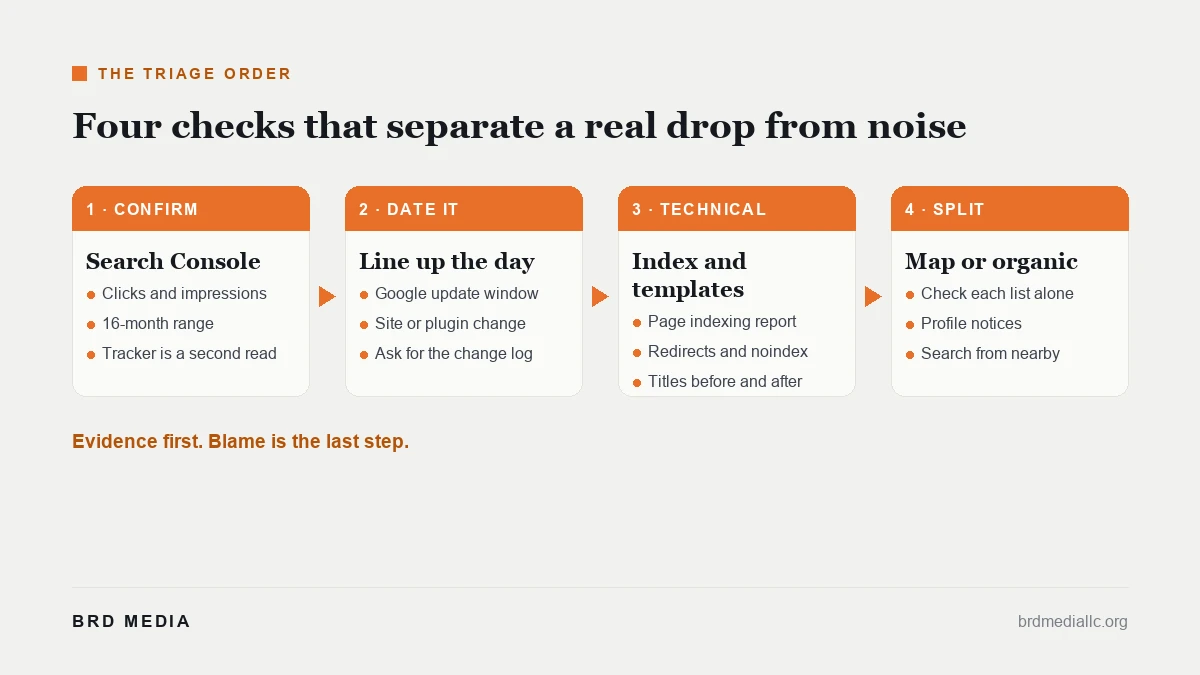
Firms say "rankings" for two different lists. The map pack is the three local listings with a map near the top. Organic results are the blue links below it. A drop in one can leave the other untouched, and the fixes differ.
For organic results, the earlier checks apply. For the map pack, the factors are different. Google's help page on improving local ranking describes local ranking as relevance, distance and prominence, and points to accurate profile information and reviews. A review count that stalled, a category change, a change to the listing's hours or address, or a suspension can each move a listing without any change to the website.
Check the Business Profile for notices, then compare calls and direction requests before and after the date. Then search the main practice-area term from outside your office and from a few miles away, because local results shift with the searcher's location. Our guide to content marketing for law firms covers the practice-area pages that organic results lean on, which is where a template or title change tends to do its damage.
You do not need to guess at causes in the dark. Ask for a short written read, and judge it by whether it answers these points with evidence:
A good answer says what is known and what is not. It does not promise a recovery date, because no one can set one. A drop that traces to an update may not need a fix at all, while a drop that traces to a template change needs a rollback now. Both are better than a vague reassurance, and both give you something to act on.
If you are comparing this read to the plan you hired for, our guide on whether law firms need SEO sets out what the work is supposed to deliver, and the law firm marketing strategies page lists the other parts of the system that can pull case volume down when SEO is steady, such as intake and reviews.
The honest take: A drop is not proof that anyone failed, and it is not proof that nobody did. It is a question with an order to answer it in: confirm it, date it, rule out the technical causes, split map from organic, then ask for the findings in writing. A firm that works through that list in a week will know more than one that spends two months guessing. Do not skip the list because the answer might be uncomfortable.
Rankings are one input to signed cases, so keep an eye on calls and consults as well as position. Our law firm SEO work includes monthly reporting and a roadmap of what to build first. If your firm sits in a practice area with heavy local competition, the law firm marketing overview shows how search, paid and intake fit together. Engagements start at $2,500 a month on a six-month term; the three tiers are on our pricing page. Ad spend is separate and belongs to you.
Send us the date it started and a Search Console screenshot. We will tell you what the data shows and what to check next.
Book a consultSources: Debugging drops in Google Search traffic · Search Console performance report · Google Search Status Dashboard · Tips to improve your local ranking
Cite this page. Credit BRD Media with a dofollow link to this page: https://brdmediallc.org/law-firm-rankings-dropped-two-months-what-to-check/
See BRD Media first in Google
Add us as a preferred source and our SEO breakdowns rank higher in your own Search results, AI Mode and AI Overviews.