
"The leads are garbage" is the most common complaint in Meta advertising, and if your Facebook leads are not converting, you have probably already blamed the targeting, the algorithm, or the platform itself. Here is the uncomfortable pattern we see when we audit these campaigns: the ads are usually fine. The system around the ads is broken. Facebook can fill a spreadsheet with names and phone numbers all day. Turning those names into booked appointments is a machine with five specific parts, and in most businesses at least two of them are missing. Here is how to find yours, in the order that actually matters.
A Google lead searched for you. A Facebook lead was interrupted. They were scrolling, your ad earned three seconds, and they tapped a form that Facebook helpfully pre-filled with their name, email, and phone number. That is not a bad lead. It is an early lead. They are often a real person with the real problem your ad described, but they were not standing there with their wallet out. Treating interrupted people like search traffic is the root mistake behind almost every "Facebook leads are junk" story. Early leads convert on speed, follow-up, and offer. Judge them on that machine, not on the click.
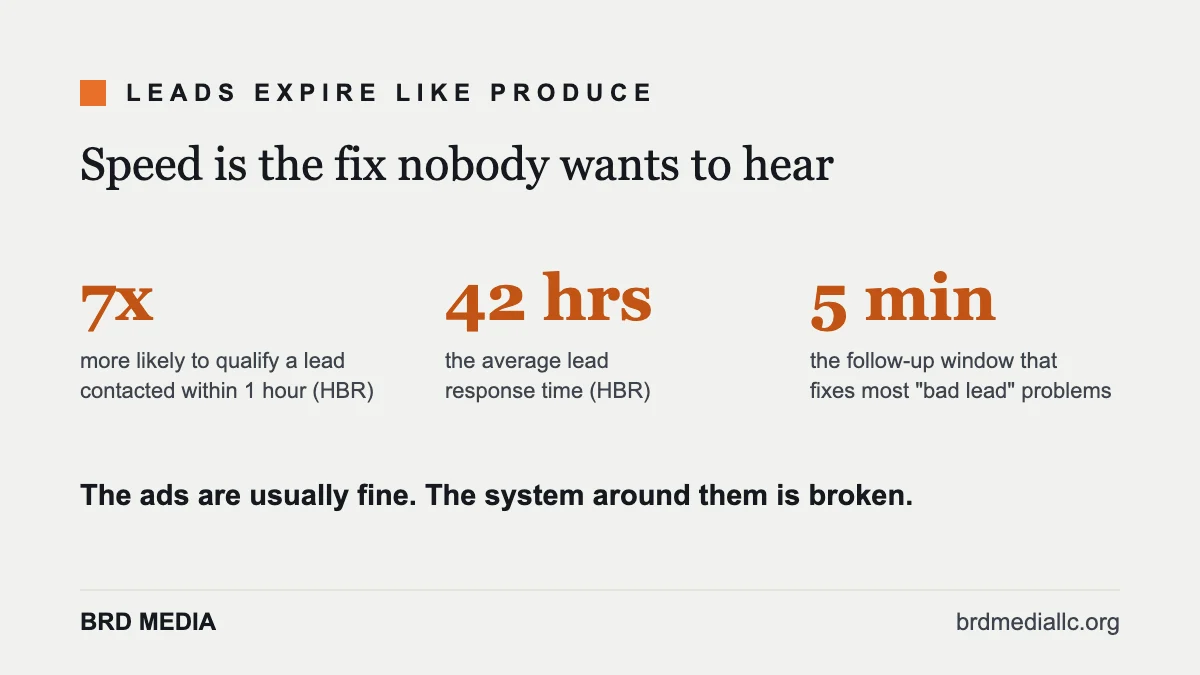
This is the number one killer and the least glamorous. Harvard Business Review's audit of B2B firms found the average lead response time was 42 hours, while the odds of qualifying a lead were nearly 7x higher when firms responded within the first hour. An interrupted scroller who tapped your form at 9:14pm has mentally moved on by 9:40pm. If your process is "the front desk calls tomorrow morning," you are paying Meta for leads and then letting them expire like produce.
The fix is mechanical, not motivational: an automatic text within the first minutes ("Hi, it's X from Y, saw you asked about Z, want tomorrow at 2 or 4?"), an automatic email, and a phone call the same business day. This is exactly why our lead campaigns ship with speed-to-lead texting wired into CRM and follow-up automation before the first ad runs.
Meta's default instant forms auto-populate every field, which means a thumb twitch can become a "lead." Volume looks great, quality feels awful. Meta itself offers a higher-intent form type that adds a review step before submission for exactly this reason.
Expect cost per lead to rise when you do this. That is the point. You are trading spreadsheet volume for people who remember filling out your form.
Meta's delivery system is terrifyingly literal. Optimize for lead volume at the lowest cost and it will find the corner of your audience most likely to submit a form and least likely to buy. This is the trap behind most "quality dropped when we scaled" stories.
The lever most businesses never pull: report quality back. When your CRM marks which leads booked, showed, and paid, and sends those events back to Meta (Conversions API, offline or CRM events), you can optimize toward qualified leads and actual customers instead of raw submissions. Meta can only aim at what you measure. If the only signal it ever receives is "form submitted," cheap form-fillers are what you will get, forever. That feedback loop is the core of our Meta ads management for service businesses.
"Free consultation" pulls a different crowd than "$99 new-patient exam, includes X." Ultra-soft offers create ultra-soft leads: people who wanted the free thing, not the service behind it. Look at your ad and ask what a stranger would think they signed up for. If the honest answer is "something free with no commitment," the leads are behaving exactly as designed. Match the offer to the buyer: name the service, name the outcome, and where possible name the number. A weight-loss clinic advertising "free consult" and one advertising "medical weight loss program, $XX/week, first visit free" will get very different phone conversations.
| Order | Check | Question | Typical finding |
|---|---|---|---|
| 1 | Speed-to-lead | How many minutes until first contact? | Hours or days. Fix with automated text + same-day call |
| 2 | Contact attempts | How many touches per lead? | One call, no voicemail, no text. Industry practice is 6+ touches |
| 3 | Form type | Default or higher intent? Any typed question? | Default auto-fill form, zero friction |
| 4 | Offer | What did the lead think they asked for? | A free thing, not the service |
| 5 | Optimization signal | Does the CRM report booked/showed/paid back to Meta? | No feedback loop at all |
| 6 | Targeting and creative | Only NOW look here | Usually adequate all along |
Note the order: targeting, the thing everyone blames first, is checked last, because it is broken least often and costs most to rebuild.
Our honest take: when an agency tells you the fix for bad leads is a bigger budget, new audiences, or a rebuilt campaign, be suspicious. Rebuilds are what agencies sell because "answer your leads within five minutes, every time, including Saturdays" does not sound like expertise. It is the fix that works most often. We have taken over accounts where the ads needed almost nothing and the follow-up needed everything.
This is not theory. For Wellness Homes, a medical wellness practice, we run Meta lead generation with the full machine described above: qualified forms, instant speed-to-lead texting from the CRM, and revenue reported back into optimization. The practice reached 70% local search visibility and brings in roughly 30 new patients a month at about $6,000 in lifetime value each. Same platform everyone complains about. Different machine around it.
Free audit. We will look at your campaigns, your forms, and your follow-up, and tell you in plain English why the leads are not turning into customers, and what we would fix first. No rebuild pitch unless you actually need one.
Audit My Lead FlowSources: Harvard Business Review: The Short Life of Online Sales Leads · Meta Business Help Center: About Lead Ads
See BRD Media first in Google
Add us as a preferred source and our SEO breakdowns rank higher in your own Search results, AI Mode and AI Overviews.