
Does Google penalize AI content for law firms? That question comes up often when a firm considers using AI drafts. The honest answer has two parts, and much of what ranks for this question covers only the first one. Google does not penalize a page because AI helped write it. A page that is misleading is a problem under a lawyer's advertising rules, however it was written. A firm that wants to use AI drafts needs a process built for both.
Google has answered this in public. Its Search Central guidance on AI-generated content says its ranking systems aim to reward original, high-quality content, and that its focus is on the quality of content rather than how it is produced. The same guidance says that using automation, including AI, to generate content with the primary purpose of manipulating search rankings is a violation of its spam policies.
The spam policy that matters here is called scaled content abuse. It describes many pages generated for the primary purpose of manipulating search rankings and not helping users, and it lists using generative AI tools to generate many pages without adding value for users as an example. Notice the two conditions: many pages, and no value added. A single well-edited article drafted with AI help does not fit that description. Two hundred near-identical practice area pages do.
So the answer to the headline question is no, not for using AI. The risk is in what a firm does with it. Our own guide to whether law firms need SEO covers the broader case for publishing at all. This post covers how to publish with AI help and stay safe.
Law firm sites tend to fail in the same few ways, with or without AI.
Google also publishes guidance on creating helpful, people-first content, and the questions in it are a good checklist for any legal page: does it show first-hand experience, does it give a complete answer, and would a reader trust it enough to act. AI drafts rarely pass those without a lawyer's edit. That edit is where the process below starts.
Google does not read your state's rules of professional conduct. Your regulator does. Take Illinois as an example. Rule 7.1 says a lawyer shall not make a false or misleading communication about the lawyer or the lawyer's services, and defines that as one that contains a material misrepresentation of fact or law, or omits a fact necessary to keep a statement from being materially misleading. The rule does not ask how the words were produced. It asks whether they are true and complete.
That is the part a firm can lose sight of when a draft arrives in thirty seconds. An AI draft can sound confident while being wrong about a statute, can imply a result the firm cannot promise, or can describe a specialty the firm does not hold out. Each of those can raise a problem under a rule like 7.1 whether or not a person typed it. Other states add their own requirements on disclaimers, labeling and specialization claims, so check yours rather than assuming Illinois is typical.
Two practical consequences follow. A lawyer, not a marketer, should be the last person to read every page before it goes live. And the firm should be able to show that this happened.
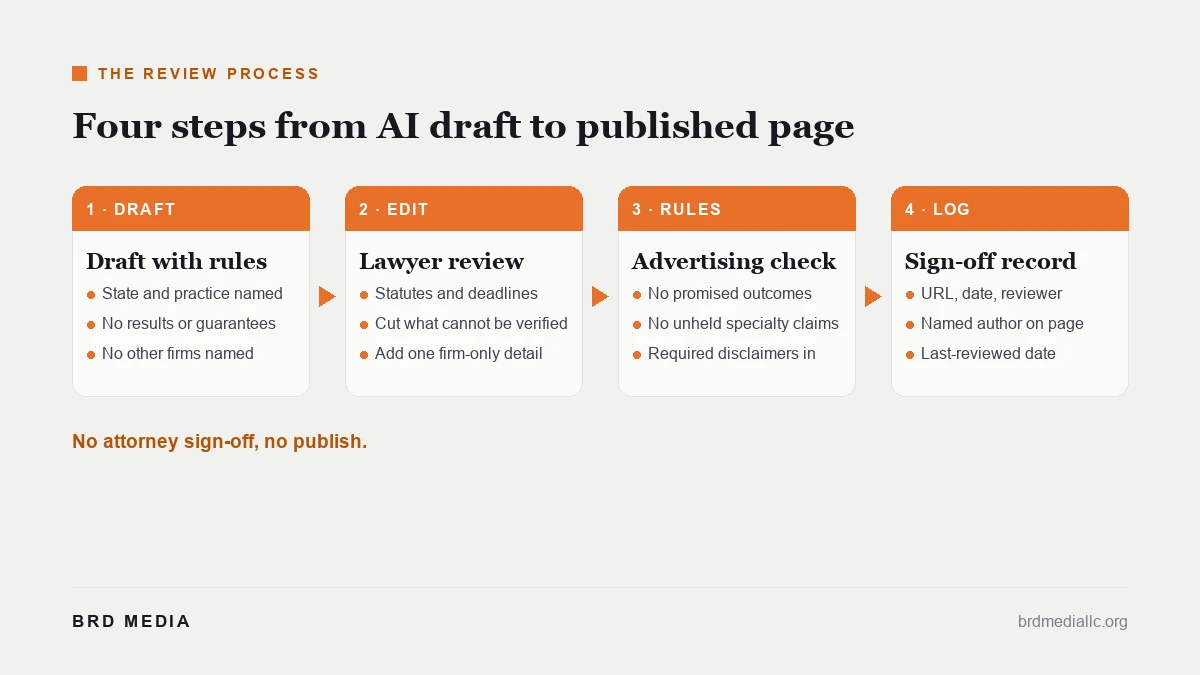
Four steps, each with an owner and a check. The table is the whole process. It fits on one page of the firm's own marketing procedures.
| Step | Owner | What gets checked |
|---|---|---|
| 1. Draft with rules | Marketing lead or writer | The prompt names the state, the practice area and the audience. The draft contains no case results, no guarantees and no firm names other than your own. |
| 2. Lawyer edit and fact-check | A named attorney | Every statute, deadline and procedure is checked against the current source. Anything the lawyer cannot verify is cut. The page gets at least one detail that only this firm knows. |
| 3. Advertising rules check | The same attorney or the firm's ethics contact | Nothing promises an outcome, nothing claims a specialty the firm does not hold out, required disclaimers are in place, and no testimonial or result is shown without the context your rules require. |
| 4. Sign-off log | Marketing lead | URL, date, reviewer and a one-line note go into a shared sheet. The page gets a named author and a last-reviewed date. |
The detail a page gets from the lawyer in step two is what separates it from the thousand other pages on the topic. It can be a court's local practice, a common mistake the firm sees at intake, or a timeline that surprises clients. Google rewards original, useful pages, and the lawyer's knowledge is the part a model cannot supply.
Most firms have pages that never went through any review, AI-drafted or not. Run the same table over them, starting with the pages that get the most traffic.
Do the high-traffic pages first and the rest on a schedule. A firm with a hundred pages that reviews ten a month is done in under a year, and a firm that publishes a new batch of unreviewed pages every month is making the problem faster than it fixes it.
The honest take: AI drafts save time on structure and a first pass. They do not save the lawyer's time on the checks that matter. If a firm is not willing to have an attorney read every page, the safer choice is fewer pages, not faster ones. Published pages are advertising, and the firm answers for them.
Review is one half of the job. The other half is deciding what to publish. Our guides to content marketing for law firms and law firm marketing strategies cover which pages earn cases. If you want a team to build the pages, with an attorney review step before anything goes live, see our law firm SEO services. Engagements start at $2,500 a month on a six-month term; the three tiers are on our pricing page. Ad spend is separate and belongs to you.
Send us your five most visited pages. We will tell you which ones are thin, which are templated, and what an attorney review should catch.
Book a consultSources: Google Search Central, Google Search's guidance about AI-generated content · Google Search Central, spam policies (scaled content abuse) · Google Search Central, creating helpful, people-first content · Illinois Rules of Professional Conduct, Rule 7.1
See BRD Media first in Google
Add us as a preferred source and our SEO breakdowns rank higher in your own Search results, AI Mode and AI Overviews.