
Most pages on this subject open with the same three tactics: list the clinic in directories, sponsor a local event, ask a blogger. They treat a link as something you go and get. The question a clinic owner should be asking is the other one: what does a med spa have that makes a publisher want to link to it? That is what a med spa earns links for, and it is a shorter list than the tactics pages suggest, but every item on it is real.
One honest sentence on the consensus: links from relevant local and industry sites help a clinic rank locally, and a handful of good directory listings are the usual starting point. This post starts where the directories stop, and assumes the clinic already has a profile, a site and a booking flow; our med spa SEO guide covers those.
A link from another site is a vote that your page is worth reading, and it is one input among many into how a page ranks. The input is also the easiest one to abuse, which is why Google writes it down. Its spam policies define link spam as "creating links to or from a site primarily for the purpose of manipulating search rankings," and the examples include buying or selling links for ranking purposes, exchanging goods or services for links, excessive link exchanges, and "low-quality directory or bookmark site links."
The same page is plain about the other side. Buying and selling links is a normal part of advertising and sponsorship on the web, and it is not a violation as long as the link is qualified with a rel="nofollow" or rel="sponsored" attribute. So a sponsorship can be worth doing for the audience it reaches. It just should not be bought as a ranking tactic. For a clinic whose name is its livelihood, a link scheme is a liability with a bad ratio: the upside is a small ranking nudge and the downside is a manual action on the one site that carries every booking.
That leaves earning. A link is earned when the person linking has a reason that has nothing to do with you: you gave their reader something useful. Everything below is a way of having something useful to give.
A medical aesthetics practice employs people who know things a local reporter, a wedding blogger or a health writer needs and cannot easily get: what a treatment is, what recovery looks like, what to ask before booking, what is changing in the field.
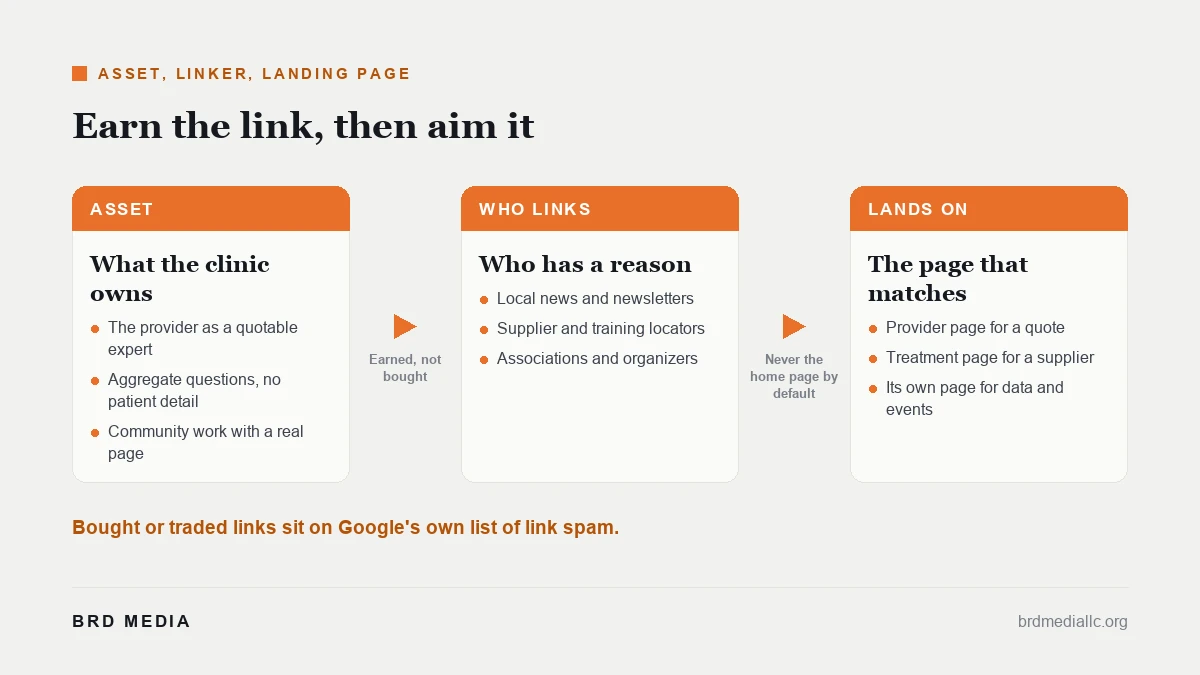
Build for that. Give each provider a page on the clinic site with credentials, training, the treatments they perform and a short statement of what they will speak about. That page is what a journalist checks before quoting, and it is the page the link should land on. Then make the provider findable: a few local outlets, the chamber, a school or hospital newsletter, a professional association. Offer a specific, useful answer to a specific question rather than a general pitch.
A clinic sits on information nobody else has, and none of it needs a patient in it: the questions people ask at the consult, in aggregate, the treatments that book up before wedding season, how far people travel for a particular service. Each can become a short, citable page: "What our front desk hears most before a first filler appointment" is a page a local writer can link to and a patient can read.
One rule is non-negotiable. Use aggregate counts and common questions only. Never an individual story, a photo, a date of service or any detail that could identify a person, and have your counsel read the first one you publish. The aim is a page that earns a link on its merits, and a clinic that cannot publish it safely should publish the questions and leave the numbers out.
Several suppliers, device makers and training organizations publish a list of providers on their own sites, and a listing there is a link from a relevant, trusted domain. The terms are set by the company, not by you. Some tie a listing to training or certification, some to being an active customer, and some to a review of your credentials. The approach is simple: ask your account representative or training contact whether a provider listing exists, what qualifies, and what they need from you, then give them the provider names, credentials, and the exact page on your site to link to.
Professional associations and training bodies work the same way. If a provider completed a recognized course or belongs to an association that lists members, the listing is earned by the credential, and it carries more weight than a generic directory because the page it sits on is about the same field. These are the links that are hard for a new competitor to copy, because they follow real relationships.
| Asset | Who has a reason to link | What they need from the clinic | Where the link should land |
|---|---|---|---|
| Provider as expert | Local news, newsletters, bloggers | A named, credentialed source who answers plainly and on deadline | The provider page |
| Aggregate clinic data | Local writers, community sites | A short page of counts and common questions, with no patient detail | The data page itself |
| Supplier or training listing | The manufacturer or training body | Provider names, credentials and the page to link to | The treatment page for that product |
| Community work | The organizer, the local paper | A page written for a stranger, with a date and a named partner | The community page |
| New treatment launch | Local health and appearance outlets | A plain page on what it is for, who performs it and what the consult covers | The new treatment page |
Sponsoring a charity run for a logo on a banner earns a link only if the organizer's site happens to list sponsors, and then it is usually a footer link on a page nobody reads. Community work earns a good link when it produces something a person would want to read: a page on your site that says what the clinic did, with whom, when and where, and a note to the organizer or the local paper that points at it.
Two things make that work. The page has to exist before you ask, written for a stranger. And the work has to be real, with a date and a named partner, because a page of vague goodwill gives nobody a reason to link. If the sponsor link is paid, ask for it to be marked rel="sponsored", which keeps you inside Google's policy.
Launching a new treatment gives a clinic a small, honest news hook once. The hook is not "we now offer X." It is what the treatment is for, who it suits, what the consult covers and who at the clinic is trained to perform it. Write it as a plain page on the site, skip any claim about results, and send a short note to the two or three local outlets that cover health and appearance. The page earns the link or it does not, and either way it becomes the treatment page the clinic needed.
The home page is the wrong answer more often than the right one. A link is strongest, and most useful to the reader who clicks it, when it points at the page that matches the reason it was given. A quote from a provider goes to the provider page. A supplier listing goes to the treatment page for that supplier's product. A community post goes to the community page. A data page goes to itself.
That has a second benefit. Treatment pages that rank for treatment searches are the pages that fill the book, and a link into one of them helps the page that sells. If the clinic has one services page for twelve treatments, there is nothing good to link to, which is a problem to fix before any outreach; once they exist, the work of a med spa SEO program is to connect them to the sources that have reason to point at them, and our content marketing work covers the supporting articles and data pages.
Count the links a patient could plausibly read, not the links in total. Ten links from sites a local resident would visit outweigh a hundred from sites no one does. Each quarter, list the new referring sites, mark which landed on a treatment or provider page, and watch the rankings for the three or four treatment terms those pages target. Add one question to the front desk script: "How did you hear about us?" Occasionally the answer is a local article, and that is the link paying twice.
If the clinic loses the map pack because of where the searcher stands, links are not the cause; see why a med spa loses the map pack.
The honest take: a clinic in a crowded market will not earn its way past established competitors in a month, and no single link changes that. The compounding comes from the provider pages, the data pages and the supplier listings existing at all, each one a durable reason for someone to link. Start with one provider page and one supplier listing this quarter, and measure again in ninety days.
We do not have a link-earning case study to cite, and we would rather say so than stretch one. Dr. Mo's Wellness Home came to us for a full-funnel build: website, landing pages, paid media and the CRM system behind the booking flow. It produced 144.9 percent year-over-year active-user growth and roughly 20 new patients a month. We cannot show a link result from it, and we do not claim one. We do start with the site and the intake, because a link earned today lands on a page that either books or does not.
Write down the five assets above and mark which ones your clinic already has. Pick the one that needs the least work, usually a provider page, and publish it. Ask one supplier or training contact whether a provider listing exists. Draft the community page for the last thing the clinic did that deserves one. That is a week's work, and it begins the answer to what a med spa earns links for in your market. For the plays that fill this month's book while the links compound, start with med spa marketing ideas, and for the whole acquisition picture see our med spa marketing agency page.
Engagements start at $2,500 a month on a six-month term; the three tiers are on our pricing page. Ad spend is separate and belongs to you.
Send us the provider names and the treatments you want to grow. We will map which assets you already own, who has a reason to link to them, and which page each link should land on.
Book a consultSources: Google Search Central, spam policies for Google web search · Google Search Central, qualify your outbound links to Google
See BRD Media first in Google
Add us as a preferred source and our SEO breakdowns rank higher in your own Search results, AI Mode and AI Overviews.