
The account is open, the certification question is settled, the campaign is structured by drip. Then half the ads come back disapproved and the other half limited. The guides that rank for IV therapy advertising are deep on account structure, call tracking and conversion imports. On what the copy is allowed to say, they offer very little that is specific.
This post is the copy half, written as a procedure. It covers how IV therapy ad copy meets health policy on Google: which claims trip a review, how to say the same thing in a form that clears, what the landing page has to carry, and what to change first when a specific ad is rejected. Review outcomes vary and the platform's policy is always the authority. Treat every example line here as a pattern, not a guaranteed approval.
Health advertising is policy-reviewed, product and outcome claims are the usual trigger, and the destination is judged along with the ad. Google's healthcare and medicines policy restricts prescription drug terms in ads, landing pages and keywords, not just in the headline. If your account itself is not cleared to run yet, that is an eligibility problem rather than a copy problem, and our post on LegitScript certification for an IV clinic covers it. This post assumes the account is eligible and asks what the ads may say.
Five claim shapes come up again and again on IV accounts.
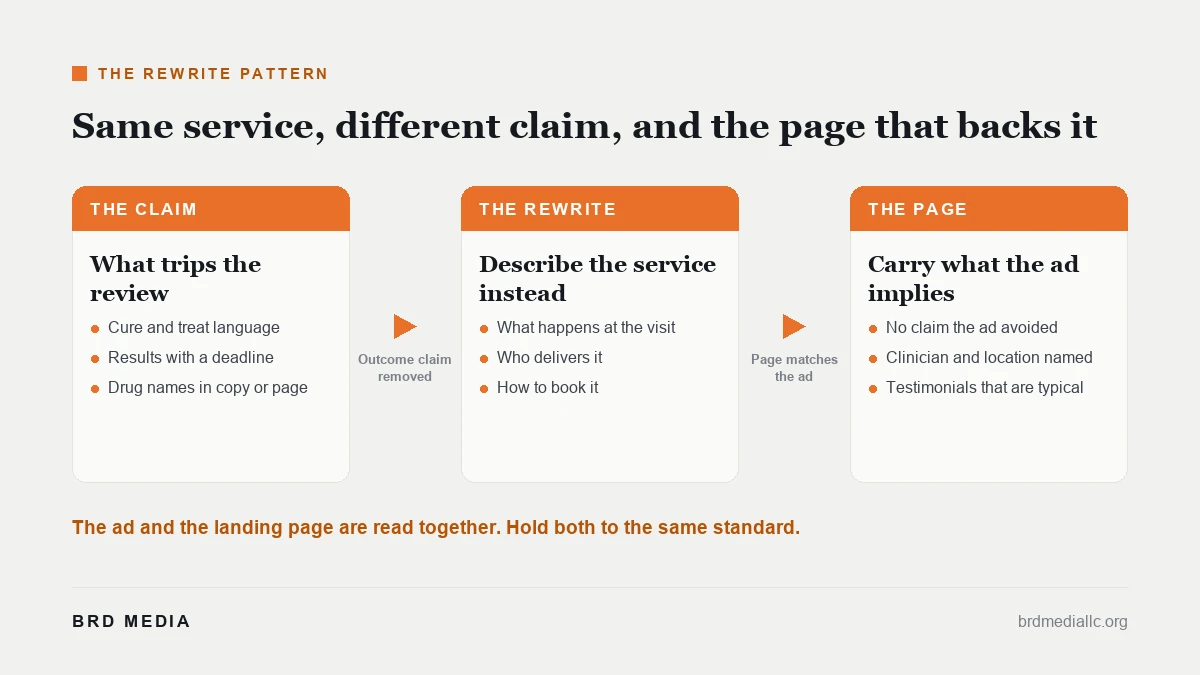
The pattern is the same every time. Keep the service, drop the promised result, and replace it with something concrete a reviewer cannot object to: what happens at the visit, who delivers it, where it is, and how to book. The benefit does not disappear. It moves into specifics the clinic can stand behind.
| Claim shape | Why review objects | A version that describes the service | What the landing page has to carry |
|---|---|---|---|
| "Cures hangovers fast" | A medical outcome stated as certain | "IV hydration in [neighborhood]. Walk-ins and same-day slots." | The drip's ingredients, who administers it, and no cure language |
| "Boost your immune system" | A health effect the clinic would need to substantiate | "Vitamin drips administered by licensed nurses. Book online." | Clinician credentials and a plain description of the visit |
| "Look ten years younger in one session" | An improbable result with a deadline | "Wellness drips in a private suite. 45-minute appointments." | Appointment length that matches the ad, no before-and-after promise |
| A prescription drug named in the headline | Restricted term in ad, keyword or page | "Physician-supervised weight management. Consult first." | The same restriction applied across every page the ad reaches |
| "Tired all the time?" (on Meta) | Implies the viewer has a condition, which Meta does not allow | "Vitamin drips by appointment. Open evenings and weekends." | No quiz or headline that diagnoses the visitor |
Two notes on that table. The bracketed and numeric details are placeholders: only print an appointment length or a staffing claim that is true for your clinic. And a version that clears is not the same as a version that converts. Test two or three service-first lines per ad group and let the booking rate pick.
Keywords need the same pass. A keyword list that bids on a prescription drug name or on a condition phrase can put the account in front of a reviewer even when every headline is clean, because the policy covers keywords along with ads and pages. Search terms that describe the service, the setting and the location usually carry the buying intent anyway. Someone searching for an IV drip near their office is closer to booking than someone searching a symptom.
Reviewers read more than the headline. Sitelinks, callouts, images and the destination page all count, and a clean headline on top of a callout that says "detox your body" fails anyway.
Testimonials are where clinics get caught. The FTC's health products guidance says testimonials reporting results more dramatic than people can generally expect are likely to be deceptive, and that "results not typical" does not fix it. Quote the experience, not the outcome: the staff, the setting, how easy booking was.
Meta runs its own review with its own rules. Its personal attributes standard shows the line clearly: "New diabetes treatment available" is acceptable, "Do you have diabetes?" is not. We cover the Meta side of creative in our med spa advertising playbook, and the same logic applies to drip clinics. If the landing page carries a tracking pixel, that is a separate question again, and our post on HIPAA compliant marketing covers it.
Read the policy named in the disapproval before you touch anything, because it tells you whether the problem is the ad, the keyword or the page. Then work in this order:
Never try to beat a filter with misspellings or symbols. Google's abusing the ad network policy bans manipulating ad text to bypass detection and treats it as egregious: the account is suspended without warning.
The honest take: sometimes the copy is not the problem. If the only way to make an offer sound appealing is to promise a medical outcome, the offer itself is the issue. Clinics that lead with the experience, the staff and the convenience tend to see fewer disapprovals, because there is less in them to object to.
Premier IV advertised physician-supervised GLP-1 care on Meta and Google with campaigns structured to survive ad-platform review, and produced $80,496 or more in cohort lifetime value from 99 qualified leads. The detail is on the Premier IV case study. The case study describes the campaigns as structured to survive ad-platform review.
Engagements start at $2,500 a month on a six-month term, and the three tiers and what sits in each are on our pricing page. Ad spend is separate and belongs to you. If you want the account built and the copy written for you, that is what Google Ads management for regulated clinics is for, and the vertical side sits in our IV therapy and GLP-1 clinic marketing services.
Export every active headline, description, sitelink and callout into one sheet. Mark each line that promises an outcome, names a drug or asks the reader about a condition. Rewrite those lines as service descriptions. Then open each landing page and apply the same marks there. Getting IV therapy ad copy through health policy review is mostly this: one sheet, one afternoon, and the page held to the same standard as the ad.
We will audit your ads and landing pages against the policies and hand back copy that describes the service.
Book a consultSources: Google Ads healthcare and medicines policy · Google Ads misrepresentation policy · Google Ads abusing the ad network policy · Meta advertising standards, personal attributes · FTC health products compliance guidance
See BRD Media first in Google
Add us as a preferred source and our SEO breakdowns rank higher in your own Search results, AI Mode and AI Overviews.