
Most telehealth weight loss programs pick their market the way a retailer would: where the searches are, where the cost per click is lowest, where a competitor looks weak. Then the leads arrive from a state where nobody on the team can treat, and the program pays for a click, a form and a phone call that end in "sorry, we cannot see you".
Telehealth licensure, advertising and the states a weight loss program can reach are one decision, not three. Nobody on page one of Google connects them. The legal guides are written for the clinician deciding where to prescribe, and the marketing guides never mention licensure at all. This post sits in between.
Where a clinician may treat is a state question, and in telehealth it is generally decided by where the patient is located, not by where the clinic or the website sits. The legal guides on page one for this search all say the same thing, and it is the reason a national website does not make a national practice. Treat it as the working assumption and confirm it with your counsel or medical director.
Compacts speed things up without changing the rule. The Interstate Medical Licensure Compact describes itself as a faster pathway for physicians, and it is clear that the licenses are still issued by each individual state. It covers physicians only, and it currently includes 44 states, the District of Columbia and Guam. It does not cover nurse practitioners or physician assistants, so confirm separately with counsel how each of them is licensed in every state the program serves. Your counsel or medical director confirms which states each clinician on the program can serve. That list is the input to everything below.
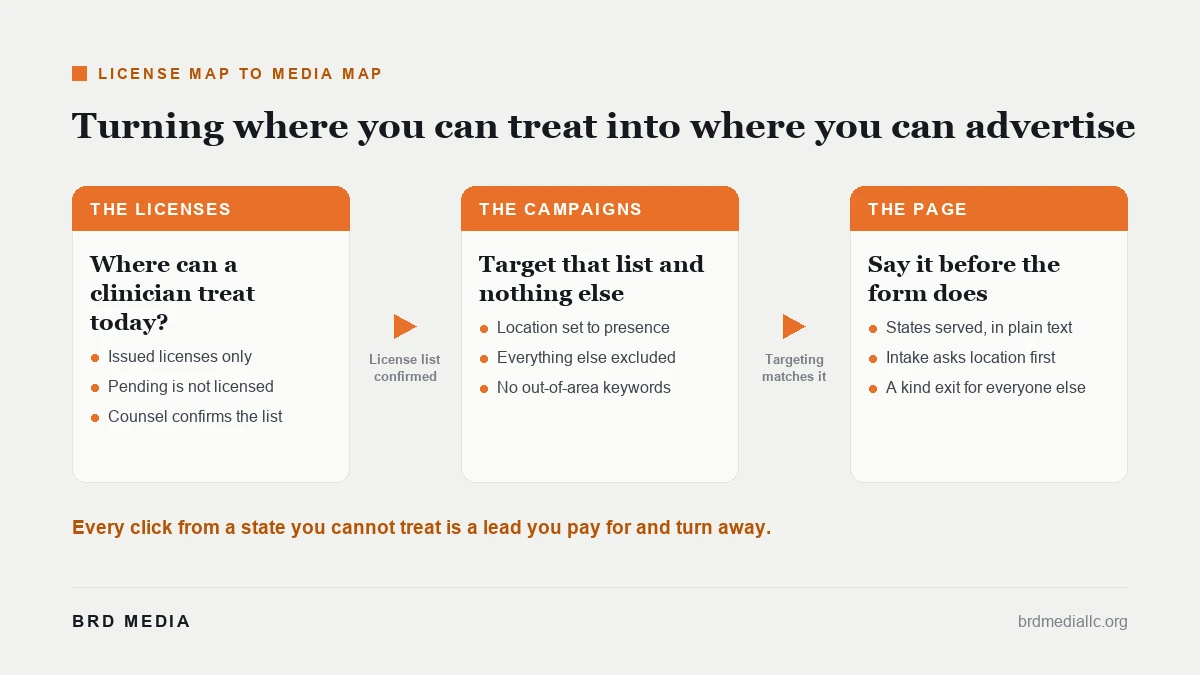
Start with the confirmed list of states and build every channel from it.
Search campaigns. Target the licensed states and nothing else. Google offers two location settings, and its own location targeting help page recommends the stricter "Presence" option when a business sits in a sensitive vertical or only wants people physically in the targeted area. The broader "Presence or interest" setting will show your ad to someone in an unlicensed state who searched about a licensed one. For a telehealth program, that is a paid click you cannot convert.
Keywords. Drop state and city modifiers for places you do not serve. A search that names an unlicensed state tells you where the patient is.
Paid social. Same list, same discipline. Location targeting on Meta is set by state, and the ad copy never implies the viewer has a condition, which Meta's personal attributes standard rules out.
The landing page. Name the states served in plain text near the top, not in a footnote. Put the location question first on the intake form, so a patient in an unlicensed state learns that in ten seconds rather than after the eligibility quiz. Give them a kind exit. And when the program touches GLP-1 prescribing, the product-side rules sit on top of this one; our GLP-1 clinic marketing page covers that side.
| Situation | License position | What the campaign may target | What the page has to say |
|---|---|---|---|
| Single-state clinic with telehealth follow-ups | Licensed in its home state | That state, by presence | The state served and the clinic address |
| Multi-state telehealth program | Licensed in a confirmed list of states | Those states only, everything else excluded | The full list, in text, above the fold |
| Program adding a state | License applied for, not yet issued | Nothing in that state yet | Nothing yet; a waitlist page at most, if counsel approves it |
| Physician licensed through a compact | A separate license issued by each state | Each state as its license is issued | The same list, updated the same day |
| Patient near a state line | Depends on where the patient is at the time of care | Presence targeting handles most of it | Intake confirms location before anything else |
The license comes first and the marketing follows it, in this order. Counsel confirms the license is issued and the clinician can serve patients there. The landing page's state list is updated. The intake form's accepted-states list is updated. Then the location is added to the campaigns, with a small test budget of its own so you can see what that state costs. Prescription fulfillment has its own state rules as well, so confirm the pharmacy side covers the new state before the first dollar goes live.
Get the order wrong and the page promises something intake cannot deliver, or the campaign buys leads the clinicians cannot see. If you are still building the program itself, our guide to what a weight loss clinic should launch first covers the sequence. This post assumes the sequence and handles the map.
Three things, and each one is easy to miss on a dashboard.
The fix for all three starts in reporting. Break conversions out by the state the patient is in, not just by campaign. A campaign that looks healthy overall can be carrying one state that produces clicks and no eligible patients, and you only see it when the report is cut by location. Once the targeting matches the license list, that column should read zero outside your licensed states. If it does not, a setting somewhere is still reaching past the map.
Patient data is a separate gate with its own rules, covered in our post on HIPAA compliant marketing, and clearing the licensing question says nothing about it.
The honest take: if your program is licensed in one state, most of this collapses into a single setting. Where it starts to matter is the second and third state, because that is when national-sounding campaigns get built and leads start arriving from everywhere. Build the map before you build the campaign, not after the first month's invoice.
Premier IV ran a compliant GLP-1 acquisition system across several clinic locations, with lead routing that sent each inquiry to the right one. It produced $80,496 or more in cohort lifetime value, and the detail is on the Premier IV case study. The routing is the same discipline as the license map: a lead that reaches someone who cannot serve it is a lead you paid for twice.
Engagements start at $2,500 a month on a six-month term, and the three tiers and what sits in each are on our pricing page. Ad spend is separate and belongs to you. The license-to-media map is where our weight loss clinic marketing services start with a telehealth program.
Ask counsel for the confirmed list of states each clinician can serve, in writing. Open your campaigns and compare their location settings with that list, and switch anything set to "Presence or interest". Add the state list to the landing page in plain text. Move the location question to the top of intake. Getting telehealth licensure and advertising to agree on which states a weight loss program can reach is one afternoon of work, and it stops the program paying for leads it has to refuse.
We will map your license list onto your campaigns and show you where spend is leaking across state lines.
Book a consultSources: Interstate Medical Licensure Compact, a faster pathway to physician licensure · Google Ads help, target ads to geographic locations · Google Ads healthcare and medicines policy
See BRD Media first in Google
Add us as a preferred source and our SEO breakdowns rank higher in your own Search results, AI Mode and AI Overviews.