
For a decade, dental SEO meant one thing: rank in the blue links for "dentist near me" and win the click. That game is quietly ending. In 2026, a patient types a question and Google answers it at the top with an AI Overview, or they skip Google entirely and ask ChatGPT. If your practice isn't part of that answer, you don't get a lower ranking. You get left out of the conversation. This is what AI search for dentists actually means, and what to do before your competitors figure it out.
Search used to send people to your site. Now it increasingly answers them in place. AI Overviews appear on the majority of searches and have reduced clicks on the top organic results by roughly 58%. Patients are getting their shortlist of practices from an AI summary, not from scrolling ten blue links.
At the same time, a growing share of people skip search engines and ask an assistant directly. "Find me a highly rated dentist near me who takes my insurance" is now a ChatGPT question. The practice that AI names gets the patient. Everyone else is invisible, no matter how good their old rankings were.
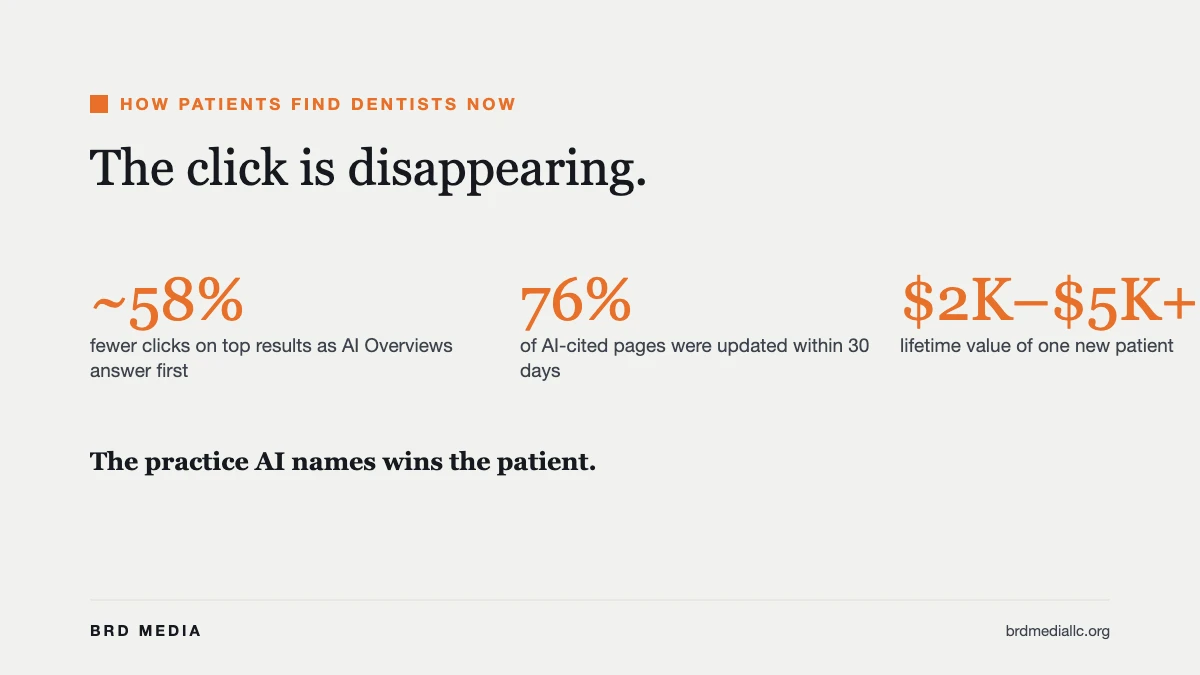
Dental is high-intent and high-value. Around 90% of prospective patients take action within a day of searching for a dentist, and a single new patient is worth $2,000 to $5,000+ over their time with your practice. When AI shortens the path from question to chosen provider, the practice that owns the answer captures that value immediately, and the one that doesn't loses it before the patient ever sees their site.
The local map still matters, too. AI answers and Google's local results both lean heavily on your Google Business Profile, your reviews, and consistent information across the web. Weak signals there and you're not in the AI's shortlist at all.
AI engines don't reward the same things the old algorithm did. They favor content that directly answers real questions, is well structured, and is current. Three things matter most:
The good news: the practices adapting to this are still few, so the window is open. What we build for dental clients:
Done together, this is what turns a practice into the one AI recommends, and it feeds every other channel in your dental marketing.
We publish real numbers. Our engagements run in three tiers, with web and SEO in every one:
Structure is the other half of showing up in AI answers. Assistants quote sites where every service owns one clear page, which is exactly the system laid out in SEO keywords for dentists, mapped to pages.
AI answers pull from the same places a patient looks: your profile, your reviews, your pages. Most of the practical dental marketing moves that feed those answers is the same work you would do anyway, which is why we run it as one program rather than two.
We'll check whether AI Overviews and ChatGPT surface your practice, show you who they name instead, and map what it takes to become the answer.
Book a free strategy callRelated: The same shift applies to med spas: how new clients find med spas today.
Related: the best dental SEO companies for 2026.
See BRD Media first in Google
Add us as a preferred source and our SEO breakdowns rank higher in your own Search results, AI Mode and AI Overviews.