
Ask ten agencies how long SEO takes and nine will say the same thing: six months to a year. It's the most repeated line in the industry, and in 2026 it's mostly wrong. Part of it is outdated, because AI search rewards fresh, structured content in weeks, not quarters. Part of it is a business model, because "be patient" is a convenient thing to say while a retainer clears every month. Here's the honest breakdown of what actually happens, and how fast.
It isn't made up. Traditional SEO, ranking a page in the classic blue links for a competitive term, genuinely takes time: technical cleanup, content, links, and trust all compound slowly. For a hard national keyword on a newer site, six to twelve months is real.
The problem is that the industry quotes that worst-case timeline for everything, including work that moves far faster. And it conveniently sets expectations so low that almost no result looks like underperformance.
AI answers rewrote the clock. Google's AI Overviews and AI Mode, plus assistants like ChatGPT and Perplexity, pull from fresh, well-structured content, and they update quickly. Structured-data and content changes can surface in Google's AI answers in as little as 14 to 21 days. Perplexity often reflects new content in two to four weeks. And freshness is a real ranking factor now: 76% of ChatGPT's most-cited pages were updated within the last 30 days.
Local moves fast too. Google Business Profile and map-pack improvements often show up in weeks, not months, because you're competing in one city instead of the whole country.
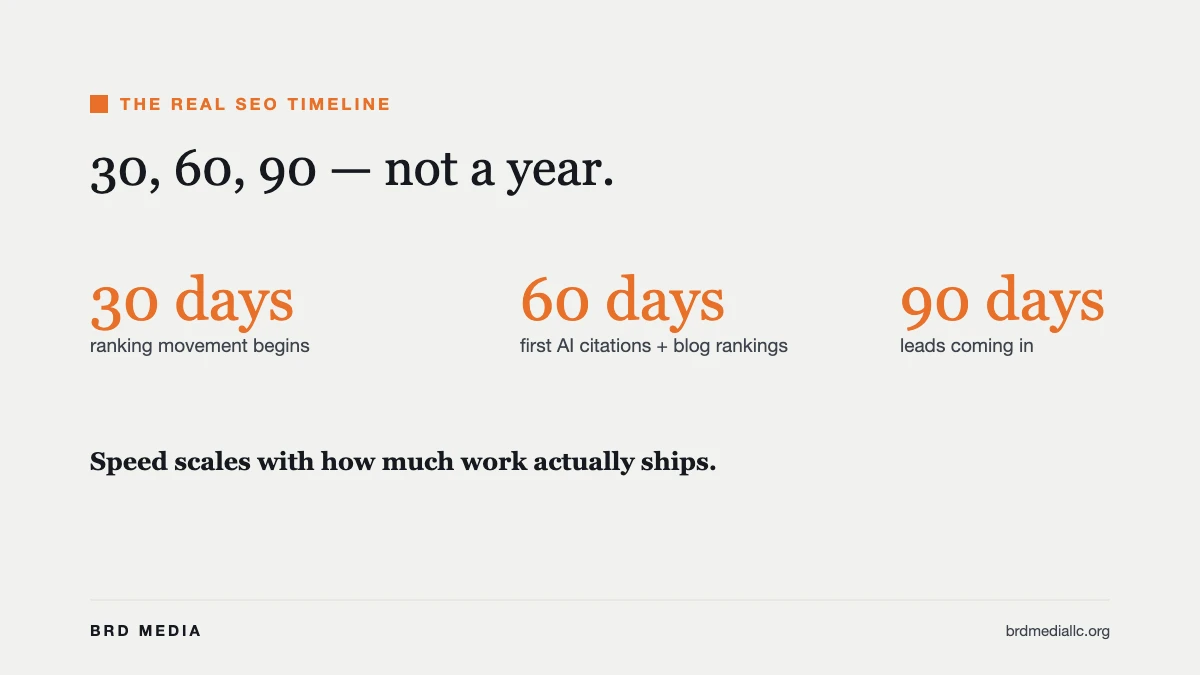
Here's what we actually see across our clients when the work is done consistently:
That's not a promise of a #1 ranking for your hardest keyword in 90 days. Competitive heads still take longer to fully win. It's the honest curve: real, visible movement early, compounding into leads by the end of the first quarter.
SEO timelines aren't fixed physics. They scale with how much real work gets done. An agency shipping three pages and one blog a month will always look like SEO takes forever, because at that pace it does.
We work a client's profile as hard as the budget allows: as many page optimizations, schema markups, and posts as we can ship every month, not a fixed trickle. More correct work in month one means more movement in month one. That's the whole difference, and it's why our SEO services are built around volume and velocity instead of a slow drip.
Fast results still require the right work, done right:
Whether it's dental SEO, law firm SEO, or any local vertical, the levers are the same. The only variable that changes your timeline is how much of it actually gets done.
We publish real numbers. Our engagements run in three tiers, with web and SEO in every one:
The higher the tier, the more work ships each month, and the faster the curve. That's not a coincidence. It's the whole point.
We'll audit where you stand, show you what can move in the first 30 days, and give you an honest schedule instead of a stall.
Book a free strategy callRelated: If you are also budgeting, what SEO costs for a small business.
See BRD Media first in Google
Add us as a preferred source and our SEO breakdowns rank higher in your own Search results, AI Mode and AI Overviews.