
You already paid for marketing once. It didn't work. Now another agency wants you to trust the same promise.
That hesitation is the smartest thing your practice has going for it.
Most multi-provider groups that got burned didn't hire a bad agency. They hired a fine one that sold them the wrong thing: a website refresh, a new logo, a social calendar. What fills a schedule is showing up the second a patient searches. The medical practice marketing agency pitch loves the shiny deliverable. Patients don't book the logo.
Here's what actually moves new-patient volume, why the last engagement probably missed it, and how to tell the difference before you sign anything.
They sold a deliverable, not an outcome. A site that looks great but ranks for nothing is a brochure nobody opens.
The industry has a name for it: the "click trap." Traffic goes up, the dashboard looks busy, and the schedule stays flat. You paid for impressions, not appointments.
Multi-provider groups feel this harder than solo docs. More overhead, more chairs to fill, more salaries riding on volume. A pretty rebrand doesn't pay any of that down.
The behavior is well documented, and it doesn't favor the brand-first approach.
Every one of those numbers points at the same thing: being found and trusted in search. Not a logo.
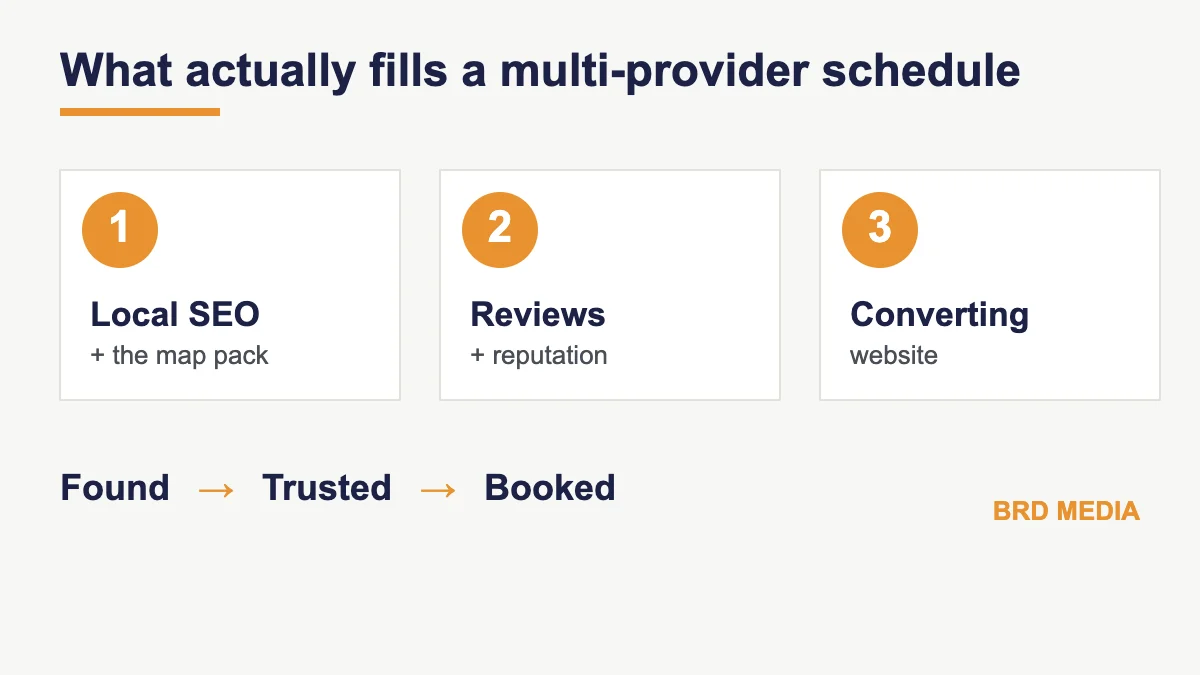
Patients search "dermatologist near me" and "[suburb] urgent care." If you don't rank in the local pack, you're invisible at the exact moment of intent. For a group, each provider and each location needs its own page. Generic "our team" listings don't rank. This is the core of medical practice SEO, and the same local-search work behind our local SEO playbook.
When two practices both rank, reviews break the tie. A steady stream of recent, responded-to reviews is a ranking signal and a trust signal at once. Reputation management is not optional for groups.
Fast, mobile, and easy to book. The job of the site is to move a searcher from "found you" to "booked" without friction. Design that wins awards but buries the phone number loses patients.
Buying brand work before visibility. A beautiful site nobody can find is the single most common way practices light money on fire.
Run this quick diagnostic on your current setup:
If you answered no more than once, your last agency sold you the wrong service.
For a multi-provider group, visibility is a structural problem, not a campaign. Multiple locations means multiple location pages, each earning its own local rankings and feeding the same intake system. That's the work that compounds. Our Chicago SEO services are built around exactly this for healthcare.
One of our healthcare clients, Dr. Mo Wellness, is the clean example. Not a rebrand. A system: a website built to convert, paid media feeding it, and a CRM catching every inquiry.
Read the full breakdown in the Dr. Mo Wellness case study. The point isn't the channel mix. It's that the pieces were built to hand off to each other.
| What most agencies sell | What fills the schedule |
|---|---|
| Logo refresh and rebrand | Local SEO and the map pack |
| Social media calendar | A unique page per location |
| Vanity traffic reports | A review and reputation system |
| Award-bait website design | One-tap mobile booking |
| Brand-first spend | Paid ads after the funnel converts |
Patients don't book the logo.
A practice in Naperville competes on a different board than one in Oak Brook, Elmhurst, or Lombard. Each suburb has its own search demand and its own ranked incumbents. You need a page built for every community you actually draw patients from.
And the pressure is real: consolidators are buying independent practices across Chicagoland and outspending everyone on ads. Organic visibility and reviews are how an independent or mid-sized group fights back without matching a hospital network's budget. Industry research backs the shift: referrals alone no longer guarantee a full schedule.
Medical practice marketing isn't a one-time campaign. It's infrastructure. The practices that treat it that way get something a rebrand never delivers: predictable, compounding patient flow instead of a referral pipeline they can't control.
You don't have a branding problem. You have a "can patients find and trust you in search" problem. Buy for that.
Before you hire anyone it helps to know what you are buying. What a doctor's marketing program should include is the short version of that, and what to fix before you buy patient traffic covers the unglamorous work most agencies will not do for you.
If your last agency sold you a rebrand and called it a strategy, let's look at what's actually keeping your schedule from filling. No pitch deck, no fluff, just where the money should go.
Book a Free Strategy Call →Related: Before you sign with anyone, ask does your marketing agency carry cyber insurance.

Founder of BRD Media LLC, a Villa Park, IL digital marketing agency helping Chicago-area service businesses get organized, get found, and get more leads. Chris builds CRM and automation systems for local businesses across DuPage and Cook County.
See BRD Media first in Google
Add us as a preferred source and our SEO breakdowns rank higher in your own Search results, AI Mode and AI Overviews.