
Every front desk hears it: "I found you on Google." It is a useful sentence and a poor measurement. Dental new patient attribution is the habit of recording where a patient came from so the next marketing decision rests on something better than a guess. No method is exact, and a consistent one beats a clever one that nobody follows. This post gives a method a practice can run with a clipboard and a monthly report. It is general information, not legal or accounting advice.
The phrase hides three very different paths, and they call for different credit.
All three can get logged as "Google", which makes the search channel look larger than it is and can hide the referrals, mailers and word of mouth that started the first path. Our guide to dental marketing ideas ranks the channels by effort and payback. Attribution is how you check that ranking against your own schedule.
Ask one question, the same way, every time: "How did you first hear about us?" Then offer fixed choices so the answers can be counted. Free text alone turns into a pile of unsorted notes by March.
| Answer the patient gives | What the desk logs |
|---|---|
| Searched Google for a dentist or a treatment | Google search, non-branded |
| Typed our name into Google | Google search, branded, plus "how did you hear of us first?" |
| Saw us on the map or in the reviews | Google map listing |
| A friend, family member or another patient | Referral, with the referrer if the patient volunteers it |
| Another provider or specialist | Professional referral |
| Mailer, event or something seen locally | Offline, with the piece named |
| An AI assistant or chat tool | AI search |
| Cannot remember | Unknown |
Ask twice. The person who books the appointment hears the answer first, and the clinical team can confirm it at the first visit, when the patient has relaxed and remembers more. When the two answers differ, keep both. A patient may say "Google" on the phone and "my sister told me" in the chair. In that case the sister created the demand, and Google got the click.
Keep patient names out of the marketing spreadsheet. The answers live in your practice system, and the monthly report holds only counts. If you are unsure how your system should store this, ask your compliance advisor.
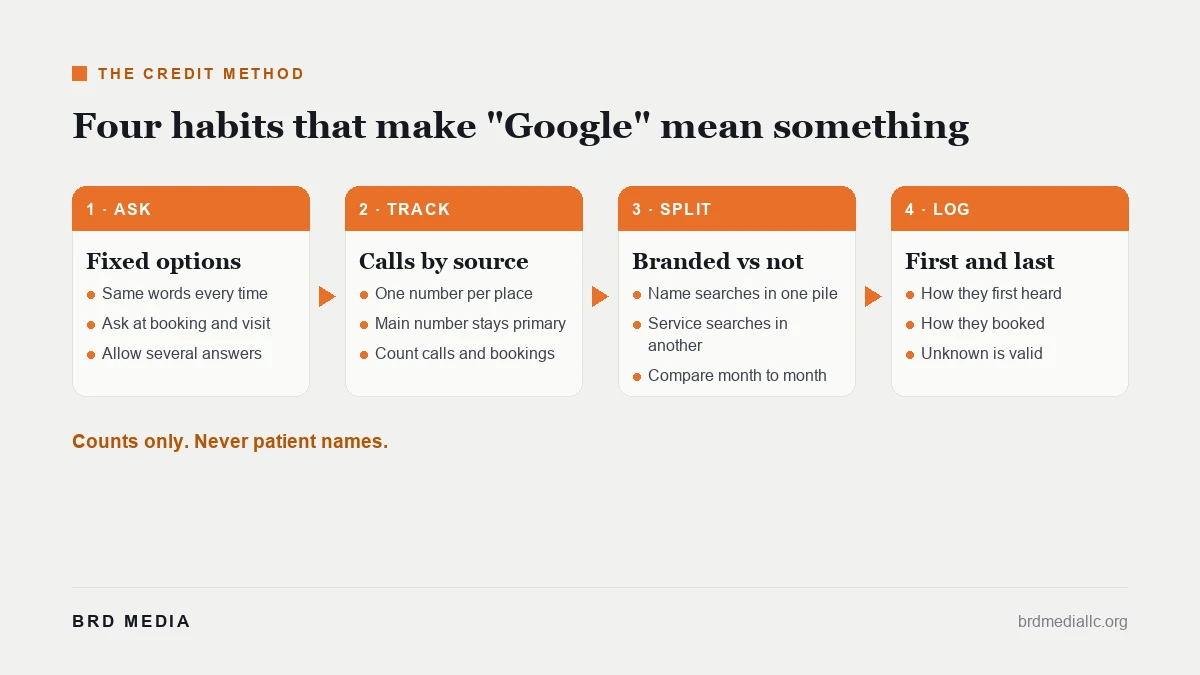
Some new patients call instead of filling out a form, and a call that never touches a form leaves no trail unless you build one. Use a separate tracking phone number for each place a patient can find you: one on the website and one on print and mailers. Count calls from your map listing with the calls figure in your Business Profile's performance report, and keep your main number unchanged on the profile so your listings stay consistent.
Then count at the call level. Each month, tally calls per number, and for each call note whether it became a booked appointment. A number that rings often and books rarely tells you something different from a number that rings rarely and books every time. For forms and online booking, add a hidden "source page" field, so a request that began on your implant page is not filed as a generic inquiry.
Branded search is any query that contains your practice name or a close variation of it. Non-branded is everything else, such as "dentist near me" or "dental implants" with your area. Google Search Console has a Performance report where the Queries tab lists the searches that showed your site, and you can filter it, so a monthly look takes minutes. Google describes that report in its Search Console Help.
Why bother? The two groups answer different questions. Non-branded queries show whether people who have never heard of you can find you, which is the job of your dental SEO services and your map listing. Branded queries show whether your other work is making people curious enough to look you up. A rise in branded searches after a mailer may be a sign the mailer did something, even if every one of those patients says "I googled you".
Analytics adds a trap. In Google Analytics 4, the Direct channel is defined as visits from a saved link or a typed URL, and Organic Search covers non-ad links in search results. A patient who types your name into Google lands in Organic Search, and one who types your web address into the browser bar lands in Direct. The default channel group definitions spell this out. So an organic search total includes people who were already sold, and it should never be read as a count of people you won from a cold search.
Pick a rule, write it down and apply it the same way for a year. A simple one needs two fields per new patient: first touch (how they first heard of you) and last touch (how they booked). A patient can have the same answer in both, and often will.
| What the patient said | First touch | Last touch |
|---|---|---|
| "A friend told me. I googled you and called." | Referral | Google, branded |
| "I searched for an emergency dentist and picked you." | Google, non-branded | Google, non-branded |
| "I got your mailer, then looked you up on the map." | Mailer | Google map listing |
| "I do not remember." | Unknown | Whatever the call or form source shows |
Report both columns side by side. First touch tells you what creates demand, and last touch tells you what captures it. Both matter, and neither is the whole answer. Avoid splitting one patient into fractions of credit across channels, because the fractions are guesses that look like data.
Small samples will mislead you in a month with a dozen new patients. Look at three months together before cutting anything, and compare each channel with its own earlier months, not with a figure from another practice. Our guide to AI search for dentists covers AI visibility, and SEO keywords for dentists shows which searches to expect in the non-branded group. For patients who mention an assistant, a ChatGPT version of the same intake question is worked out in its own guide.
Four mistakes are common, and each one is cheap to fix.
A hypothetical month shows how this plays out. A practice books 20 new patients. Fourteen say "Google". When the clinical team asks the second question at the first visit, six of those fourteen say a friend or family member told them first and they searched the practice name afterward. The practice now has a different picture: eight patients came from a cold search or the map, six came from word of mouth that Google only confirmed, and six named other sources. That is a long way from "70 percent of our new patients come from Google", and it points to a different decision: keep the referral habit warm, and judge the search work on the eight.
The honest take: a practice will never know the exact reason a patient picked up the phone. The goal is a record consistent enough to show which channels deserve more money and which deserve less. A rough answer collected every time is worth more than a precise answer collected once.
Dental new patient attribution is not a separate project. It is the feedback loop for everything else: your map listing, your site, your referral work and your mailers. Our dental marketing work reports on calls and booked appointments, so this record can sit beside a monthly report that goes past clicks. Engagements start at $2,500 a month on a six-month term; the three tiers are on our pricing page. Ad spend is separate and belongs to you.
Send us your current intake questions. We will mark up a fixed-option version and a monthly report that fits on one page.
Book a consultSources: Search Console Help, Performance report (Search results) · Analytics Help, Default channel group
See BRD Media first in Google
Add us as a preferred source and our SEO breakdowns rank higher in your own Search results, AI Mode and AI Overviews.