
A vendor says Local Services Ads put a firm at the top of Google and charge only when a potential client calls. A partner asks whether that is worth trying. Many pages on the subject count the same thing: cost per lead. That is the wrong number to decide with, because a lead is not a case. This post gives you the formula that matters, a worked example with made-up numbers, the call-quality checks that change the answer, and a 60-day test that limits what you can lose.
Cost per lead tells you what a phone call or message costs. It says nothing about who was on the line. A lead can be a person with a case the firm handles, a person with a case the firm does not handle, a person looking for a job, a person who dialed the wrong office, or a person who wants free advice and will never hire anyone.
Google's help page on how leads work explains that you can be charged for answered phone calls, for missed calls during business hours that run past 20 seconds, and for messages. It also says that Google keeps assessing lead quality for a period after the charge and may credit low-quality or duplicate leads. Google can filter out some leads, but it cannot know whether a caller who is a real prospect will hire your firm, so the lead price is still a price for contact, not for a client. That page does not address legal leads in particular, so check what applies to your account and practice area before you build a budget on it.
The takeaway: a lead is a cost you pay up front, and a signed case is the result you want. Judge the channel on the second one.
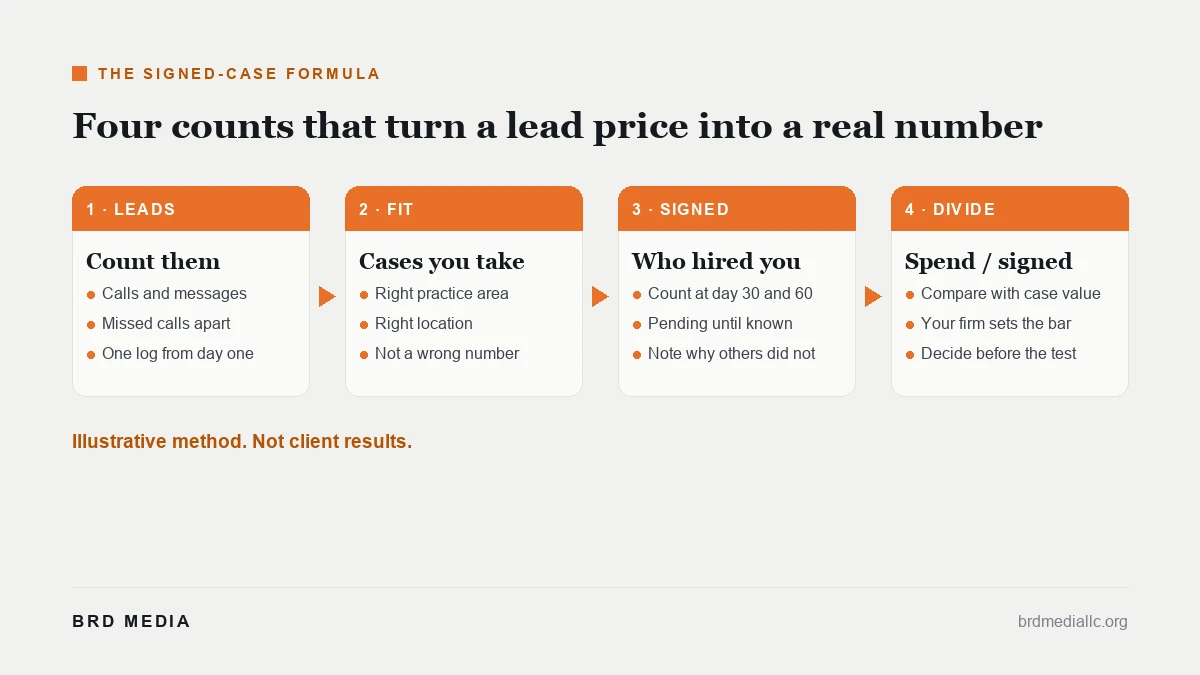
The formula has three steps. Count the leads. Count how many were about a case you would take. Count how many of those signed. Then divide your spend by the signed cases.
Cost per signed case = spend divided by signed cases. Or, in the same terms, cost per lead divided by the share of leads that sign.
The two rows below are illustrative. They are made-up numbers to show how the math can flip a decision, not client results and not a benchmark for any market or practice area.
| Illustrative month | Spend | Leads | Cost per lead | Cases worth taking | Signed | Cost per signed case |
|---|---|---|---|---|---|---|
| Channel A | $4,000 | 40 | $100 | 16 | 4 | $1,000 |
| Channel B | $4,000 | 25 | $160 | 15 | 5 | $800 |
Channel A looks cheaper on the invoice, at $100 a lead against $160. Channel B produces fewer leads, but more of them are worth taking and more of them sign, so each signed case costs less. A firm that compared lead prices would pick the wrong channel. The formula is the same whether you are looking at Local Services Ads, search ads or any other source.
One more step makes the number useful: compare cost per signed case with what a signed case is worth to the firm. Only your firm can supply that figure, because it depends on the practice area, how matters resolve and how your fees work. If you are comparing Local Services Ads with other ways to bring in cases, our guide to Google Ads vs SEO for law firms compares paid and organic search.
The lead you pay for only turns into a case if someone picks up and handles the call well. A firm that answers a high share of calls in the first minute can pay a similar lead price to a firm that sends half its calls to voicemail, but may get far more for it. Before you decide the channel does not work, find out how many of the calls it sent were answered by a person who could take the matter.
Intake is often the first thing to repair, before any change to the ads. Our law firm marketing strategies guide begins with intake for that reason: a paid lead that meets a slow phone is a lead you bought twice.
Lead prices and the share of leads that sign differ by practice area, by how many firms are bidding in your market and by how well your profile reads. A firm in a smaller market with fewer competing advertisers may see a different picture from a firm in a large city. A practice area with clear, urgent demand may behave differently from one where people shop around for weeks.
That is why a figure from another firm or an industry article tells you little about yours. The only reliable number is the one from your own test. A firm with several practice areas should keep a separate log for each one, because a combined average can hide a channel that works for one area and fails for another.
A test limits what you can lose and gives you real numbers. Here is a plan that fits a firm that has never run the channel.
Signed cases take time to appear, because a matter can sign weeks after the first call. Count a lead as pending until the firm knows the outcome, and re-run the numbers after the test ends.
Paid ads for legal services are communications about the firm, and lawyer advertising rules can apply to them. In Illinois, Rule 7.1 bars false or misleading communications about a lawyer or the lawyer's services. Other states have their own rules about wording, testimonials and results, and the platform may have its own eligibility steps for law firms. Ask your counsel to review the profile text before it goes live.
The honest take: Local Services Ads can be worth it for some firms in some markets and a poor use of money for others, and nobody can tell you which one you are before you measure. What you can do is turn the question into one number, cost per signed case, and run a capped test to find it. If the number beats what a signed case is worth to your firm, keep going. If it does not, you have learned that for a small, known cost.
Paid leads work best when the rest of the system is ready for them: intake that answers fast, a site that backs up the profile and a way to count signed cases. Our law firm PPC management is built around signed cases rather than clicks, and it covers Google Ads and Local Services Ads together. If you are still deciding whether the firm needs organic search too, do law firms need SEO is a good place to start. Engagements start at $2,500 a month on a six-month term; the three tiers are on our pricing page. Ad spend is separate and belongs to you.
Send us your practice areas and your current intake steps. We will set up the call log and the signed-case math.
Book a consultSources: Local Services Help, How leads work · Illinois Rule 7.1
See BRD Media first in Google
Add us as a preferred source and our SEO breakdowns rank higher in your own Search results, AI Mode and AI Overviews.