
Open page one for this topic and you will find a pile of pages about e-commerce tools and ad-creative software, and a handful of agency posts that list formats in a line each: video, user-generated content, provider intro, testimonials. Few show how to build a specific ad for a specific treatment that passes review. That is the gap. The rules for why Meta rejects an ad are in our post on med spa advertising, and this one is about what to put in the ad instead.
First, the rule, stated as Meta states it. The health and wellness standard says ads promoting cosmetic products, procedures or surgeries must be targeted to people at least 18, and it lists "general cosmetic products, procedures, surgeries depicting before and after transformation" among the things advertisers can run when targeting adults. For cosmetic procedures and weight loss alike, ads cannot contain "statements of inferiority about physical appearance." For weight loss, ads also cannot depict a close-up on a specific body area by pinching fat. In a health or weight loss context, ads cannot use clickbait that promises specific outcomes within a set timeframe without disclaimers or qualifiers. So a before-and-after is allowed, and an ad still gets pulled when the words wrapped around it cross one of those lines. If a split-screen is working for your account, keep it. The rest of this post is for the clinic that has had one rejected, cannot get written authorization for one, or wants more than one creative to test.
Four reasons, none of them about the policy. The first is paperwork: a patient photograph used in an ad is a use of that patient's information, so get a written authorization that names advertising, and have your counsel confirm the form. A clinic without that file for a given result should not run it. The second is fairness: results photographed under different lighting, angle and posture invite a reviewer, and a patient, to question whether the image is representative. The third is range: a split-screen shows one outcome for one person, and a prospect who does not see herself in it has nothing else to engage with. The fourth is fatigue. One strong image shown to the same audience for weeks stops earning attention, so a clinic with a single hero creative runs out of road.
The answer is a set of formats that prove the clinic is competent without depending on one photograph. Here are the three that carry most of the load.
A provider facing the camera and answering one question about one treatment is the most reusable format a clinic has. The structure is simple. Open on the question a patient asks in the first ten seconds of a consult, such as "how long will I be out of commission after microneedling?" Answer it in plain words. Say who is speaking and where they practice. End with the next step: book a consult. Keep it short enough that the answer arrives before the viewer scrolls; start under thirty seconds and let your own retention numbers move it.
Two cautions keep it approved. Describe the treatment and the process, not the viewer: a description of what the treatment involves, in the words your provider and the product labeling use, describes a service, while "your skin looks tired" describes the reader. And stay away from promised results and timeframes. A provider who says what the consult covers and what recovery usually involves, in qualified language, is both safer and more persuasive than one who promises an outcome.
The second thing a prospect wonders is not "will it work?" It is "what will it feel like, who will be there, and will I be judged?" Footage of the treatment room, the check-in, the consult conversation and the aftercare sheet answers that without showing a patient's body at all. A fifteen-second walk through a first visit, narrated by the person who will greet her, does more for a nervous first-timer than a polished result image.
This is also the format with the least policy exposure, because it shows a place and a process. Do not film patients without a signed authorization, and keep the camera off anyone mid-treatment unless the release covers advertising use.
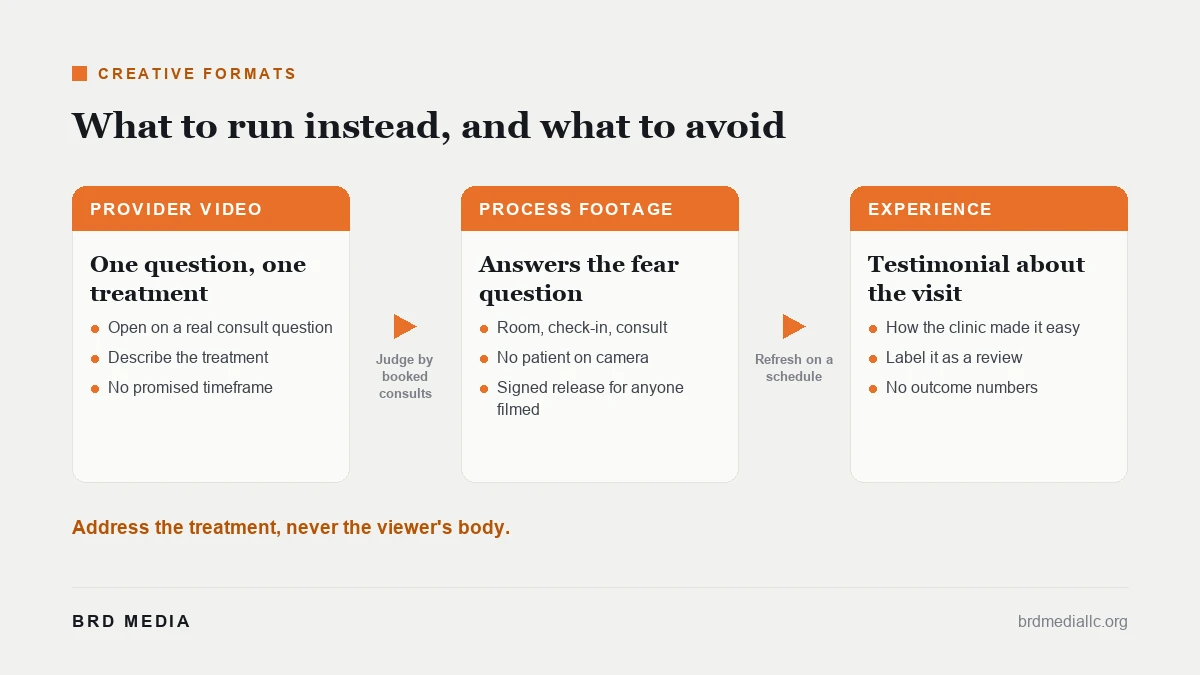
A patient describing the experience of the clinic is the strongest form of social proof that clears review easily. "I was nervous before my first consult, and my provider walked me through everything" is a testimonial about the experience. "I lost eleven pounds in two weeks" is an outcome claim with a timeframe, and it sits squarely in the territory the standard warns about. If you quote a review, label it as one, for example "Google review, September 2026," and get the reviewer's agreement to use it in an ad.
Meta's personal attributes standard adds a second filter on the wording. It lists "Ready to upgrade your skin to look younger?" as a line that is not allowed, because it implies something about the person reading. The pattern to avoid is a headline that addresses the viewer's body, age or condition. The pattern to write is a headline about the treatment or the clinic.
The image is half the ad. The headline and primary text carry the rest of the review risk, because the standard judges the words. Use one formula: name the treatment, say what the consult covers, describe who it is for in terms of the service rather than the person's flaws, and give one next step. For example: "Microneedling consults at our Chicago clinic. A provider walks you through what the treatment involves, how many visits to expect and what recovery looks like. Book a consult." That line avoids the viewer's body, avoids a timeframe, and promises an experience the clinic controls.
Keep the targeting equally plain: location and an age of 18 or over, not health interests or body-related behaviors. The rest of the audience setup is in our paid playbook.
The table pairs each treatment with a format that fits and the kind of line to avoid. The example lines are patterns, not claims; write your own from the consult.
| Treatment | Format that fits | The line to avoid |
|---|---|---|
| Neuromodulators | Provider answering one consult question, with the treatment described in plain words | A headline that addresses the viewer's face or age, such as "Tired of looking older?" |
| Dermal filler | Process footage of the consult and the mapping conversation, no close-up of a face | A promised timeframe for visible change |
| Microneedling and skin treatments | Short explainer of what the treatment is, with an experience-led testimonial | A line that names or implies a skin condition the viewer has |
| Body contouring | The device and the treatment room, the provider explaining who a consult suits | A negative statement about a body part |
| Laser treatments | Provider walk-through of the first visit and what to prepare | "Gone in X sessions" style promises with no qualifier |
None of this removes the need to check the ad against the standard, and the standards change. Read the current page before every launch, not the version you remember.
Set the rules before launch so the decision is not made in a panic. Run three or four creatives in the first round, each a different format, so you learn which format the audience responds to rather than which wording of one format. Judge them on booked consults and show rate, not clicks; a cheap click from a viewer who never books is the expensive one. Our post on the consult show rate covers why the number after the click is the one to watch.
Refresh on a schedule: when a creative has run long enough that your cost per booked consult is climbing while the audience stays the same, replace the weakest one, keep the strongest and add one new format. Keep a library of provider clips so a new creative is an edit, not a shoot. If a rejected ad needs repair, resubmit after changing the wording first, and see the steps in our paid playbook. Our Meta ads management retainers include creative production and iteration.
The honest take: for some treatments a real before-and-after is still the best creative a clinic has, and the right move is to use it, with authorization, an 18-plus audience and clean wording. The alternatives above are not a replacement for that; they are what keeps the account running when the photographs are unavailable, rejected or tired.
Premier IV is a GLP-1 weight-loss practice. The case study credits LegitScript certification and Meta prescription-drug authorization for keeping the accounts live long enough to compound. The campaign produced 99 qualified leads and 12 or more patients, about 12 percent of leads, with a 12-month patient lifetime value of $6,708 and a cohort value above $80,496. The carry-over to this post is narrow: an account that stays approved keeps compounding, and creative that passes review is part of staying approved.
Pull your current Meta creatives and mark each as a split-screen, a provider, a process, a testimonial or an explainer. If four of five are the same format, that is the finding. Record two provider clips on the questions your front desk hears most, film the first-visit walk-through, and collect two experience-led testimonials with permission. Read your headlines against Meta's list and rewrite any that address the viewer instead of the treatment. For the offers and audiences to put around the creative, see our Facebook ads for med spas page, and for the wider acquisition plan our med spa marketing agency page.
Engagements start at $2,500 a month on a six-month term; the three tiers are on our pricing page. Ad spend is separate and belongs to you.
Send us your top three treatments and your current ads. We will map the formats, write the lines that pass review and set the refresh schedule.
Book a consultSources: Meta Transparency Center, Health and Wellness advertising standard · Meta Transparency Center, Privacy Violations and Personal Attributes
See BRD Media first in Google
Add us as a preferred source and our SEO breakdowns rank higher in your own Search results, AI Mode and AI Overviews.