
Every guide to advertising a weight loss program ends the same way: get certified, do not name the drug, do not promise a number. Good advice, and all of it is about the week before you launch. None of it is about 9am on a Tuesday when the campaign that was booking consults is marked Disapproved and the phone has stopped ringing. A glp-1 ad disapproved google notice is a procedure, not a verdict, and this post is that procedure.
One rail first. BRD is a marketing agency. Nothing here says what a clinic may prescribe, compound or claim; that is between the clinic, its counsel and the platform's policy. What follows is how to read the notice, what to change, what to run in the meantime and how to keep it from happening twice.
Google's healthcare and medicines policy restricts prescription drug terms in ads, keywords and landing pages, requires telemedicine providers to hold LegitScript certification, and adds Google's own application on top: advertisers must apply to serve ads for prescription drug services. Drug and brand names in creative trip automated review. Outcome claims with a number or a timeframe trip it too. The appeal is filed from inside the account after the asset changes. That is the consensus. It tells you the button. It does not tell you which asset to change.
A disapproval is three facts stacked together: the policy that fired, the asset it fired against, and the surface where it found the problem. Hover over the status in the Campaigns view and the notice names the policy. Open Policy Manager and it lists every affected ad, keyword and destination. Read all three before changing anything, because the same policy name means different work depending on where it landed.
| What the notice says | What it usually means | The asset to change | What to submit |
|---|---|---|---|
| Healthcare and medicines, prescription drug terms, on the ad | A drug or brand name, or a close variant, is in a headline or description | The ad text | A new ad with the term removed, then the appeal marked "made changes to comply" |
| Same policy, on the destination | The landing page names the drug, the dose or the pharmacy, or links to a page that does | The landing page, and every page one click away from it | Fix the page, wait for it to be live, then appeal; the ad is not the problem |
| Same policy, on keywords | The keyword list contains drug names | The keyword list and the search-terms report | Remove the terms, add them as negatives, resubmit |
| Unapproved substances | Something on the page reads as an unapproved or compounded product for sale | The page copy and any product schema | Counsel reviews the page before anything is resubmitted |
| Misrepresentation, unrealistic claims | A weight number, a percentage or a deadline in the ad or on the page | Wherever the number is | Rewrite to describe the program, appeal as a dispute only if there was no number |
The one that costs clinics the most time is the second row. A clean ad pointing at a page that names the medication will be disapproved again after every rewrite, and the account team burns a week editing headlines that were never the problem.
Rewrite by policy, not by instinct. For a prescription-drug-terms notice, the fix is removal, full stop. The drug name comes out of the ad, the keywords and the page, including image alt text and the FAQ, and the ad describes the program: medically supervised weight loss, an initial consultation, what a visit involves, where the clinic is. If the program cannot be described without naming the medication, the answer is certification, and the certification post covers what that application asks for. No copy change gets a non-certified advertiser past that policy.
For a claims notice, take the number out and keep the sentence. "Lose 20 pounds in 8 weeks" becomes "a supervised program with weekly check-ins". For a destination notice, treat the landing page like an ad: the same standard applies to the headline, the body, the testimonials and the footer links. Then make every change in one pass, because Google's ad review page says changes to an ad restart the review, and most reviews take up to one business day. Five separate edits can be up to five business days.
This is also where the Google Ads management service earns its keep for a clinic: the rewrite happens against the policy text, in one submission, with the destination fixed first.
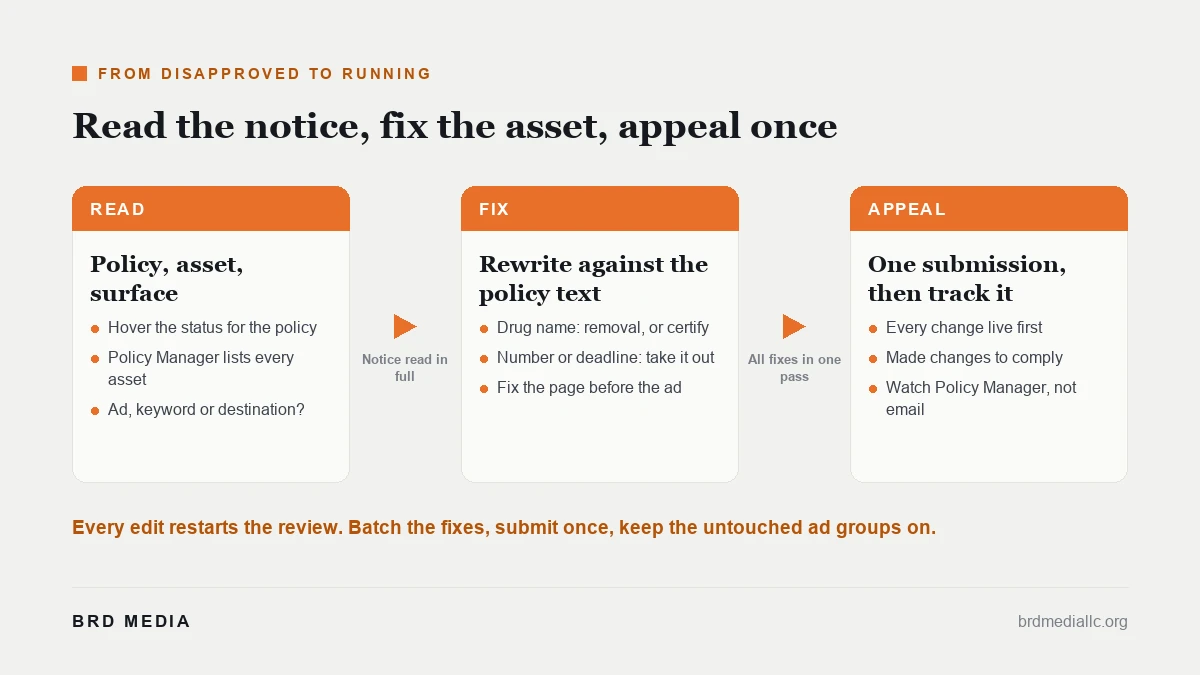
A disapproval hits ads, not the account; account holds come from the strike system or from egregious violations. Everything that was not named in the notice is still serving. Check it is:
Appeal once, after every change is live. From the Campaigns view, hover the Disapproved status and choose Appeal; pick "made changes to comply with policy" if you changed something and "dispute decision" only if you believe nothing was wrong. Select every ad the notice named. Google's disapproved ads help page notes that where the Appeal link is missing, a saved edit to the ad triggers the review instead. Track the result in Policy Manager rather than waiting for an email.
A second refusal on the same asset means the review found something you did not. Go back to the surface named in the notice and read it as a reviewer would: the page title, the meta description, the image file names, the schema, the FAQ answers, the linked pages. The drug name is usually in one of those. If the second refusal names a different policy, treat it as a new notice and start the table again.
Where a policy on Google's strike list is violated repeatedly, unapproved substances among them, the strike system takes over: a warning by email, then a 3-day account hold on the first strike, a 7-day hold on a second strike within 90 days, and suspension on a third within 90 days of the second. The prescription drug terms policy is not on that list, but Google says it can still suspend an account for egregious or repeated violations of any policy. Either way, that is the reason to batch fixes and appeal once rather than resubmit the same ad five times.
Meta rejects for the same two reasons most often, drug names and outcome claims, and a rejected ad there can restrict the whole ad account rather than one ad. The remedy runs through Account Quality. Our practice is one review request, filed after the offending ad has been edited or removed. Same rule as Google: fix the page before the ad, and do not resubmit the same creative repeatedly. Pixel and tracking questions are a different problem and are not covered here.
The clinics that lose a month to a disapproval are the ones that found out from the front desk. Set a policy alert in the account so a status change emails the owner the same day. Add a weekly check of the search-terms report for drug names entering through broad match. Put every new landing page through the same read as the ad before it is linked. The launch sequence post puts that check in week five, before the first dollar, which is where it belongs.
The honest take: some offers cannot be advertised on search, and no rewrite changes that. If the program's only pitch is a medication the advertiser is not certified to name, the honest path is certification first or a different channel, and a marketing agency that says otherwise is selling you the next disapproval.
Premier IV is the proof we point to. A compliant, multi-location GLP-1 patient acquisition engine, built with the prescription drug authorization in place before launch, delivered 99 qualified leads, 12 or more new patients at roughly a 12 percent lead-to-patient rate, and $80,496 or more in cohort lifetime value at $6,708 per patient over twelve months. Compliance was the thing that let it scale, not the thing that held it back.
Open the notice and write down the policy, the asset and the surface. Read the landing page as a reviewer. Make every change in one pass, including the keywords. Confirm the untouched ad groups are still serving. Appeal once, and track it in Policy Manager. A glp-1 ad disapproved google notice handled this way is a two-day interruption. Handled by rewriting headlines, it is a month. Our weight loss clinic marketing services are built so the account never gets to the strike stage in the first place.
Engagements start at $2,500 a month on a six-month term; the three tiers are on our pricing page. Ad spend is separate and belongs to you.
Send us the notice. We will tell you which asset fired and what to submit.
Book a consultSources: Google Advertising Policies, healthcare and medicines · Google Ads Help, about the ad review process · Google Ads Help, disapproved ads: fix or appeal · Google Advertising Policies, the strike system for repeat violations · Meta Advertising Standards, drugs and pharmaceuticals
See BRD Media first in Google
Add us as a preferred source and our SEO breakdowns rank higher in your own Search results, AI Mode and AI Overviews.