
Updated September 2026.
Most lists of dental marketing ideas are the same twenty items in a shuffled order, with no opinion about which one you should run on Monday. That is the problem. A practice owner with four hours a week does not need a longer list, they need a shorter one with a sequence attached. This guide ranks the ideas by what they cost, how much work they take, and how long before somebody new sits in the chair. We run these programs for dental practices, so the ordering comes from watching which plays move the schedule and which ones just look busy on a report.
Read ten pages on this topic and you will get the same core set. Claim and work the Google Business Profile. Collect reviews constantly. Make the site fast and easy to book from. Text your recall list. Ask happy patients for referrals. Run search ads on treatment terms. Post before-and-after photos. Show up at the school fundraiser. None of that is wrong, and none of it is a secret.
Where practices lose money is in running eight of those at 20 percent effort instead of three at full effort. Marketing that half works costs the same in staff hours as marketing that works, and produces a fraction of the appointments. So the useful question is not "what else could we try," it is "what do we run first, and what are we allowed to ignore until that is finished."
The second thing nobody tells you is that these ideas are not independent. Reviews make the map pack work. The map pack makes ads cheaper, because a searcher who has already seen your name clicks your ad more often. Ads that send people to a page with a slow form waste both. Treat them as a stack, not a menu. That stacking effect is the whole argument for a single coordinated dental marketing program instead of five vendors who never talk to each other.
Here is the honest ranking. Effort is your team's time, cost is real dollars out the door, and the last column is how long before you can reasonably expect a booked appointment traceable to that play.
| Idea | Effort | Monthly cost | First booked patient |
|---|---|---|---|
| Google Business Profile, fully worked | Low | $0 | 2 to 6 weeks |
| Review engine, asked at every visit | Low | $0 to $50 | 3 to 6 weeks |
| Phone-first booking path and call handling | Medium | $0 | Immediate |
| Recall and reactivation texts to your own list | Low | $0 to $100 | Days |
| Patient referral program | Medium | Low | 4 to 8 weeks |
| Google Ads on treatment and emergency terms | Medium | $1,500+ spend | Days |
| Paid social offers and retargeting | Medium | $750+ spend | 1 to 3 weeks |
| Local SEO, service pages and neighborhood pages | High | Retainer | 3 to 6 months |
| Patient story and staff video | High | Time | 1 to 3 months |
| Community sponsorship and events | Medium | Varies | Slow, hard to trace |
Read the table top to bottom and the pattern is obvious. The cheapest, fastest plays are the ones that use assets you already own: your profile, your patients, your phone line. The expensive, slow plays buy reach you do not have yet. Start with what you own.
Every service you offer gets its own entry. Hours must match reality including holidays, because a wrong hour on a Saturday sends an emergency patient to the practice down the street. Twenty real photos, not stock: the front door, the parking, the operatories, the team. Turn on messaging only if someone will answer it inside the hour. Add the booking link. Post something once a week, even if it is a two-sentence note about a service. This takes one afternoon to fix and about twenty minutes a week to maintain.
Not a campaign. A habit. The front desk hands over a card or sends a text with a direct review link while the patient is still in the parking lot. Two things matter more than volume: recency and specificity. A steady trickle of reviews written this month beats a pile from two years ago, and reviews that name the procedure help you show up for that procedure. Google's own profile content guidelines spell out what you can and cannot do here, and the short version is never offer anything of value in exchange for a review.
Call your own office at 4:45 on a Friday and count the rings. Fill out your own contact form on a phone and time how long it takes. Most practices lose more patients in this fifteen-foot gap than they ever lose in search results. The rules we hold clients to: answer inside four rings, return a missed call within an hour, reply to a form inside fifteen minutes during business hours, and never send a new patient to a PDF they have to print.
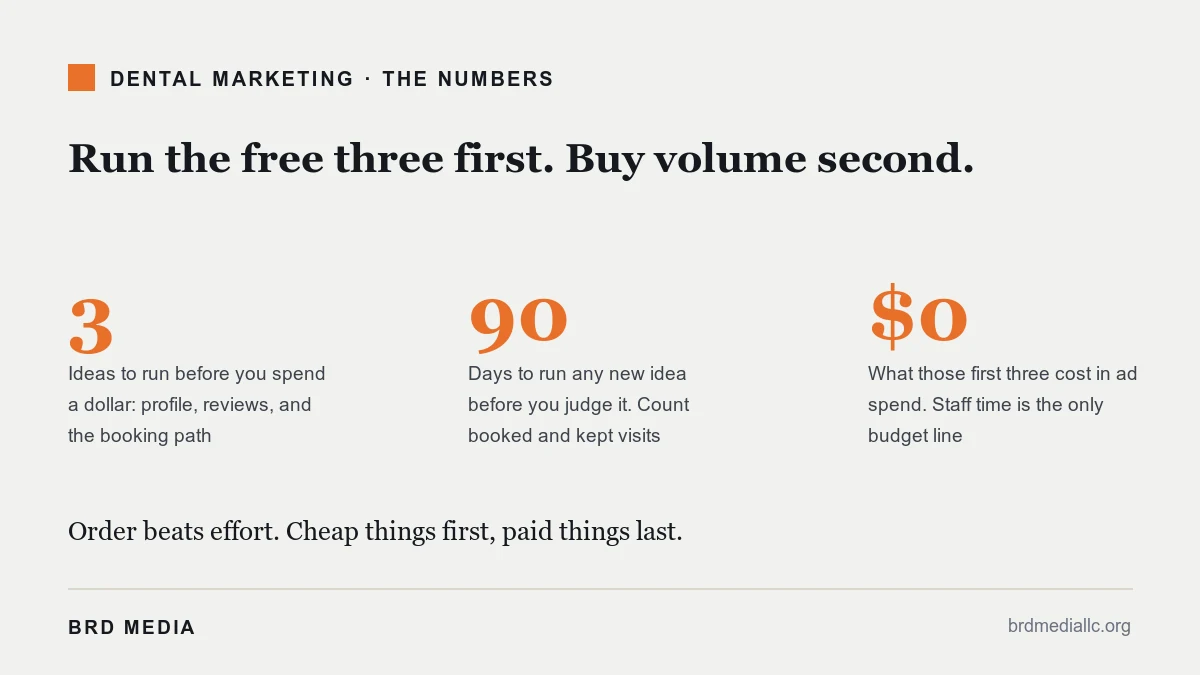
Once the free three are running, paid traffic stops being a gamble and starts being arithmetic. This is also the point where dental SEO services for practices start paying for themselves, because the organic and paid results reinforce each other on the same searches. Search ads are the right first buy for dental because the intent is unambiguous. Somebody typing an emergency or implant term is not browsing. Build the account by treatment rather than one catch-all campaign, geo-fence it to the drive time patients will realistically accept, and add negative keywords for the school, career and do-it-yourself searches that eat budget quietly.
Paid social plays a different role. It is not where people search for a dentist, it is where you stay visible to the ones who already looked. Offers, financing messages, and retargeting the visitors who read your implant page but never called. Judge it on consultations booked, not on cost per click, and expect to test three or four creative angles before one works.
If you want the arithmetic behind the search side before you commit a budget, we broke it down in our guide to what Google Ads cost dentists. And if you are still deciding which terms are worth a page on your site at all, the full dental keyword list maps each one to where it belongs.
Our honest take. Community sponsorship, printed newsletters and branded merchandise are not bad ideas, they are just unmeasurable ones, and they get recommended because they are easy to sell. If your schedule has holes right now, sponsoring a little league team will not fill them. Fix the profile, get the reviews, answer the phone, then buy traffic. Come back to the banner at the ballpark when you are turning patients away.
Weeks one and two are audit and repair. Profile, hours, call handling, form speed, tracking so we can tell which calls came from where. No new spend. Weeks three through six, the review engine goes live and the recall and reactivation messages go out to the existing patient list, which is where the first quick wins almost always come from. Weeks six through twelve, search ads turn on with a tight treatment focus while the service pages and neighborhood pages get built underneath them.
At day 90 we look at booked appointments by source, kept-appointment rate, and cost per booked patient. Not traffic. If a play has produced nothing measurable in three months with the budget it needed, it gets cut and the money moves. That single rule saves more money than any clever tactic on this page.
We publish our pricing because hiding it wastes everyone's time. Management starts at $2,500 a month, the middle tier is $4,000, and full market capture is $6,500. Every tier includes the technical work, the site build or reskin, the profile work, schema, tracking and reporting, and every tier carries the same 90-day guarantee. Your ad spend is separate and sits in accounts you own, along with the site, the analytics and the content, so nothing is hostage if you leave.
If you are shopping, the number to compare is not the retainer. It is what the retainer includes and who owns the assets at the end. A cheaper monthly that leaves you with nothing you can keep is not cheaper.
Filling a schedule is a practice problem before it is a dental one. If the gaps are still there after the free plays, the same fixes in the order any practice should run them walks the sequence end to end.
Tell us your market and your open chairs, and we will tell you which three of these dental marketing ideas to run first.
Get a straight answerSources: Google Business Profile content guidelines · FTC Endorsement Guides · American Dental Association practice management resources
See BRD Media first in Google
Add us as a preferred source and our SEO breakdowns rank higher in your own Search results, AI Mode and AI Overviews.