
Every list of SEO keywords for dentists looks the same: a wall of phrases with no instructions. That is why most practices either chase terms their website can never win, or spread one homepage across twelve services and rank for none. This guide gives you the actual keywords, and the part every other list skips: which bucket each term falls into, which page of your site should carry it, and how to build your own list in about 20 minutes for free.
Before you copy a single phrase, sort by intent. Every keyword a dental practice should care about lands in one of three buckets, and each bucket lives on a different part of your online presence. Getting a term in the wrong spot is the most common mistake in the dental sites we audit.
| Bucket | Example searches | Who is searching | Where it belongs |
|---|---|---|---|
| Map-pack terms | dentist near me, emergency dentist near me, dental office near me | Someone ready to book, deciding by proximity and reviews | Google Business Profile, not a website page |
| Service + city terms | dental implants [city], Invisalign [city], pediatric dentist [city], teeth whitening [city] | Someone comparing providers for a specific treatment | A dedicated service page for each treatment |
| Question terms | how long do veneers last, does a root canal hurt, wisdom teeth removal recovery time | Someone researching, weeks or months before booking | Blog posts that link to the matching service page |
These are the service families that carry real search demand for a general practice. Swap in your own city, and only keep the rows for services you actually offer. Each row is one page on your site, not one line stuffed into the homepage.
| Service family | Core keywords (add your city) | Supporting variations |
|---|---|---|
| Emergency | emergency dentist, emergency dental care | same day dentist, toothache relief, broken tooth repair |
| Implants | dental implants, implant dentist | full mouth dental implants, single tooth implant, implant consultation |
| Cosmetic | cosmetic dentist, veneers | smile makeover, teeth whitening, dental bonding |
| Orthodontics | Invisalign, clear aligners | Invisalign provider, adult braces, aligner consultation |
| Family / general | family dentist, dentist accepting new patients | dental checkup, kids dentist, pediatric dentist |
| Restorative | root canal, dental crown | tooth extraction, dentures, bridge repair |
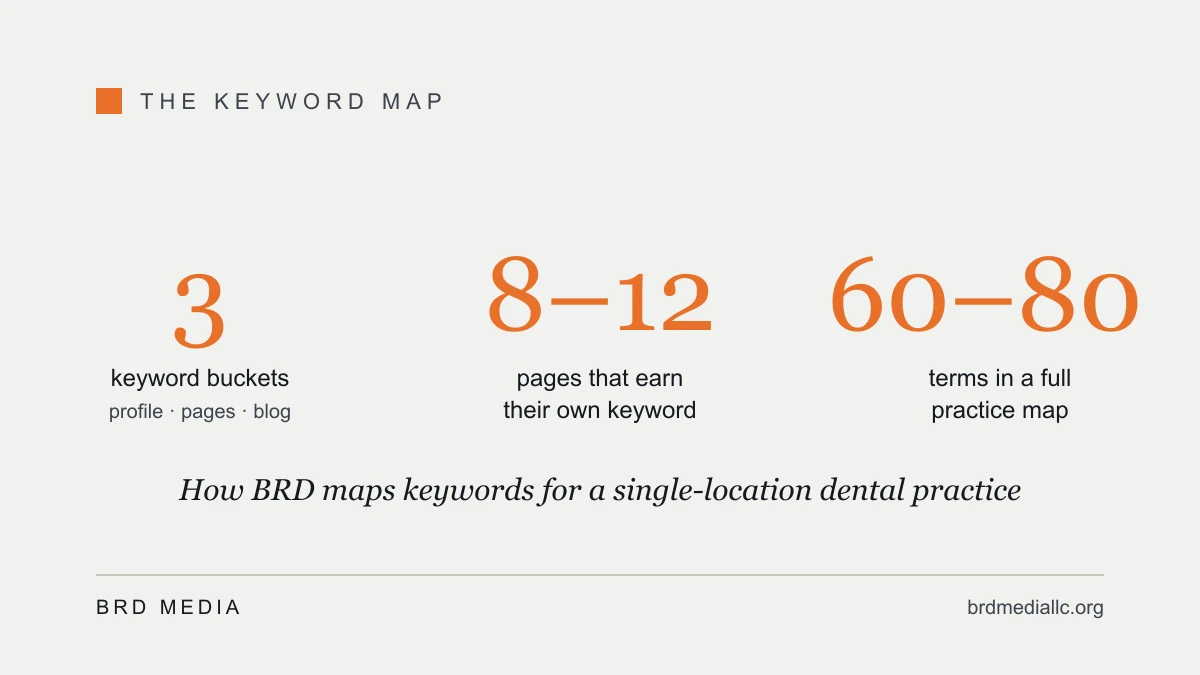
When we build a keyword map for a single-location practice, the finished map usually holds 60 to 80 terms, and only 8 to 12 of them earn a page of their own. The rest are variations that live inside those pages as headings and FAQ answers. That ratio surprises most dentists, and it is exactly why practices that publish six strong service pages beat practices that stuff 40 phrases into one.
The highest-volume dental searches all end in "near me," and no service page will win them. Google answers proximity searches with the map pack, and the map pack ranks profiles, not websites. So work the profile like a page:
The profile is also what AI assistants read first when someone asks for a dentist recommendation, a shift we broke down in AI search for dentists. Full setup guidance lives in Google Business Profile Help.
You do not need paid software to build a working list. Four sources, in order:
The map is the deliverable. Homepage carries your brand plus "dentist [city]." Each service family from the table gets its own page targeting its core keyword, with the variations as H2s and FAQs. Question terms become blog posts that link to the service page they feed. That structure, not the word list, is what dental SEO services are actually built on. And keep paid search in its own lane: bidding on a keyword and ranking for it are different systems with different math, which we covered in our dental PPC breakdown.
Worked example: your implant page targets "dental implants [city]" in the title, H1, and first paragraph. Its H2s carry the variations: full mouth dental implants, single tooth implant, implant consultation. The FAQ answers what patients ask before booking, and your research-stage blog posts about implants link into it. One page, one family, every variation accounted for. Repeat that pattern for each service family in the table and the whole site starts pulling in the same direction.
Start with the three buckets, claim the service and city terms you can genuinely win, and give every keyword family one clear home. Do that and the rest of the SEO keywords for dentists conversation gets simple, because your site finally matches the way patients actually search.
Keywords decide which pages you build, but they are rarely the first thing a quiet practice should touch. If the phone is slow right now, start with which dental marketing plays to run before you chase keywords and come back to this list once the basics are covered.
Get a free dental SEO audit: we will show you which terms your practice can win and which pages are missing. Or reach the team through the BRD Media contact page.
Get a Free Dental SEO AuditSources: Google Business Profile Help (profile categories and services); Google Search Central (Search Console documentation); Google Keyword Planner.
See BRD Media first in Google
Add us as a preferred source and our SEO breakdowns rank higher in your own Search results, AI Mode and AI Overviews.