Dental Marketing Strategies That Actually Grow a Practice
Updated
The short version
Build a page per high-value treatment with a published price range and financing. Practices that hide pricing lose the patients who fear the number.
Work your Google Business Profile weekly and run reviews on a script and a same-day text link, not luck.
Film the doctor one hour a month. Ten 60-second answer videos feed every channel and get you named in AI answers.
Buy clicks only on procedures where one case pays for the month. Emergency and implants, exact match, tracked to booked consults.
Sell a membership plan and run a referral system. Price fear and inertia lose more patients than your competitors ever will.
Search for dental marketing strategies and you get the same recycled list everywhere: post on social, start a blog, run some ads. That is a list of channels, not strategies. A strategy tells you what to do, in what order, with what numbers. Below are nine dental marketing strategies with the actual execution detail, the kind an office manager could start running this week, from an agency that builds these systems every day. Use the table to pick the two or three that match your growth goal, then run them for six straight months.
Which strategy fits your goal?
Growth goal
Run these first
Typical payoff speed
High-value cases (implants, full-arch, aligners)
#1 treatment pages, #5 targeted ads, #8 financing
Weeks to months
New or relocated practice
#2 Google Business Profile, #3 reviews, #4 local SEO
Months
Standing out in a crowded suburb
#6 doctor content, #7 AI search, #3 reviews
Months, compounding
More production from existing patients
#8 membership, #9 referrals
Days to weeks
1. Build a Page for Every High-Value Treatment
A patient researching implants is not searching "dentist near me," and a homepage cannot close them. Build a dedicated page for each procedure you want more of, with this exact skeleton:
H1: the treatment plus your area ("Dental Implants in [Your Suburb]")
The price range, published. Typical ranges patients already see elsewhere: single implant $3,000 to $5,000, full-arch $15,000 to $30,000+, clear aligners $3,000 to $8,000. Publishing a range does not scare patients away; the practices that hide numbers lose the patient who assumes the worst and never calls.
Financing right under the price: the monthly payment framing ("most patients finance full-arch for roughly the cost of a car payment") plus your financing partners.
Before-and-after photos with signed consent, your real cases, not stock.
Five to eight FAQs with schema markup: does it hurt, how long does it take, how long does it last, am I a candidate.
Online booking or a consult form, twice: mid-page and bottom.
The first thing we check when we audit a practice is whether the high-value treatments have their own pages. Most do not, including practices spending thousands a month on ads pointed at their homepage. One implant case at $3,000 to $30,000 pays for building every page on this list. Want them ranking without ad spend? That is the job of dental SEO services.
Start this week: pick the one treatment you want more of and build its page: price range, financing, three FAQs, a booking button.
2. Turn Your Google Business Profile Into a Booking Machine
The map pack is where local dental decisions happen, and most profiles are half-empty. The full checklist, in order:
Primary category: match it to the goal, not the license. If implants are the growth target, "Dental implants provider" beats plain "Dentist." Secondary categories catch the rest.
Services: add every treatment you offer as its own service with a two-sentence description. Google matches these against searches.
Q&A section: seed it yourself with the ten questions your front desk answers every week: do you take my insurance, do you offer payment plans, do you see emergencies same-day, is parking free, do you offer sedation. Answer them as the practice.
Photos: ten or more real photos a month: operatories, the front desk team, the doctor, the building entrance. Practices with active photo streams get measurably more calls and direction requests.
Weekly post: one case result, one offer, or one team photo. Fifteen minutes.
Booking link connected so a searcher can book without ever visiting the website.
None of this costs a dollar. It is the highest-return hour in dental marketing, and it compounds with strategy #3.
Start this week: fix your primary category and add every service with a two-sentence description. Twenty minutes, zero dollars.
3. Run a Review Engine, Not a Review Hope
Reviews move rankings and hire decisions at the same time, and steady beats big: ten recent, specific reviews outperform two hundred stale ones. The system, word for word:
The ask, at checkout, after a good visit: "So glad it went well today. Would you mind sharing that in a Google review? I can text you the link right now." One sentence, from the person who checked them in.
The text goes out before they leave the parking lot. Same-day asks convert several times better than next-day emails.
A QR code card at the front desk for the patients who prefer to do it themselves.
Reply to every review within a week. For negative ones, one calm sentence offering to take it offline, and never confirm the person was a patient: acknowledging a patient relationship in a public reply is a HIPAA problem most practices do not see coming.
Target: five to ten new reviews a month, every month. If your current pace is one a month, this single change outperforms most ad budgets.
Start this week: teach the front desk the one-sentence ask and text the review link before the patient leaves the lot.
4. Own Your Local and Condition Searches
When a tooth breaks at 9 PM, whoever shows up gets the call. The build list for a practice site:
A page per service (the strategy #1 pages) plus a page per location if you have more than one.
Name, address, and phone identical everywhere: your site, Google, the top directories, your insurance profiles. Inconsistent listings quietly cap local rankings; one cleanup pass usually settles it.
Answer content for what patients actually type: "how long do dental implants last," "does a root canal hurt," "can a cracked tooth wait until Monday." Each answer page links to its matching treatment page. This is also exactly the content AI search engines quote.
Start this week: Google your top three treatments plus your suburb and note who outranks you. That list is the to-do list.
5. Spend Ad Dollars Only Where a Case Pays for the Clicks
Dental clicks in a metro like Chicagoland run $5 to $50, so paid search is a scalpel. Whether you run it yourself or pay someone, these are the owner-level decisions that make it work:
Only advertise procedures where one case covers a month of spend. Emergency visits, implants, aligners. Do not pay for "dentist near me" clicks that fill $89 cleaning slots.
Every ad lands on the matching treatment page from strategy #1, never the homepage. A person who clicked an implant ad and lands on "Welcome to our practice" backs out. This is the most common fix we make in dental ad accounts.
Demand one number from whoever runs it: cost per booked consult. Not clicks, not impressions. If a booked implant consult costs $150 and a case is worth $5,000, spend more. If nobody can tell you that number, stop spending until they can.
Once a month, ask to see the actual searches your money bought. You will find junk: free clinics, dental school applicants, people three states away. Every dollar pulled off junk is a raise for the campaign.
Set a floor and a deadline: a fixed monthly budget and a 90-day verdict. Producing booked consults at a profitable cost? Scale it. Not? Kill it and put the money into strategies #2 and #3, which cost time instead of cash.
Start this week: find out your current cost per booked consult. If nobody can answer, that is the finding.
6. Publish the Doctor, Not Stock Photos
Patients are choosing a person to trust with their mouth. The efficient version is one filming hour a month:
Batch ten questions per session, 60 seconds each: does getting a crown hurt, what does an implant actually cost, why did my dentist recommend a night guard, is charcoal toothpaste safe.
Setup: a phone, a $20 clip-on mic, window light. Unpolished and real outperforms produced and generic.
Structure per video: the question, the straight answer, one sentence of what to do next.
Each video becomes four assets: a YouTube Short, an Instagram reel, a Google Business Profile post, and an embed on the matching treatment or FAQ page.
Before-and-afters and patient stories need signed consent forms. Build that into the workflow once and it stops being a bottleneck.
That is 40 pieces of content a month from one hour of the doctor's time, and it is the raw material every other strategy reuses.
Start this week: book the doctor one hour on the calendar, write the ten questions, film them all in one sitting.
How do you get named by AI?
A growing share of patients now ask ChatGPT and Google's AI features things like "best implant dentist near me," and those answers name specific practices. Getting cited is not magic, and it is mostly built from strategies you are already running:
Real answer pages (strategy #4) that state the consensus answer plainly near the top, then add your expert detail.
FAQ schema on treatment pages, a complete Google Business Profile, and identical business details across the web.
One fact only you can publish: your own case counts, your own typical timelines, your own pricing. AI engines favor pages that add something beyond the recycled consensus.
Test it monthly: ask ChatGPT and Google "best [your procedure] dentist in [your suburb]" and note who gets named. That is the scoreboard.
Start this week: ask ChatGPT "best dentist near [your suburb]" and see who gets named. That is your baseline.
8. Market a Membership Plan and Financing
Roughly a quarter of adults skip dental care over cost, and they avoid even calling because they fear the number. Two fixes, both marketable:
An in-house membership plan. The standard math: $30 to $45 a month covers two cleanings, exams, and X-rays (roughly $400 retail value) plus 10 to 20 percent off treatment. The plan is not a discount program; it is a subscription that keeps uninsured patients attached to your practice and saying yes to treatment.
Third-party financing on every treatment page, quoted as a monthly payment next to the price range from strategy #1.
Then say it everywhere: "No insurance? No problem." On the site header, the Google profile, and at the front desk. You are not discounting; you are removing the reason a third of your market never picks up the phone.
Case acceptance rises when the money conversation happens before the appointment instead of during it.
Start this week: price your membership plan (two cleanings, exams, X-rays, a treatment discount) and put "No insurance? No problem" on the homepage.
How do you build referrals?
Referrals are every practice's best patients and worst-run channel, because "we get referrals" usually means "we wait for them." Two tracks:
Patient track: ask at the moment of a great outcome (the full-arch reveal, the aligner finish): "The best compliment you could give us is sending someone you care about." Hand them two cards. Thank every referrer with a handwritten note or a small gift, and log "who sent you" at intake so you know the channel is working.
Professional track: a quarterly lunch with the three specialists you refer out to most (orthodontist, oral surgeon, periodontist). Referral flow follows relationships, and relationships follow calendars, not intentions.
The math: five referred patients a month at a typical first-year value of $1,000 to $1,500 each is a six-figure annual channel that costs you gift cards and lunches.
Start this week: put the quarterly specialist lunch on the calendar and print referral cards for the front desk.
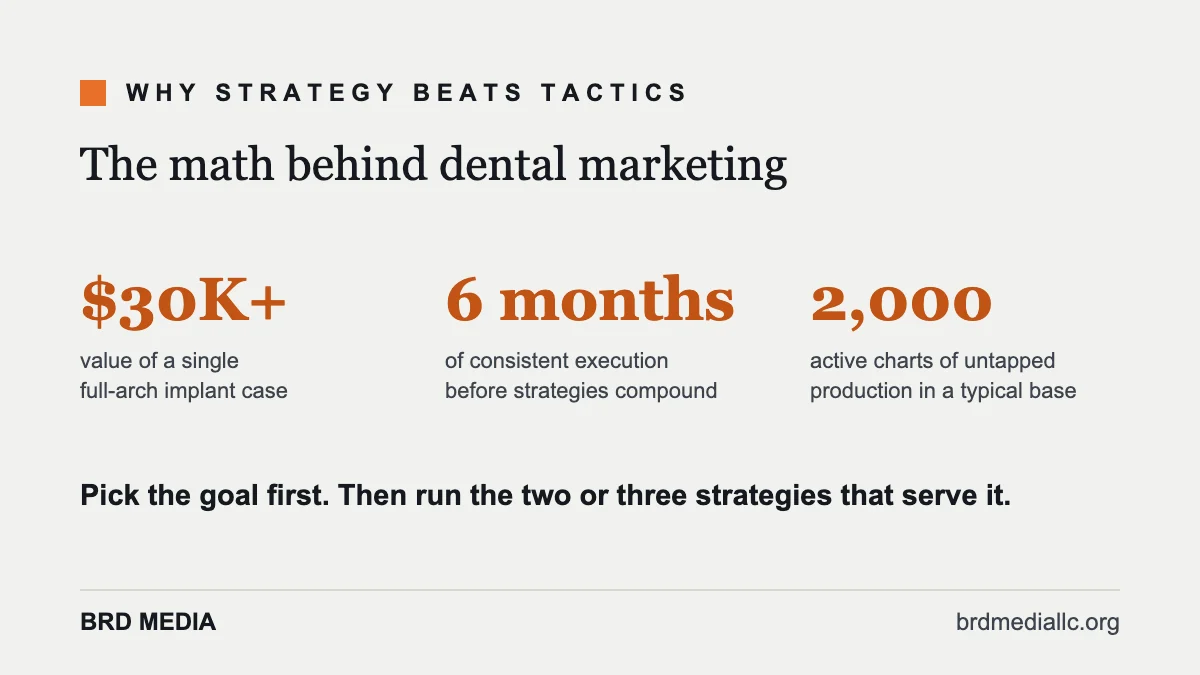
Honest take: you do not need all nine dental marketing strategies. You need two or three, matched to a specific growth goal, executed consistently for six straight months. The other quiet killer is the front desk. If calls go to voicemail at lunch or the scheduler says "we will call you back," every strategy on this page leaks. Fix answer rates and speed-to-book first, then pour fuel on it.
Before any of these strategies gets budget, nail the research underneath them: choosing the right dental search terms decides which pages you build and which searches your practice can actually win.
Strategy tells you the order to work in. If what you want next is the individual plays that fill that order, we put the tactical list of dental marketing ideas to run first in one place, ranked by what each one costs you in effort and how fast it pays back.
Want these strategies matched to your practice?
Get a free audit and we will show you which of the nine fit your growth goal, what your competitors are running, and where your current marketing is leaking.
What is the most effective marketing strategy for a dental practice?
There is no universal one. For high-value case growth, treatment-specific pages plus targeted search win. For a new practice, Google Business Profile, reviews, and local SEO come first. The most effective strategy is the one matched to a specific growth goal and run consistently for at least six months.
How do dental practices get new patients without ads?
A complete Google Business Profile, a weekly review system, local search visibility, a marketed membership plan, and a referral system that actually asks. These compound and keep producing without ad spend, though they take months, not days, to build.
Does social media marketing work for dentists?
Yes, but as a trust channel more than a booking channel. Before-and-afters, doctor videos, and patient stories make prospects comfortable choosing you. Very few patients book straight from a post, but many check your profiles before they call.
How long does it take for dental marketing to work?
Paid campaigns can produce calls in weeks. SEO, content, and review momentum typically show meaningful movement in three to six months and compound after that. Membership, financing, and referral plays are the fastest levers, since they work on people who already know the practice.
By Chris DeWilde, founder of BRD Media. We build dental marketing systems for Chicago and Chicagoland practices around one number: production.