
Most dental marketing is a pile of disconnected tactics: a boosted post here, a directory listing there, an agency that reports on clicks nobody can spend. A real dental practice marketing strategy is a system that gets you found by patients nearby, earns their trust through reviews, and makes booking easy. Here are the strategies that actually fill the schedule in 2026, in the order that matters, from a Chicago agency that runs them every day.
Before a single dollar goes to marketing, know your math. Every decision below depends on it, and it is the one thing no other dental marketing guide will tell you. A new patient is worth roughly $600 to $1,200 in first-year production for a general or hygiene-led practice, and $4,000 to $6,000+ when implants or ortho are in the mix (a single implant case commonly runs $4,000 to $6,000, and full-arch cases climb well into five figures).
The formula is simple: average first-year production times your gross margin equals what you can afford to acquire one new patient. Most healthy practices land around $30 to $75 to acquire a patient through Google Business Profile and SEO, and can justify $150 to $300+ on paid ads for high-value procedures like implants. This one number turns "is my marketing working?" into arithmetic. If a channel books patients under your target cost, scale it. If it does not, cut it.
When someone searches "dentist near me," the map pack (the three listings with the map) gets the clicks. Winning it comes down to a fully built, active Google Business Profile and a steady stream of recent reviews. Consumers read reviews before choosing a dentist, and Google weighs review recency and volume heavily. The strategy: complete every field, post photos and updates, ask every happy patient for a review through a simple process, and respond to all of them. This is the highest-ROI dental marketing there is, and it is the foundation of our dental marketing services for Chicago practices.
Two details separate practices that win the map pack from those that stall. First, ask patients to name the specific service in their review ("implant consult," "Invisalign"), not just "great experience." Service plus city in a patient's own words is topical-authority evidence you cannot write yourself. Second, keep review requests and any patient communication inside a HIPAA-compliant system, because patients sometimes share protected details and it is on the practice to protect them.
A simple review request that works, at checkout or by text:
Beyond the map, patients search specific services: "invisalign," "dental implants near me," "emergency dentist." If you do not have a clear page for each, you miss those searches. The strategy: a fast website, one strong page per service, and local content that tells Google which areas you serve. This compounds over time, which is the whole point of dental SEO.
AI search and Google's AI Overviews now answer patient questions before anyone clicks. The practices that get surfaced are the ones that answer the exact question in the first sentence, then back it with detail. Lead each procedure page and FAQ with a direct two to three sentence answer to the real question ("How long is implant recovery?"), then expand. Mark it up with FAQ schema and keep the same answer consistent across your site, your Google Business Profile, and third-party mentions, because AI models cross-check. This lane is wide open. Almost no dental marketing content addresses AI search seriously yet, and being early is the advantage.
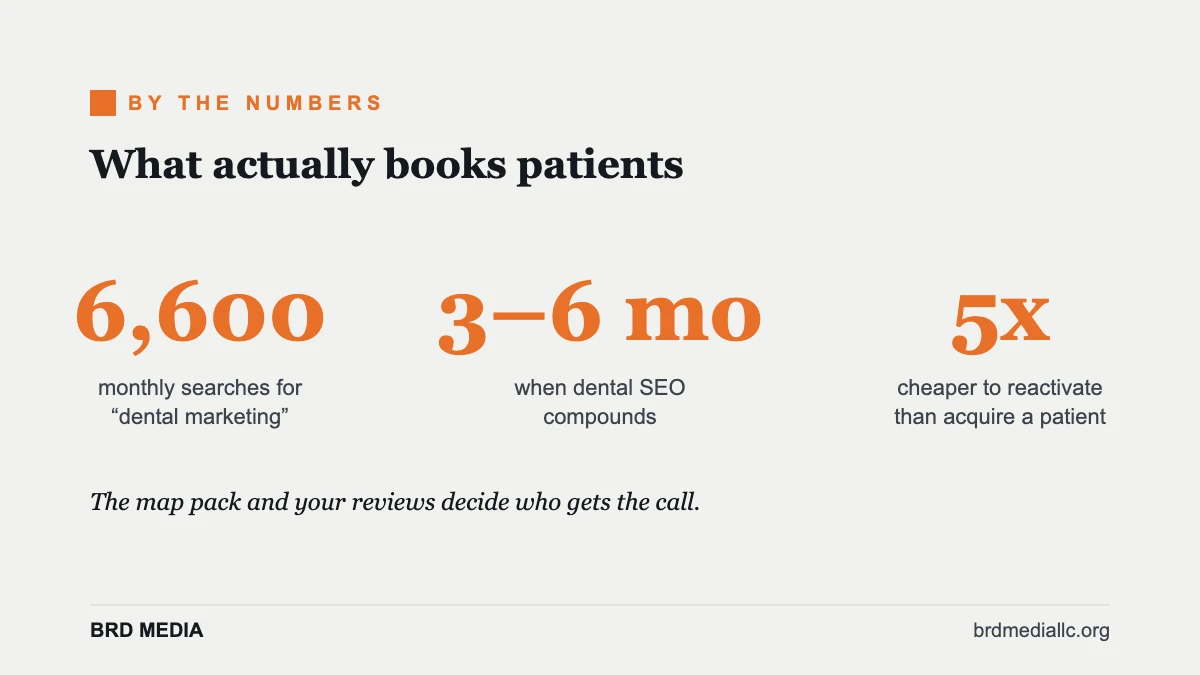
Your unscheduled and lapsed patient list is the warmest, cheapest growth you have. They already know you, met your team, and trust the practice. You are not selling them on whether you are real. You are giving them a reason to book again, and most practices leave this money on the table entirely.
The one rule that keeps it legal: these are former patients, so the copy stays generic. "You're a patient of ours and it's been a while," never "you came in for your root canal." You can only email and text people who gave consent, and text especially needs a clear yes. Cold-blasting a patient list is how a practice gets fined, not how it grows.
The shape that works is front-loaded. Reactivation lists are not patient. If you do not reach them in the first 7 to 10 days you lose most of them, so week one runs daily with email and text alternating, and every touch rotates a different reason to book so it never feels like the same pitch hammered five times. After week one, pull back to two or three touches a week, then weekly. Angles to rotate: overdue for a cleaning with a reserved slot, the treatment you were quoted is still available, a welcome-back exam and X-rays, bring a family member, financing is available, and a light check-in.
What to realistically expect from a well-run recall campaign (ranges, depending on list size and how your front desk closes):
| Metric | Conservative | Strong |
|---|---|---|
| Email opens | 18 to 25% | 30%+ |
| Email clicks | 1.5 to 3% | 4%+ |
| Appointments booked from the list | 0.5 to 1.5% | 2 to 4% |
| Booked appointments that show | 55 to 65% | 70%+ |
On a 2,000-patient lapsed list, even the low end is roughly 10 to 30 appointments from patients you already paid to acquire once. Expect 20 to 30% of the list to bounce or unsubscribe, which is normal, and what is left is a smaller, hotter list.
Paid ads make sense where a case is worth the cost. Implants, ortho, and cosmetic cases justify Google Ads and Local Services Ads; a routine cleaning usually does not. The strategy: run paid on the high-value procedures with call tracking, and measure on booked cases, not clicks. Social ads work earlier in the funnel to build awareness and retarget.
| Procedure | Typical case value | Run ads? |
|---|---|---|
| Dental implants | $4,000 to $6,000+ | Yes, high value absorbs the cost |
| Braces / Invisalign | $4,000 to $6,000 | Yes, high lifetime value |
| Cosmetic (veneers, whitening) | $500 to $10,000 | Usually, depends on the case |
| Emergency dentist | Varies | Yes, urgent and high intent |
| Routine hygiene / cleaning | $100 to $300 | Rarely, the cost eats the margin |
Point paid budget at whatever procedure is fast, repeatable, and high-margin for your practice. Implants for one office, cosmetic or ortho for another. Whatever you have down to a science.
All the marketing in the world fails if booking is hard. The strategy: online booking, a front desk that answers fast, and a short path from ad or search to a scheduled appointment. Speed to lead applies to dentistry too. The practice that answers first usually wins the patient.
| Channel | Typical monthly cost | Time to first patients | Best for |
|---|---|---|---|
| Google Business Profile + reviews | Low (mostly your time) | 2 to 8 weeks | Every practice, the foundation |
| Local + procedure-page SEO | $1,000 to $2,500/mo | 3 to 6 months | Durable, compounding new patients |
| Google Ads | $1,000 to $2,000/mo + ad spend | Days | High-value procedures only |
| Patient reactivation | Very low (uses your list) | Days to weeks | Immediate production from your list |
| Social / content | $500 to $1,500/mo | Months | Trust, AI search, brand |
Honest timeline: with diligent back-end work, new patients can start in two to four weeks, not the old six-month rule. A full site rebuild takes longer, and it all depends on your current site authority, since an aged domain moves faster than a brand-new one.
Once the practice-level picture is clear, the question becomes what to do on Monday. We wrote up the dental marketing ideas ranked by effort and payback so you can pick the two or three that fit your schedule instead of trying all of them at once.
Get a free marketing audit and we will show you where your practice is leaking patients and what to fix first.
Get a Free Marketing AuditSources: BrightLocal Local Consumer Review Survey; Google Business Profile Help; Google Search Central.
Related: our honest ranked guide to the best dental SEO companies.
Related: our guide to dental PPC and what Google Ads cost dentists.
Related: Ready to rank for your procedures? Our dental SEO services do exactly this work.
See BRD Media first in Google
Add us as a preferred source and our SEO breakdowns rank higher in your own Search results, AI Mode and AI Overviews.